







Before Gerhard Richter, before Anselm Kiefer, before the late Georg Baselitz, there was Joseph Beuys, the German artist who bridged his country’s horrific past and its post-war rise with a creation myth of his own, and a defining costumed identity drawn from old and new Germany.
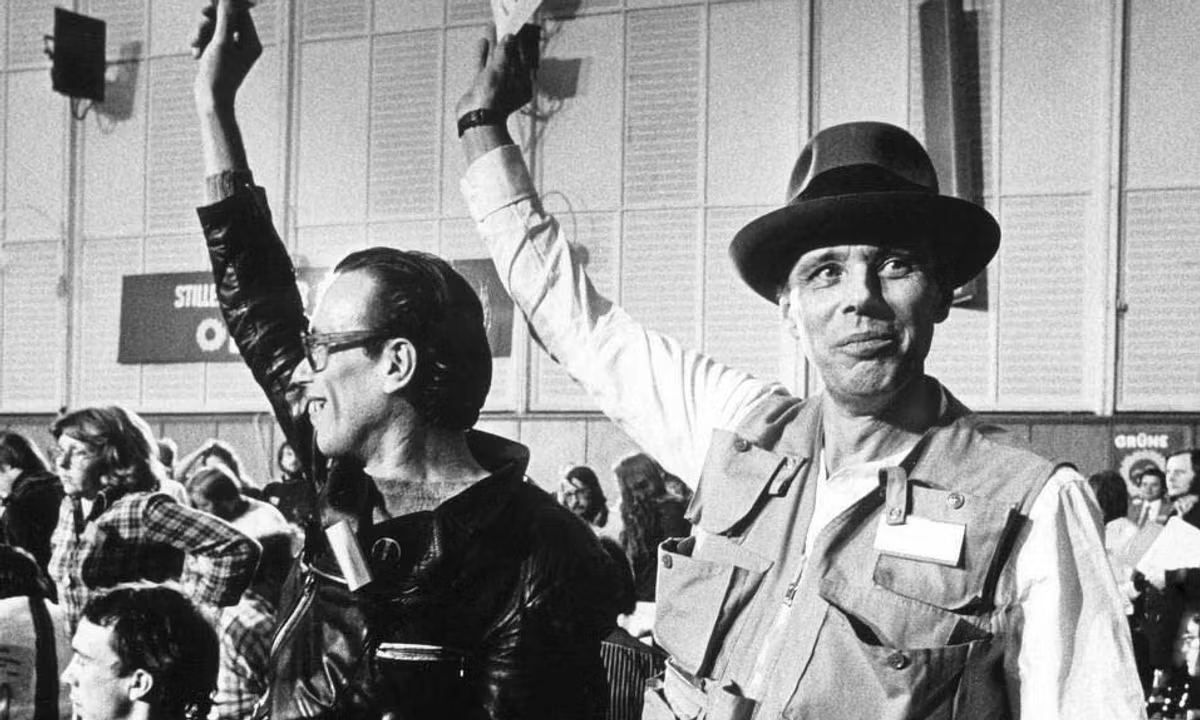
Beuys (1921-86) made his art out of fat and felt and other base materials. He talked onstage to dead animals. To say that he got his hands dirty is an understatement. Yet he entered West German (post-Second World War) politics as a counter-cultural celebrity when the country’s youth saw many of its older leaders as complicit in Nazi crimes.
Beuys made art about politics while he himself was immersed in it. He was a co-founder of the Green Party. He died at 64, yet his stature in the art market continues to rise, even as critics are divided.
A close reading of his work now comes from Daniel Spaulding, an assistant professor of Modern and contemporary art at the University of Wisconsin-Madison. Spaulding writes with precision and with a willingness to explore where he thinks that Beuys’s work falls short.
“Beuys was tremendously ambitious, perhaps to the point of megalomania,” Spaulding writes. “He aimed to totalise the concept of art. He wanted to make it the basis for a total remaking of society, economics and politics, indeed for a coming form of life, in a mode of aesthetic politics to which we can usefully attach the rich German word Gestaltung (design, shaping or form-making). Art can set a date for capitalism’s end. A more powerful idea for art’s agency is hard to imagine. The reason this might have been at least plausible is that for Beuys there was, or anyway should be, no distinction between collective practice (political practice, for example, but also the tasks of collective existence) and art making.”
That is a mouthful, and so was Beuys’s sense of destiny. Spaulding’s goal, in part, is to examine how Beuys’s work fits into a notion of “economimesis”—an amalgam of economics and representation that he takes from the French 20th-century theorist Jacques Derrida. Derrida borrowed the concept from the Prussian-born Enlightenment philosopher Immanuel Kant.
If such an approach were to succeed, art would enter the economy in a way that it never has before, which some admirers would say Beuys achieved. If it fell short, the evidence would show art at the mercy of economic forces beyond its control, which was usually the case.
Spaulding balances thick doses of theory with careful description. Yet the cover of his jargon-ridden but judicious book is a close-up of a posed picture that helped build Beuys’s stardom: a somewhat Warhol-esque tinted photograph, La Rivoluzione Siamo Noi (we are the revolution) of 1972. Beuys, in hat, hunting vest and boots, is walking directly ahead, with a bag slung over one shoulder. Some might say that the only thing missing is a gun draped over the other shoulder. Che Guevara, at the Kunstakademie Düsseldorf? Beuys did not advocate violence, but he knew how myths worked.
Memorable scenes
In a book that is not built on anecdotes, there are scenes that stay with you. For Beuys’s performance, I Like America and America Likes Me, the artist flew to New York in 1974 to appear for eight hours on each of three days in an enclosed space in a gallery with some straw, a cane, sheets of felt and a coyote. He and the coyote coexisted in that microcosm on mostly friendly terms, inhabiting their own mini-world (of attempted economimesis, Spaulding suggests) where art reigned. The coyote did bite off the thumb of one of Beuys’s gloves. Only food and excrement passed in and out. Copies of the Wall Street Journal absorbed liquids on the floor. The audience watched through a metal barrier.
Beuys said at the time that he would not travel to the US while the country’s troops were still in Vietnam, but why get in the way of a three-day adventure with a native species?
Beuys’s 1977 industrial equipment piece Honigpumpe am Arbeitsplatz © Artists Rights Society (ARS), New York/VG Bild-Kunst, Bonn
Spaulding addresses another Beuys escapade, his near-fatal injury after volunteering for the Luftwaffe when his plane was shot down in Crimea in the Second World War. Beuys’s version, which many now doubt, is that Tatar nomads covered him for warmth with fat and felt.
“For Beuys, myth was a way of working,” Spaulding writes: “The Tatar legend had already taken hold—had already established an association between felt and healing, which then became material for the performances with the coyote, which itself became a new myth calibrated for circulation as an anecdote (the core of any myth is a memorable narrative).”
Yet while nothing is more memorable in recent German history than the Holocaust, Beuys’s work revisits that tragedy only by suggestion in Strassenbahnhaltestelle (train stop, 1961-76), whose sparse elements hint at the end of the line for transports of Jews.
Spaulding devotes far more attention to Honigpumpe am Arbeitsplatz (honey pump at the workplace, 1977), an industrial system that circulated honey through the Fridericianum in Kassel at documenta 6. Beuys seemed then to have created a process that achieved an economic goal as well as a natural one. Spaulding says that this is as close as he came to the desired economimesis, a project created as a work of art but which operates as efficiently as a commercial production: “Beuys’s totalisation of an aesthetic of Gestaltung here parallels even as it contests the logic of post-war capitalism.”
Most of the work that Spaulding examines was far less effective by those standards, including the Nur Noch… series begun in 1981, which declared the end of capitalism in a certain number of days. That piece, reminiscent of the heartfelt and commercially successful War Is Over! If You Want It project of John Lennon and Yoko Ono (1969), was updated by Beuys for years. It is hard now not to see it as a running joke.
Forty years after the artist’s death, Joseph Beuys and History reminds us that Beuys envisioned a different future for his country and his culture. In reunified Germany (since October 1990), a far-right party opposed to immigration is a serious contender for power. Beuys, the rebel once locked up with a coyote and now viewed as a national treasure, is safe in his country’s museums.
- Daniel Spaulding, Joseph Beuys and History, Princeton University Press, 264pp, 13 col. + 26 b/w illus., $37/£30 (hb), published US 24 March and UK 19 May
- David D’Arcy is a regular contributor to The Art Newspaper


