





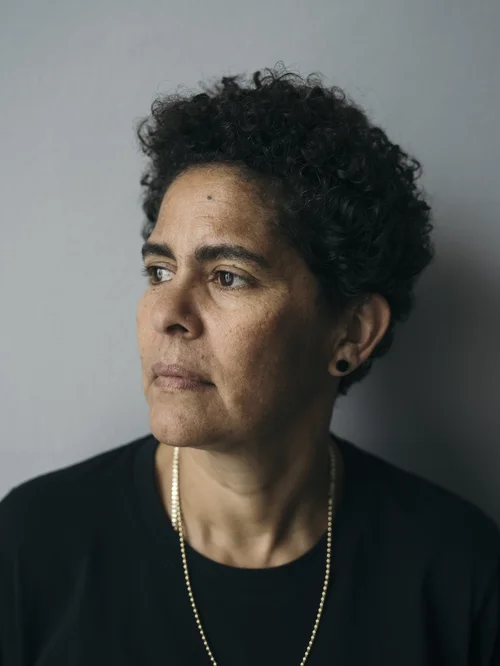

In Julie Mehretu’s restless canvases, history accumulates on the surface. The Ethiopian American artist is known for abstract paintings, drawings, and prints, and she fills her compositions with layers of marks. Each one draws on sources like maps, art history, spirituality, and global events. Gestural yet organized, Mehretu’s work uses abstraction to turn images—especially those circulating through mass media—into something both spectral and urgent.
Born in Addis Ababa in 1970, Mehretu relocated to the United States during the Ethiopian Revolution, a displacement that would later echo through her work. Her early breakthrough came with vast paintings that fused architecture, urban planning, and calligraphic marks into dizzying, multi-perspectival fields. Mehretu’s works quickly attracted institutional attention for the way they recast abstraction in a globalized age. By the mid-2000s, Mehretu had been included in major exhibitions like the Carnegie International, and in 2005 she received the MacArthur fellowship, cementing her status as one of the most significant painters of her generation.
Over time, Mehretu began to draw from additional sources, including news photography and scenes of protest, war, and catastrophe, all of which she obscures by erasing and layering marks on top. As her practice progressed, so too did Mehretu’s career, and her work has since been exhibited widely, including at the 2015 Sharjah Biennial, the 2019 Venice Biennale, and, more recently, her commission for the façade of the Obama Presidential Center.
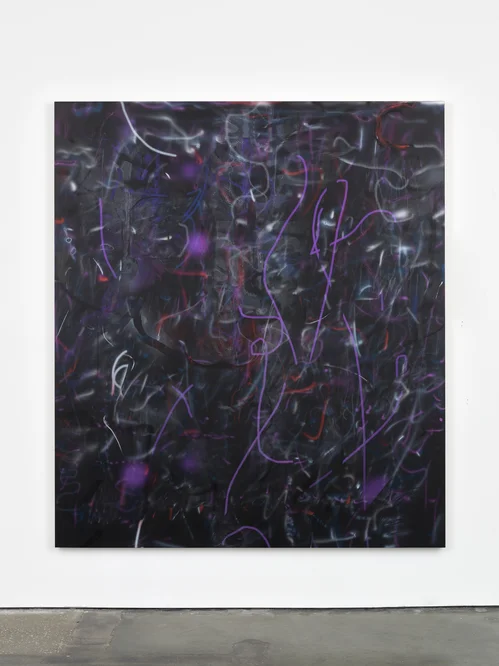
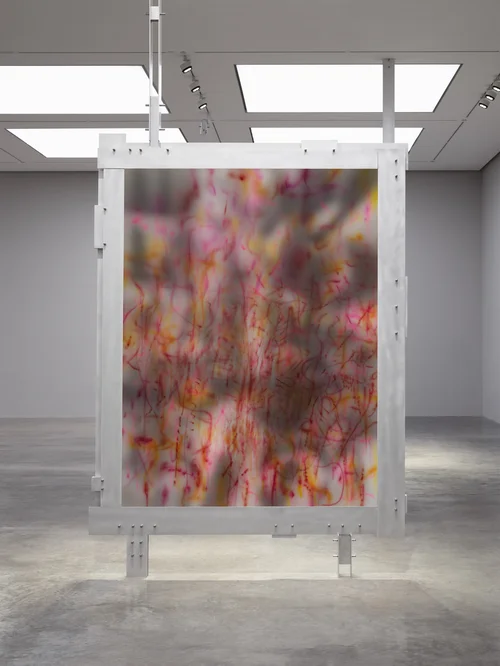
Inside Totality (what the ground cannot hold), 2025
Julie Mehretu
Marian Goodman Gallery

In her latest solo show at Marian Goodman Gallery, “Our Days, Like a Shadow (a non-abiding hauntology),” on view through June 6th, Mehretu offers a reminder that abstraction is not an escape from the world but an intensification of it. The exhibition title draws from biblical and Buddhist notions of impermanence. It shows the artist grappling with the complexities of global conflict and polarizing politics. “Beginning in 2016 with the election of Donald Trump, there’s been so much to negotiate and a different kind of dynamic to the world,” Mehretu said. “The language that emerged in the political arena was shocking and scary, but it was also haunting. It re-opened histories we’ve been through in this country that are complicated and uncomfortable. I’m not thinking of history as a positive or negative condition. Every day is a transient, fleeting, and precious experience.”
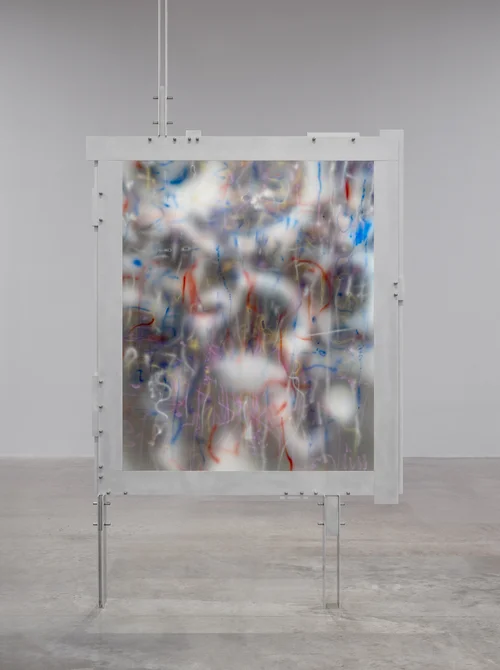
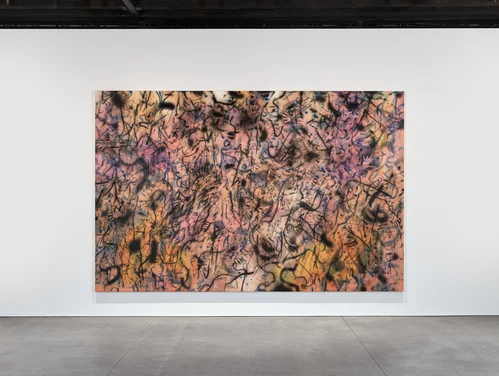
Exploring this human condition, the show features new bodies of work related to recent exhibitions at the Palazzo Grassi in Venice in 2024 and the Museum of Contemporary Art in Sydney in 2024 to ’25. It includes new examples from Mehretu’s “TRANSpaintings/Upright Brackets” (2024–26) series: ink and acrylic paintings on monofilament polyester mesh, a material that allows the artist to build the composition in layers and for light to shine through. Based on abstracted photographs from media coverage of geopolitical events, the colors and marks form ethereal shadows of their source imagery.
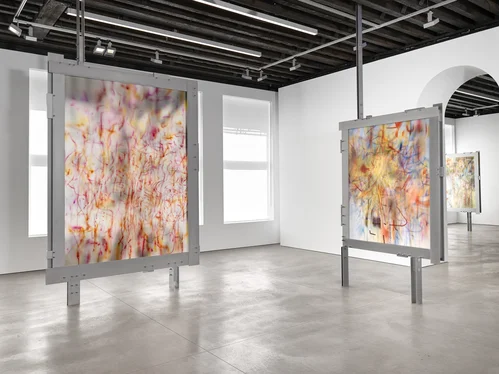

Though the images are taken from reality, Mehretu doesn’t need the viewer to identify the subjects. Indeed, ambiguity is an important part of the work. “I might be depicting a photograph of somewhere recently bombed, but we live in a time where that could be a number of places,” the artist said. “It might be Ukraine last month or Gaza two years ago. Each photograph captures a specific moment, but I’m interested in the condition of that moment and the aftermath and what that conjures in the viewer.”
Removed from the wall, the freestanding compositions are set in aluminum scaffolding-like frames by Iranian German artist Nairy Baghramian. “I was trying to figure out a way to display the paintings and saw Nairy’s show at the Nasher [Sculpture Center] and was blown away,” Mehretu said. “She’s a good friend and was open to inventing something with me. She’s constantly supporting and bracing her work, and that’s what these brackets do.” The armature connects to the ceiling via a single extension as if the entire work might spontaneously pivot. “The moment that was added, the work gained agency, like it has legs and arms,” Mehretu said.
As light shines through the composition and the viewer moves around the piece, colors seem to materialize—the fleeting moments Mehretu hopes to convey. “None of the colors and marks are stable because we live in a vertiginous world where we’re catapulted between realities,” Mehretu said. “They change based on the conditions of light, whether someone is standing on the other side, and where you’re standing.”
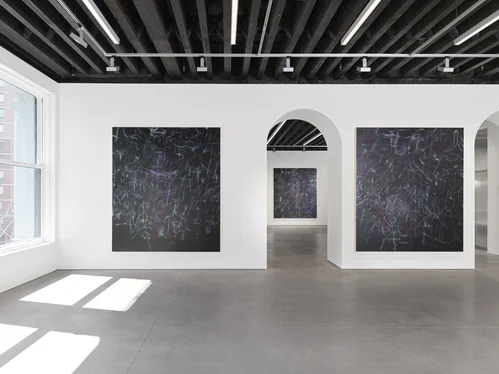
Joining the “TRANSpaintings” in the show are a new series of “Black Paintings” (2025–26), stunning meditations on the color black. Mehretu had used dark grounds in previous works, but rather than working with black ink, she wanted to explore what would happen if she introduced white and silver. Then, she made a mistake. “I wasn’t wearing my glasses and I thought I was using silver, but it was violet interference ink,” she explained. The pearlescent, vibrant hue added a new dimension to the dark ground. “As I’ve gotten older, I’ve learned to become comfortable with the uncomfortable, be patient, and to trust the process,” she said. “Once I learned about interference colors, I started to explore and I realized something like ultramarine blue over black can create this wild, reflective effect that changes as you move.”
Using these scintillating hues, Mehretu departed from the source material of her “TRANSpaintings” and instead filled the surfaces with intuitive, improvisational marks. Painted on canvas as opposed to the mesh of the “TRANSpainting” surfaces, the “Black Paintings” rely on Mehretu’s keen ability to layer marks and colors.
While fundamentally exploring the color black, the works vary greatly. Some contain countless layers of bold marks while others are pared down. In some pieces, glistening paint shifts from green to violet to silver like the hues of oil pooling on a blacktop. Iridescent blue might shift to silver like wind blowing across the sand. In others, marks jet over the surface of the work like surveillance drones and ethereal white fades into hazy smoke (is it fireworks or bombs?) across a night sky. One mark can change the whole composition, catching the eye or introducing a different visual plane. “It’s a phenomenon of the materials,” Mehretu said. “I might not even notice something until it emerges.”

The way these marks and colors appear and shift, however, can truly only be experienced in person. Therein lies another important factor in Mehretu’s work: the viewers themselves. Thinking of bodies in space, Mehretu invited choreographer John Jasperse to create a series of performances in dialogue with the show. “After my exhibition in London where I showed “TRANSpaintings” for the first time, I thought how beautiful it would be to see performers move around the works,” Mehretu said. With music by composers Hahn Rowe and Will Johnson, a new work Wandering (2026) will see seven dancers respond to shadows, movement, and energy of Mehretu’s work, performing live in the gallery from May 20th to 23rd.
Walking through the gallery with the artist, it’s clear how much the paintings change through movement. Viewing Mehretu’s work in photographs is one thing, but being there in person as the surface transforms is a completely different experience. Colors shift and layers emerge but, just like the fleeting nature of life Mehretu draws inspiration from, they dissolve just as quickly as they materialize.


