








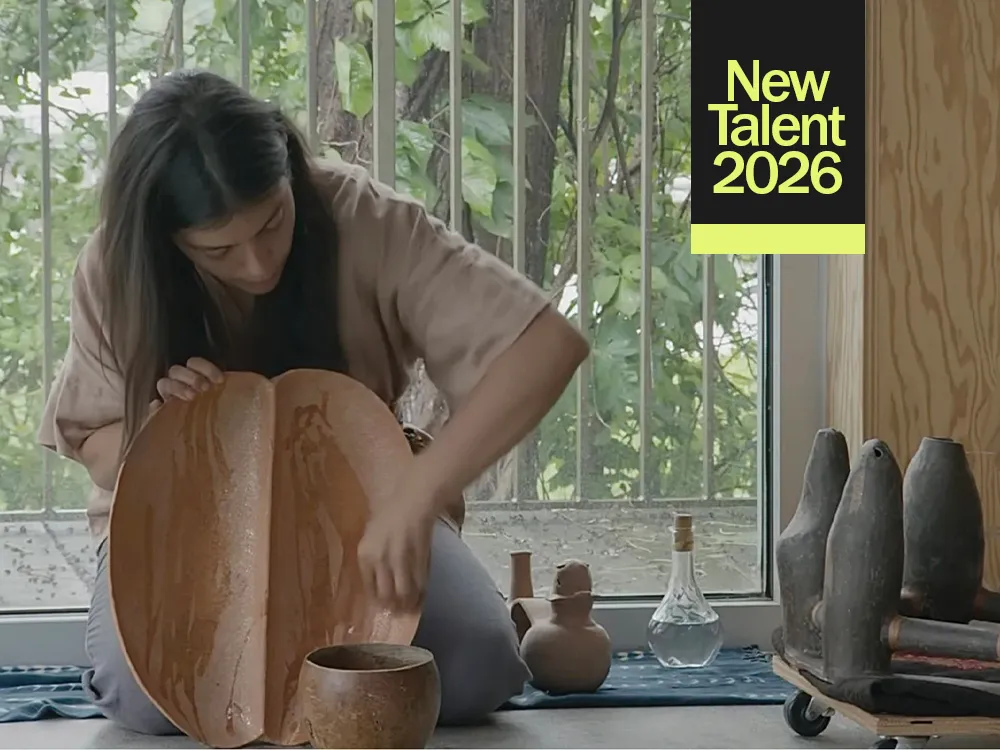
“I feel like I am in constant conversation with the past and we are discussing what we’re going to do with the future,” said Koyoltzintli, surrounded by dozens of flutes, whistles, drums, and other handmade instruments scattered around her studio in upstate New York. She was talking about her connection to the Pacific coast of Ecuador, home to some of the oldest ceramic practices and ceramic instruments in the Americas. But she was adamant about her roots in the present—“as someone who carries a lineage while doing my own thing.”
Koyoltzintli started out working primarily in photography, as a photojournalist in Ecuador with a particular interest in the expansion of Amazonian cities and healers in the Andes Mountains. But while she continues to work with the medium—as well as others, including painting, drawing, and sculpture—she had an epiphany around sound in 2020 that continues to resonate. Unable to travel back to Ecuador from the US—where she had moved to attend the School of Visual Arts in 2001—because of the pandemic, she started going to museums in search of communion and found herself rapt by ceramics she suspected possessed sound-making capabilities that had been lost to time. “There was a switch that got me deeper into sound and deeper into clay,” she said. “It was like something woke up in me.”
A desire to play instruments that might otherwise be trapped in silence in vitrines informs much of Koyoltzintli’s art, which includes making instruments of her own and organizing performances and workshops to share traditions she works to keep alive. She has performed in shows for fellow artists Guadalupe Maravilla (at Performance Space New York) and Delcy Morelos (at Dia Art Foundation), and created installations in which her instruments are accompanied by photographs, videos, and drawings that double as graphic scores.
Works from the series “An arrow to the sky,” 2026.
Courtesy Koyoltzintli
For “How to Play a Broken Bone,” her exhibition at the Al Held Foundation in Boiceville, New York, on view into June, Koyoltzintli made works inspired by a centuries-old bone flute she acquired from a private collector who had never heard it played. “This is what happens when instruments are collected by people who are not so sound-oriented,” she said. The show includes a pair of eight-foot-tall drawings related to carvings on the flute and part of a series of “spirit being” works titled “An arrow to the sky” (2026), for which she painted with liquid clay on linen to be hung by windows. “The way I was raised, you always put food [or other offerings] by the windows, because that’s where the spirits come in and go out,” she explained.
The exhibition also features 9 Tz’lkin (2026), a large ceramic water whistle comprising columnar spires topped with candles that she lights and lets burn. The title alludes to a day in the Mayan calendar that is “good for ceremonies for water and fire and giving thanks to the feminine,” Koyoltzintli said, and the materials correspond with the four elements of earth, water, fire, and air. The work’s whistling sounds are activated by pouring liquid into a spout and swirling it around to create changes in atmospheric pressure within. It feels, she said, like “the wind that comes when you’re in front of the ocean.”


Koyoltzintli: 9 Tz’lkin, 2026.
Courtesy Koyoltzintli


