








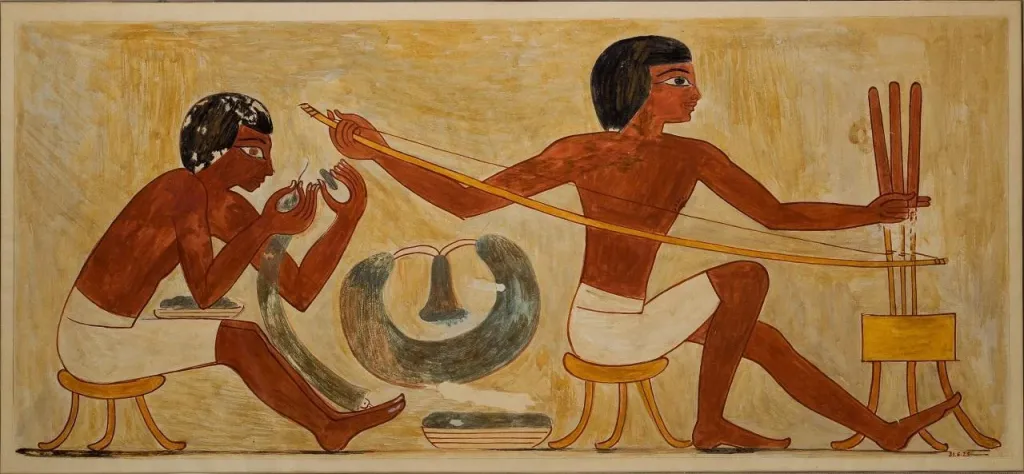
A small metal object excavated almost 100 years ago has been identified as the oldest known drilling tool yet found in Egypt. The news was reported by Archeology Today.
The artifact came from a predynastic cemetery at the archeological site of Badari in Upper Egypt and dates to the late 4th millennium BCE. Part of the grave goods of an adult male, it is made of copper alloy and measures only about two and a half inches.
A 1924 catalog entry at Cambridge Museum of Archaeology and Anthropology, where the object is housed, describes it as “a little awl of copper, with some leather thong wound round it.” But a new study, undertaken by researchers from Newcastle University and the Academy of Fine Arts Vienna has determined that the tool is in fact the remains of what is known as a bow drill.
A prehistoric invention, a bow drill consists of a cord wrapped around a shaft and held taut by a bow, which is rapidly moved back and forth to spin the drill. While the existence of bow drills in Egypt during the middle to late 2nd millennium BCE is well documented, this discovery pushes their earliest known use back 2000 years.
Finds from the necropolis where the artifact was unearthed have included beads and other drilled objects. A rotary tool would have been invaluable to craftspeople of the time, according to Martin Odler, a visiting fellow in Newcastle University’s School of History, Classics and Archaeology and lead author of the study.
“This re-analysis has provided strong evidence that this object was used as a bow drill,” Odler said in a press release, “which would have produced a faster, more controlled drilling action than simply pushing or twisting an awl-like tool by hand. It suggests that Egyptian craftspeople mastered reliable rotary drilling more than two millennia before some of the best-preserved drill sets.”
Of equal interest to the scientists was an X-ray fluorescence analysis of the drill’s composition, which revealed an unusual combination of metals, including some not found in the area. According to the authors of the study, whose findings were published in the International Journal for Egyptian Archaeology and Related Disciplines, this points to either long-distance trading networks or undiscovered sources of ore in the Eastern Desert.
The study was conducted as part of the EgypToolWear project, which examines the use wear of metal artifacts. It highlights how, for researchers armed with new knowledge and new analytical tools, museum collections can still provide major revelations.


