





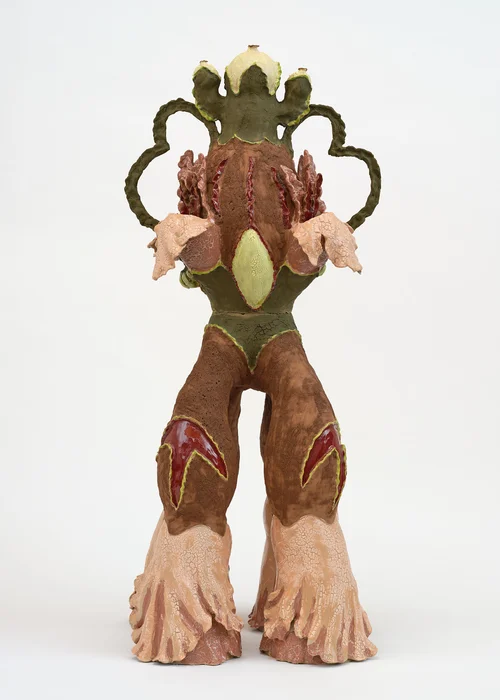

Root Worker, 2026
Maddy Inez Leeser
Megan Mulrooney
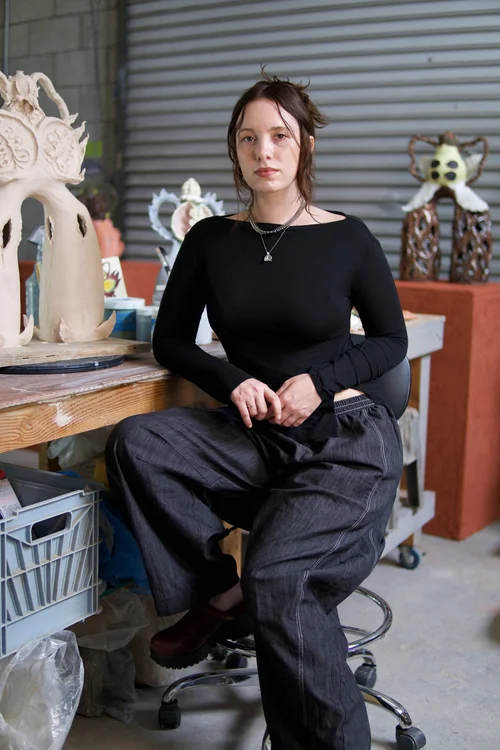
For ceramist Maddy Inez, the art-making instinct might be hereditary.
Inez is the daughter of the American artist Alison Saar and the granddaughter of assemblage pioneer Betye Saar. “We always say art is in the blood,” she said during a recent phone call. “Art is how I was taught how to process the world.”
The Los Angeles native makes hand-built biomorphic ceramic sculptures rooted in mysticism and ancestral knowledge. Over the past few years, these works have shifted into larger scales, catching the attention of the art world. Last week, Inez opened “Nascence,” her first solo exhibition with Megan Mulrooney in Los Angeles, on view through June 20th. The show features 20 ceramic vessels and wall works, all made in the past year, and each dedicated to a distinct plant variety.
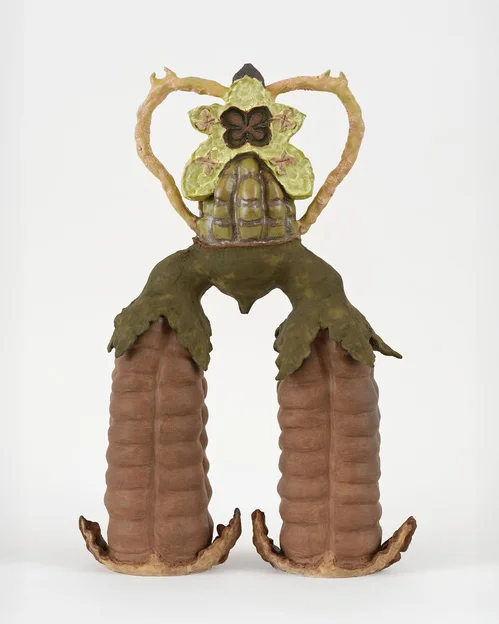

Benne Blessing, 2026
Maddy Inez Leeser
Megan Mulrooney
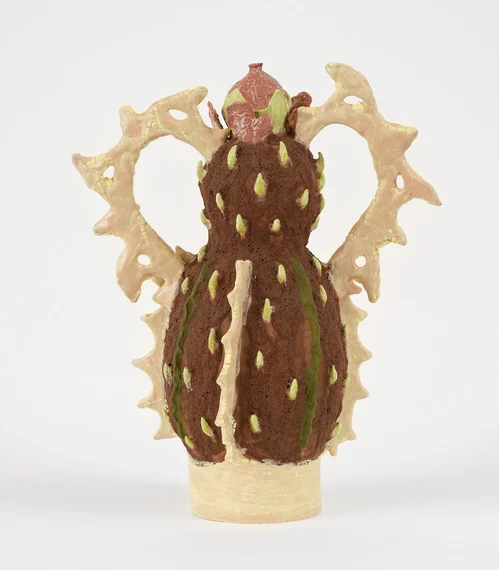

Za' atar Pistil, 2026
Maddy Inez Leeser
Megan Mulrooney
Inez’s use of clay originated, in part, from her grandfather, the late ceramist Richard Saar. “My grandfather is one of the reasons I’m attached to it,” she said.
While her creative lineage runs deep, Inez says the biggest familial influence on her work might actually be gardening. “Gardening has always been a major part of family life. It was part of daily life,” she shared. “My grandma still has a garden, and I help her in it every week.”
For Inez, gardening and growing food are among the most ancient forms of familial caregiving. In “Nascence,” she has created near-humanoid sculptures inspired by plants, including okra, black-eyed peas, and hibiscus. Her forms are sturdier and more earthbound than in the past, and seem almost alien. In Benne Blessing (2026), a sculpture inspired by the West African sesame plant benne, for instance, two pods resemble armor-clad legs on a botanical warrior.
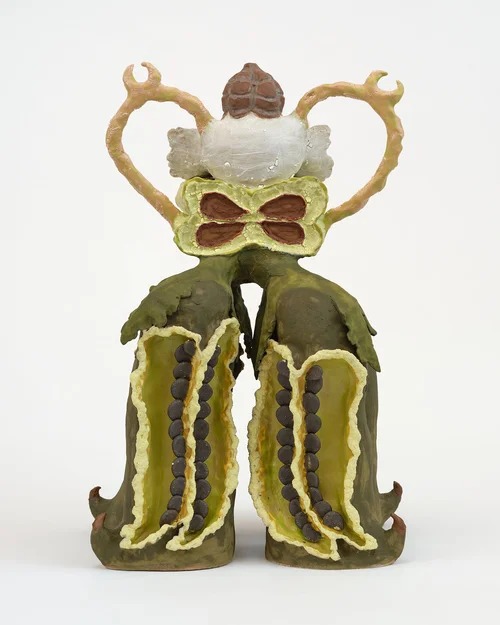

Sibyl Seedlings, 2026
Maddy Inez Leeser
Megan Mulrooney
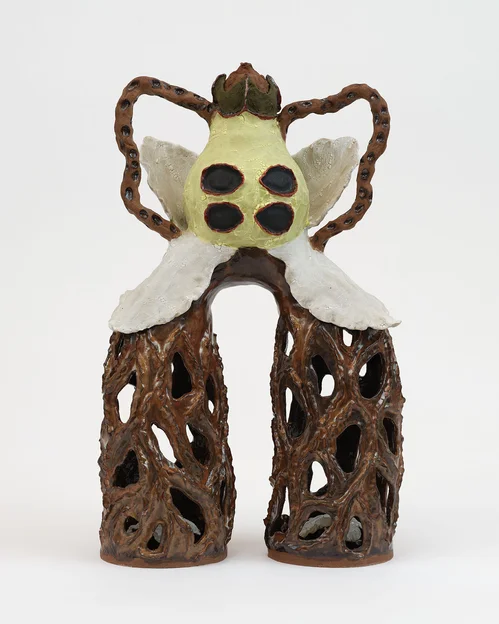
Beholder, 2026
Maddy Inez Leeser
Megan Mulrooney
Inez devotes a great deal of time to researching these plants and their histories before she ever sets her hands on clay. She keeps notebooks filled with watercolor studies of blooms, alongside notes and scribbles about their histories, folklore, and medical and culinary uses.
She started making these intensive investigations into plant life in her earlier series “Fire Followers,” which she made in the aftermath of the 2025 L.A. wildfires. (Fire followers are plants that germinate in heat.) During that time, the artist, her brother, her mother, and her grandmother were all forced to evacuate their homes, along with their menagerie of pets.
“We had six dogs, two bunnies, two tortoises, and my cat. At that point, I had my grandma’s tortoise in a bucket,” she recalled.
Through the experience, Inez witnessed both systemic failures and community support. At the time, Inez’s studio was her mother’s garden. Over time, plants emerged as a language for expressing both grief and hope. “I started really thinking about soil and how we’ve lost the language of how to care for it. Fire follower plants heal soil,” she said. “They became my little vision of hope for the future.”
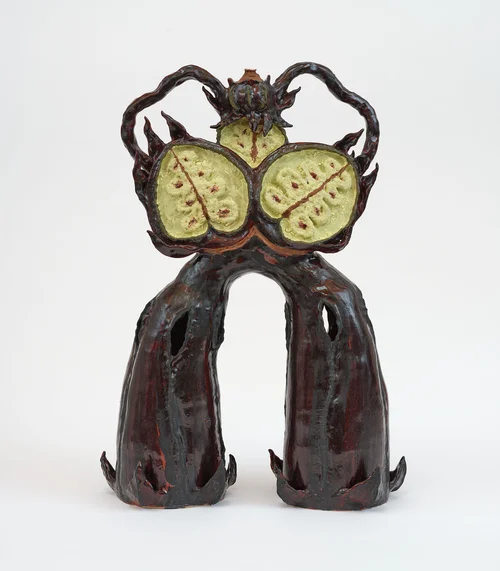

Heart Healer, 2026
Maddy Inez Leeser
Megan Mulrooney
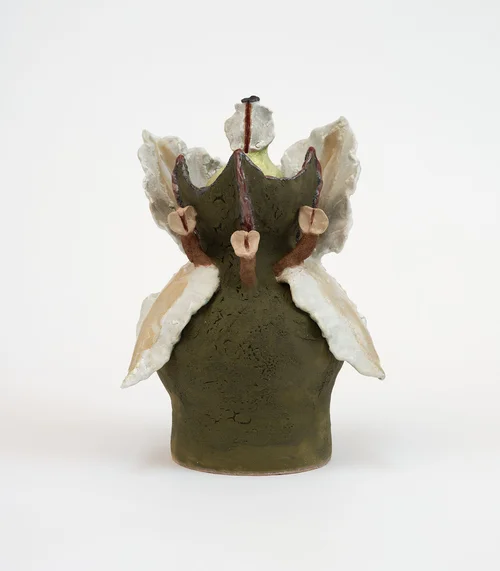
Al 'Ouna, 2026
Maddy Inez Leeser
Megan Mulrooney
Now, this interest in native ecology has expanded outward into questions of displacement, colonization, and survival. In this show, Inez dives deep into the stories of plants associated with the slave trade, referencing her family’s own connections to plant histories along the way.
In the aftermath of the fires, Inez was archiving documents belonging to her grandmother, Betye Saar, kept at the artist’s Laurel Canyon home. While sifting through photographs and papers, she discovered a certificate of midwifery belonging to her great-great–great-grandmother, Hannah Mays, a native of Louisiana.
During slavery, Black midwives were sought-after practitioners who melded Western and African medical knowledge with indigenous herbalism. After Emancipation, some of these women became officially certified and remained highly sought-after healers.
“I began to wonder what kind of plants my great-great-grandmother would have used in her practice,” Inez said. “From there, my interest expanded all over the world, as I realized in real time how agriculture was being weaponized during colonization that lasts until today.”
The stories can be strikingly powerful. “Enslaved people braided okra seeds in their hair to make sure that wherever they went, they would have the control and ability to care for each other,” Inez shared.
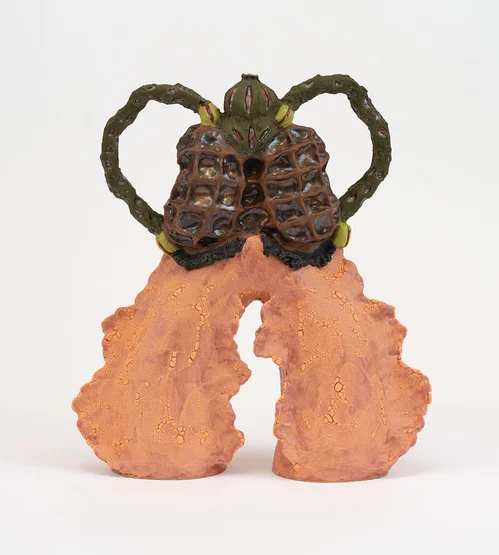

Crimson Kin, 2026
Maddy Inez Leeser
Megan Mulrooney
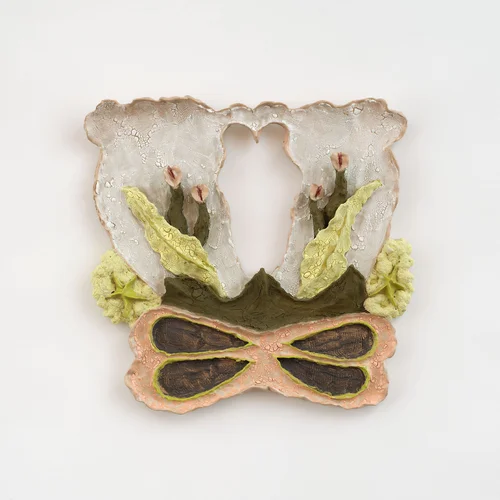

Wanderer, 2026
Maddy Inez Leeser
Megan Mulrooney
The sculpture Heart Healer (2026), meanwhile, is inspired by the hibiscus flower, popular in North Africa (particularly Sudan) and used to make karkadé, a tea, and healing remedies. In folklore, the flower is tied to the tale of two separated lovers. When one dies in battle, his beloved cries tears of blood, and wherever the tears hit the ground, a hibiscus blooms.
Inez’s own family life is a testament to the resilience of native plant knowledge even in diaspora. “Black-eyed peas symbolize luck. That tradition goes all the way back to Africa,” Inez noted. “On New Year’s Day, my family has soul food—black-eyed peas, greens, sweet potato. Every pea left on the plate is a tear you’ll shed the next year. Don’t leave any behind.”
Inez acknowledges that the exhaustive research into these histories may not be obvious to someone looking at them in a gallery setting—and she’s okay with that.
“This is all my little meditative healing practice,” she said. “I love seeing people come in and react to them.”
In botanical terms, the exhibition title “Nascence” refers to the moment right before a bud blooms. “It’s the signs of potential beauty, of a potential future,” said Inez. “Right now, I think we’re in the nascence of a revolution and, as an artist, I believe there is room for beauty in revolution.”


