








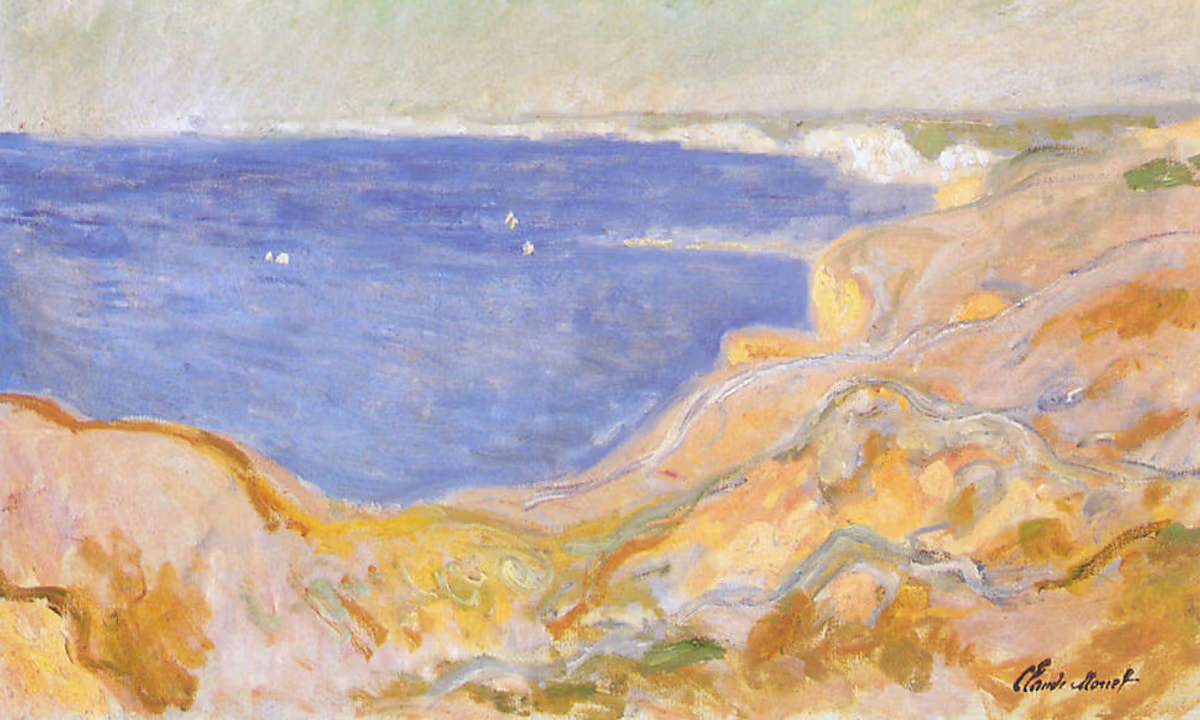
Two decades after one of the biggest art thefts in Brazilian history, the statute of limitations has expired. This means no one will ever face prison time for stealing five works by Claude Monet, Henri Matisse, Salvador Dalí and Pablo Picasso in 2006 from the Museu da Chácara do Céu in Rio de Janeiro. The four paintings and book of prints have yet to be recovered, and those responsible were never identified.
The crime was almost cinematic. On the afternoon of 24 February 2006, during Rio’s Carnival—one of Brazil’s largest annual celebrations—with the steep streets of the Santa Teresa neighbourhood filled with music and parade crowds, a group of thieves entered the museum, overpowered three security guards, took nine people hostage (including staff and visitors), disabled the security cameras and took the surveillance tapes. Minutes later, they fled on foot with the works of art, disappearing into the crowds outside. At the time, this was the largest art theft in Brazilian history and one of the top ten in the world. The works were collectively valued at more than $10m at the time they disappeared (around $16m today).
The stolen pieces were among the most important in the museum’s collection: Monet’s Marine (1880-90), Matisse’s Le Jardin du Luxembourg (1903), Dalí’s Les Deux Balcons (1929) and Picasso’s La Danse (1956) as well as a book of his Toros prints. The works were later included in international databases of stolen art, such as the Art Loss Register, and are still officially listed as missing.
Chácara do Céu is the former home of the businessman and art collector Raymundo Ottoni de Castro Maya; it was turned into a museum in the 1970s. The museum is now managed by Brazil’s Ministry of Culture and includes porcelain, silverware and furniture, as well as the country’s largest collection of art by Jean-Baptiste Debret and a significant trove of Candido Portinari paintings. However, in 2006 the cataloguing of the collection did not reflect its importance.
In a statement to The Art Newspaper, a spokesperson for the museum said its leadership “deeply regrets what happened in 2006”, adding: “The statute of limitations is a legal institution provided for in criminal law and concerns exclusively the procedural sphere. It does not alter the museum’s institutional commitment to the memory of what happened nor to the preservation and eventual recovery of the works.” The pieces are listed in Brazil’s register of missing museum assets and in Interpol’s database, in hopes that they may one day be recovered.
Museu da Chácara do Céu, Rio de Janeiro Photo: Fulviusbsas via Wikimedia Commons
Over the past 20 years, a few suspects emerged in the heist but none of the investigations led anywhere. A van driver who said he had been forced to transport the thieves was briefly arrested and later released for lack of evidence. The focus then shifted to a small group of French nationals connected to the neighbourhood and the art world, again without solid proof. At the same time, investigators failed to revisit an important fact later highlighted by a journalistic investigation: the museum had already been robbed in 1989, and some of the works stolen in 2006 had also been taken in that earlier theft and recovered.
In 2015, the Brazilian journalist Cristina Tardáguila published the book A Arte do Descaso (The art of neglect), based on five years of research into the case. Her conclusion was clear. “This is a failure to protect cultural heritage of great value. It is the failure of everyone involved: the public administration, the museum itself, the Ministry of Culture, the police, the prosecutors and the press,” she tells The Art Newspaper. “There was a total disregard. No one was really interested in finding those works.”
That indifference was reflected in the handling of the case by the authorities. For years, it moved back and forth between the federal police and the prosecutor’s office, with repeated requests for extensions and no real progress. At one point in this bureaucratic exchange, the three volumes of the investigation disappeared—they resurfaced months later among stacks of paperwork. For Tardáguila, the case was simply swallowed by administrative routine. “Given the way Brazil protects its cultural heritage, something like this could happen again at any time,” she warns. (In December, works by Matisse and Portinari were stolen in a brazen daytime heist at a library in São Paulo; some of the suspects have been arrested, but the art has not been recovered.)
Tardáguila’s research for her book led her to London, Interpol and Italy’s Carabinieri to try to understand how major art thefts are investigated. One of her central conclusions challenges the romantic myth of the collector who steals for the love of art. “Art theft is almost never done by someone who loves art,” she says. “A work of art becomes a bargaining chip. It is stolen because it is much easier to rob a museum than to rob a bank.” Stolen paintings, she says, often serve as collateral in clandestine networks, exchanged for weapons, drugs or favours far from the public eye.
Tardáguila hopes that one day the stolen works will reappear, perhaps found by accident during an unrelated investigation. But even then, she says: “No one will ever go to jail for this.”


