







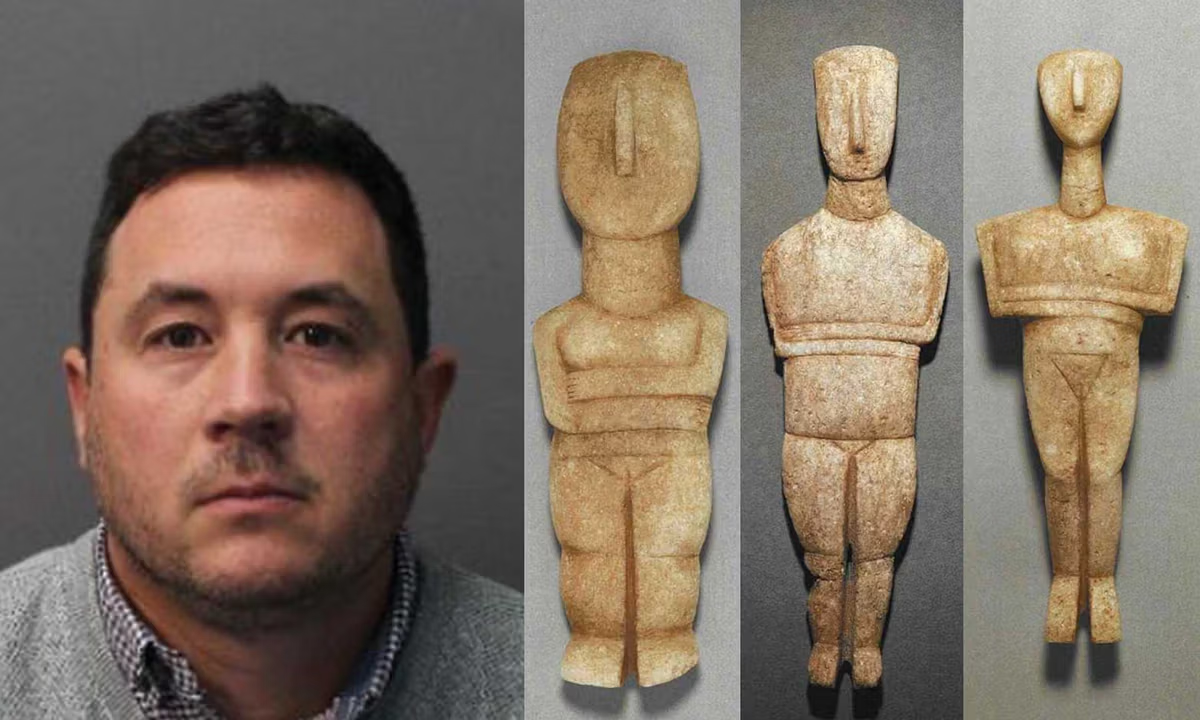
A 46-year-old man has been sentenced to two years in prison after admitting to an attempt to sell three stone Cycladic figures and an Anatolian stargazer statuette through Sotheby’s in London, using forged provenance documents.
Andrew Crowley pleaded guilty to fraud by false representation after presenting paperwork in a bid to establish an ownership history for the objects, which he claimed to have inherited from his late grandfather.
Detectives were first alerted in October 2022, when the auction house contacted the Metropolitan Police Service’s Art and Antiques Unit with concerns over several inconsistencies in the documents, which were provided with the artefacts. Crowley was arrested outside Sotheby’s in July 2023 and sentenced in Southwark Crown Court in May of this year.
The three stone figures were presented as Cycladic antiquities originating from present-day Greece. Measuring approximately 30cm in height, they would, if authentic, date back around 3,000 years. It is understood that expert evidence obtained by the police suggested the pieces were not ancient and no evidence was presented by the defence to dispute that. However, judge Nicholas Rimmer seemingly accepted that Crowley believed the items were ancient.
While prosecutors cited previous market sales to support an estimated value of up to £500,000, the judge reportedly argued that the estimate hinged on “multiple hypotheticals” and reduced their potential value to £340,000.
Meanwhile, a spokesperson for Sotheby’s said: “We believe it was a figure suggested by Mr Crowley, it didn’t come from us!”
In addition to the prison sentence, Crowley was ordered to complete 200 hours of unpaid work and pay £1,630 to cover costs.
All in the paperwork
Although there remain question marks over the authenticity of the objects themselves, the criminal conviction centred on the accompanying provenance documents.
Among the materials presented were invoices dated 1976, addressed to a John Crowley. The documents suggest the figures were acquired from Kenneth John Hewett (K.J. Hewett Limited), a London dealer specialising in ethnographic art and antiquities, who was known to have worked with Sotheby’s during the 1950s and 60s.
Andrew Crowley’s grandfather was not known to collect antiquities. Research by The Art Newspaper also shows that a John Crowley was not registered at the London address (23 Ashley Gardens) in 1976, as indicated by the fraudulent invoice.
Forensic analysis conducted by the police, in collaboration with the FBI in New York, determined that the printer technology used to produce the forged documents did not exist in the 1970s. Investigators also found that the typeface used in the documents was not developed until 2001.
Lessons learnt
The Crowley case has strong parallels to some of the UK’s most notorious art fraud cases, namely that of Shaun Greenhalgh, who created a string of forgeries attributed to renowned artists and historical figures over a 17-year period with accompanying false provenance, and often deeply researched. The fraud unravelled in 2006 when he and his family attempted to sell a fake Assyrian relief to the British Museum. He was eventually sentenced to four years and eight months in prison, in 2007.
Similarly, the partnership between John Myatt and John Drewe throughout the 1980s and 90s led to multiple forged works attributed to well-known artists including Henri Matisse, Alberto Giacometti, Marc Chagall and Ben Nicholson being sold with false provenance documents. Drewe even tampered with documents in the Tate’s archives to support the forgeries’ paper trails.
“The [Crowley] case is a textbook example of why robust provenance documentation is not a formality but a first line of defence,” says Angelina Giovani-Agha, the founder of Be My Source, a platform that connects clients directly with specialist archival and library researchers around the world—people who can access the primary sources.
Don’t rely on the police
“What’s significant here is that it was Sotheby’s own due diligence process, not law enforcement, that triggered the investigation,” Giovani-Agha adds. “That’s how it should work. The art market cannot rely solely on police intervention after the fact. Provenance research, carried out by qualified specialists before works enter the market, is what prevents fraudulent material from circulating in the first place.”
Crowley, who is registered as director of a courier company, had never sold a work with Sotheby’s previously. A spokesperson for Christie’s confirmed that they have also never sold works for him.
Detective Constable Ray Swan, who led the case for the Metropolitan Police’s Art and Antiques Unit, said in a press release: “This case highlights the crucial role played by industry experts in helping to protect the integrity of the London art market. Sotheby’s staff acted responsibly and swiftly in raising their concerns, and their cooperation was instrumental in preventing a significant fraud.”


