








Editor’s Note: This story is part of Newsmakers, an ARTnews series featuring conversations with the figures shaping how the art world is changing right now.
One of the standout works in “Art of Noise,” an exhibition of music-related design at the Cooper Hewitt Smithsonian Design Museum in New York, is a listening room devoted to a sound system built by Devon Turnbull, also known as OJAS. In the past few years, Turnbull has garnered attention as a high-fidelity evangelist who has built speakers, turntables, and amplifiers for Virgil Abloh, Supreme, the Brooklyn music venue Public Records, and numerous other high-profile collaborators.
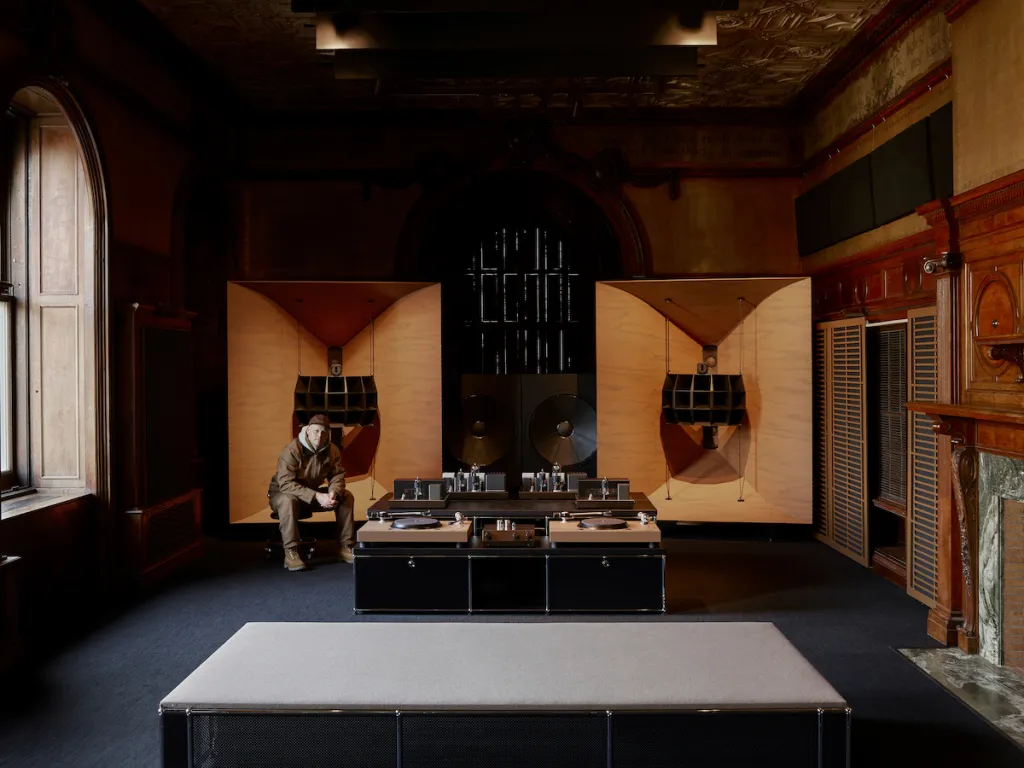
Turnbull’s entrée into the art world began with when he was included in a group show at Lisson Gallery in New York and continued with “Art of Noise,” which originated at the San Francisco Museum of Modern Art in 2024 and will be on view in New York from February 13 through August 16. In the former-mansion environs of the Cooper Hewitt, Turnbull’s HiFi Pursuit Listening Room Dream No. 3 has its own designated space in what was Andrew Carnegie’s personal library, where the artist or others affiliated with him will play music on Tuesdays, Thursdays, and Saturdays from 1 to 4 p.m. At other times, the sound system will play previously assembled playlists. On occasion, high-profile guests will join. So far, since the listening room opened early in December, that list has included filmmaker Josh Safdie playing the soundtrack to Marty Supreme as well as the ambient musician Laraaji and artist Tom Sachs.
ARTnews spoke to Turnbull about his devotion to craft and how his creations work in gallery and museum contexts.
How did your involvement in “Art of Noise” at the Cooper Hewitt come about?
It’s all been evolving and I’m going with the flow. The thing that set all this in motion was a show at Lisson Gallery in New York that included the first of these works: HiFi Pursuit Listening Room Dream No. 1. It was part of a group show in New York, and then the gallery invited me for a solo show in London the next summer where we showed the same work and a few other works in a less formal way. [SFMOMA curator or architecture and design] Joseph Becker, who curated “Art of Noise, came to the New York show.
How did you connect with Lisson Gallery at the start? The work you do is different than the rest of their program.
That’s the wildest part of the whole thing. I’ve been doing this sort of work for 20-plus years, and my vision for it has changed very little in that time. The work has evolved and gotten better and more complex, but for a decade or so, no one cared. I had a few friends who were kind of patrons and were commissioning things for themselves. Some of those friends were influential people, like Virgil Abloh, but I was just doing occasional projects and mostly just focusing on building things for myself. I didn’t really care about recognition, because it didn’t seem like it was going to come. This is my passion project, and that’s why I do it.
I met Hugh Hayden, who’s a Lisson artist, at a wedding I think 10 years ago. I had a listening room set up in my house, and a lot of the recognition I was getting was from people seeing clips of me listening to music on Instagram. I would just put a clip of a record playing, and people started wanting to come over and hear the system and talk about sound and stuff like that. Hugh came over and said, “You should really meet [Lisson Gallery CEO] Alex Logsdail. He loves music and hi-fi, and I think he’s going to really dig all of this.”
Devon Turnbull, HiFi Pursuit Listening Room Dream No. 3, 2025.
Mark Waldhauser/Courtesy Devon Turnbull and Lisson Gallery
The group show you were in was devoted to “a new generation of New York-based sculptors.” What are your memories of it now?
The show was called “The odds are good, the goods are odd,” and it was 10 or so young New York artists. The gallery was really committed to it. They built walls and did a ton of sound treatment. They let us fully design a space so that you walked through a portal into a room and were transported into a real music-listening environment. I was blown away, because I have friends who are artists and considered myself an artist on some level at times in my life, and I know how hard it is to get invited to show on that level of Lisson Gallery. I wanted to create a hi-fi listening room with the whole thing being one work—I wasn’t just going to bring some stuff from my house and sit around and listen to music as performance art. That wasn’t the idea at all. The idea was the making of the stuff and the assembly of the system and the environment that you listen in. I wasn’t considering the music I would play at all initially. I just wanted to tell the story of audio as craft through making a complete system, and talking about the process of making it and what all these things are.
The thing I spent the most time on for that first show was the design and build of the tube amp circuits. That’s what really drew me into making high-end audio stuff in the first place. I wanted this particular kind of tube amp that’s really almost impossible to mass-produce called a single-ended triode. Most of them are point-to-point wired, meaning there’s not a circuit board inside of it. It’s just components directly soldered to each other. When you look inside the amp, that is the real artwork. That craft tradition—that’s my thing. I love it. I travel to the far reaches of the world to meet and hear and see these things made by special craftsmen.
What was the response to the show like?
I just thought the Lisson crowd would pop their head in and walk back out, but people came in, sat down, and were just transfixed. That’s really hard to do in the audio industry. I’m an upsetter in the audio industry because I’m not a traditional manufacturer. I’m a craftsman. I don’t advertise in the magazines. I don’t do the hi-fi shows. Most brands spend a lot of money to do all that stuff and then can never recoup. The failure rate is extremely high, and I’m this guy that makes people wonder: Where did this guy kind of come from, and why does he get so much attention?
The thing that they can’t get around is that I get people to come in and sit down and listen. If you go to high-end audio shows, it’s very hard to get people to sit and listen for more than a few minutes. And people stayed at the gallery show for hours. At the opening there was an trail of people in line to get into this room, and it went all the way through the gallery out the door and around the corner down the street. I was blown away.
The gallery found it exciting because of the retention and the cultural component of it. They said, “Usually when a show is open, people walk in, look around for 10 minutes, and don’t talk to anyone. They barely make eye contact with people working in the gallery. But for this people are coming in and staying for an hour or two or three, and then leaving in groups talking about what they experienced. It’s creating a community.”


Devon Turnbull, HiFi Pursuit Listening Room Dream No. 3, 2025.
Mark Waldhauser/Courtesy Devon Turnbull and Lisson Gallery
Are there guidelines or dictates that you try to have follow your work when it goes out into the world on its own?
We’re trying to figure out exactly how that works. A collector acquired HiFi Pursuit Listening Room Dream No. 1 and is exhibiting it now in a property he has in London called 180 Studios. He’s invested in a lot of music- and audio-related stuff, and the listening room has been successful enough that he has a small staff of people that pretty much run it and do ticketed listening sessions a few times a week.
What was the response to your work like at SFMOMA? A museum setting is different than a gallery.
There were some confused people, but there were incredible turnouts there too. There’s a cadence to the listening room that means a lot of people would come once a week. In San Francisco, there are all these Berkeley sound nerds that would hang out a lot. The music community in San Francisco is really great, and the hi-fi community is really great. There were certain days that we’d have a big artist come in and people would catch word, and there would be thousands of people who showed up for, like, Beck playing records for an afternoon. That was maybe the craziest one, with thousands of people in line to get into the room. The last two days of the show were also, like, completely insane. Fred again [an electronic music-maker who has worked with the likes of Brian Eno and Skrillex] came, unannounced. He just came in and hooked up and played ambient music from his laptop for a couple hours.
How do you describe your craft? What are you in search of?
The whole point of this is the pursuit. The name of the works is HiFi Pursuit Listening Room Dream. A lot of people miss the “pursuit” part, and they’ll be like, “How dare you tell me that this is like the best audio system ever made!” That’s not what I’m saying. It’s my dream of the pursuit. And the pursuit is really important. There’s activeness in it. Part of what makes this fun is constantly trying to improve, and you can’t do that without reference and a test subject. That’s why sometimes we’ll have a speaker switcher so we can listen to many pairs of speakers. You have to be able to compare things to each other. That’s a big part of what we do.

Devon Turnbull, HiFi Pursuit Listening Room Dream No. 3, 2025.
Mark Waldhauser/Courtesy Devon Turnbull and Lisson Gallery
It’s like tasting five wines together.
Cooking analogies are interesting. I talk about cooking a lot when I talk about building audio components. The other day I was talking to Ignacio Mattos [acclaimed chef of New York restaurants including Estela and Altro Paradiso], and he was talking about how he can’t just walk into a kitchen and cook something. For him it has to start with sourcing the ingredients. It’s the same with this kind of audio. Modern stuff, like the sound card in your wireless speaker, is not the same. For that, there are thousands of components, and people working on that have to meet the specifications and they don’t really care where a part is manufactured. For my kind of audio, where the signal will often only pass through four or five individual components, every single one of those components matters. It’s like cooking a dish with five ingredients. When you go to McDonald’s, no one cares where the potatoes came from, or what kind of tomatoes went into the ketchup. It’s been abstracted way too far for those individual things to be relevant.
A lot of engineers think I’m an idiot because I go to Japan to buy potentiometers, when you can just go to wholesale parts websites and order these things for $1.50. And I go all the way to Japan and buy a handful of them, because that’s all I can get. The guy who made the tubes that are in the show at the Cooper Hewitt made them by hand. He’s the only person I know in the world that is hand-making tubes in an artisan capacity. It’s hard to get him to sell you the tubes, and I asked him, “Do you want me to promote you with the show?” He said, “Please no. I don’t need more people asking me for tubes—I can’t make anymore.” Sometimes I feel the same way. People are constantly saying “why don’t you just make more stuff?” But it doesn’t work like that.
Being so steeped in the process, how do you describe what you listen for? You’ve talked about how like you don’t like to listen to music played loud and how oftentimes when people see one of your systems they expect it to blow their face off.
There’s a lot about this that is counterintuitive. We’ve had moments where someone will put a video on TikTok and put music over it that makes it sound like some VIP nightclub. That is absolutely not what it is. It’s much more introspective. We rarely play music with vocals, because vocals contextualize the experience too much. Once there’s a narrative it doesn’t let you just be with your own thoughts. And most of what we listen to is acoustic. The most fun stuff to listen to in these kinds of systems is music that sounds real. I love beautiful, warm analog synth sounds—that music can be really beautiful too. But you don’t have the same experience of listening to something like a cello. I oftentimes get an album and listen to it in a car, and I don’t really even understand all the instruments that are like on a track until you sit down with a good system and really listen to it, and you’re like, okay, I didn’t realize that there was a ukulele that you can barely hear back there. And being able to tell the difference between subtly different instruments.
Devon Turnbull, HiFi Pursuit Listening Room Dream No. 3, 2025.
Mark Waldhauser/Courtesy Devon Turnbull and Lisson Gallery
The most important thing, whatever your system, is for to draw you to sit and really actively listen. There’s a great audio writer, Herb Reichert, who talks about the idea of building yourself a shrine to music. A lot of people in a lot of cultures have a place to worship in the home—a place where you go to sit and meditate or pray or do whatever it is that you do. You have to create a setting to give attention like that. There’s a lot of music that has way too much subtle content to appreciate without taking the time to sit and listen and appreciate it. That’s what I’m trying to do. That’s where I started.
How did you begin?
When I was a kid, I had a stereo and was always inheriting a new amp or finding things friends in thrift stores and putting together systems. But when the MP3 revolution happened, and music-sharing made it so that you could listen to every album, not just the one that you picked when you went to the record store, it became about quantity over quality and my system devolved to a desktop speaker. There was an experience where I went to the ballet and heard a piece by [Estonian composer] Arvo Pärt and was just blown away by the beauty of the music. I went straight to the Virgin Megastore in Union Square and bought all the versions of the CD, but none of them were quite getting there. Around that time I realized: I don’t listen to John Coltrane or Bach, and it terms of the story of music evolution, this is the really important shit and I don’t get it anymore! I needed to create a way of getting the emotional stuff out of the music, the stuff you know that makes you cry. I need that, and that was the point where I realized I need to take this a lot more seriously.


