







While the Metropolitan Museum of Art just announced a sizable Lee Krasner–Jackson Pollock exhibition for the fall, it now appears that that show isn’t the only grand one for a postwar painter on the docket at the New York institution.
Last week, the Met posted a job posting for a researcher who would work on a retrospective for Cy Twombly due to open in 2029. “Cy Twombly will be a retrospective exhibition of the artist comprising paintings, sculptures and drawings,” the listing notes. “It will examine the artist’s trajectory between two continents and how ancient myths, literature and travel influenced his work.”
Spokespersons for the Met and the Cy Twombly Foundation did not respond to ARTnews’s requests for confirmation. The Met’s listing remains active on sites such as Indeed, LinkedIn, and the New York Foundation for the Arts.
If the retrospective comes to fruition, it will be a momentous occasion. There have been Twombly retrospectives held abroad, with ones taking place at Tate Modern and the Centre Pompidou in 2008 and 2016, respectively. But the last time the US saw a Twombly retrospective was more than 30 years ago, while the artist was still alive.
The last US Twombly retrospective opened at New York’s Museum of Modern Art in 1994, at a time when the artist’s reputation was less certain than it is now. It went on to travel to the Menil Collection in Houston, the Museum of Contemporary Art Los Angeles, and the Neue Nationalgalerie in Berlin.
“I will not be unhappy if Twombly’s MoMA show squares my taste with that of the collectors who, checkbooks aloft, seem to be voting him the boss abstract painter after the New York School,” wrote critic Peter Schjeldahl in the run-up to the show. Once it went on view, critic Michael Kimmelman wrote, “There is a place for Mr. Twombly in the group of America’s leading postwar abstractionists, just not at the front.”
Since then, Twombly has more firmly entered the upper ranks of the postwar canon, with his “blackboard” paintings, each composed of repeated white scrawls set against gray backgrounds, highly prized by curators and collectors alike. (In 2015, one such painting sold at Christie’s for $70.5 million, a record for Twombly.)
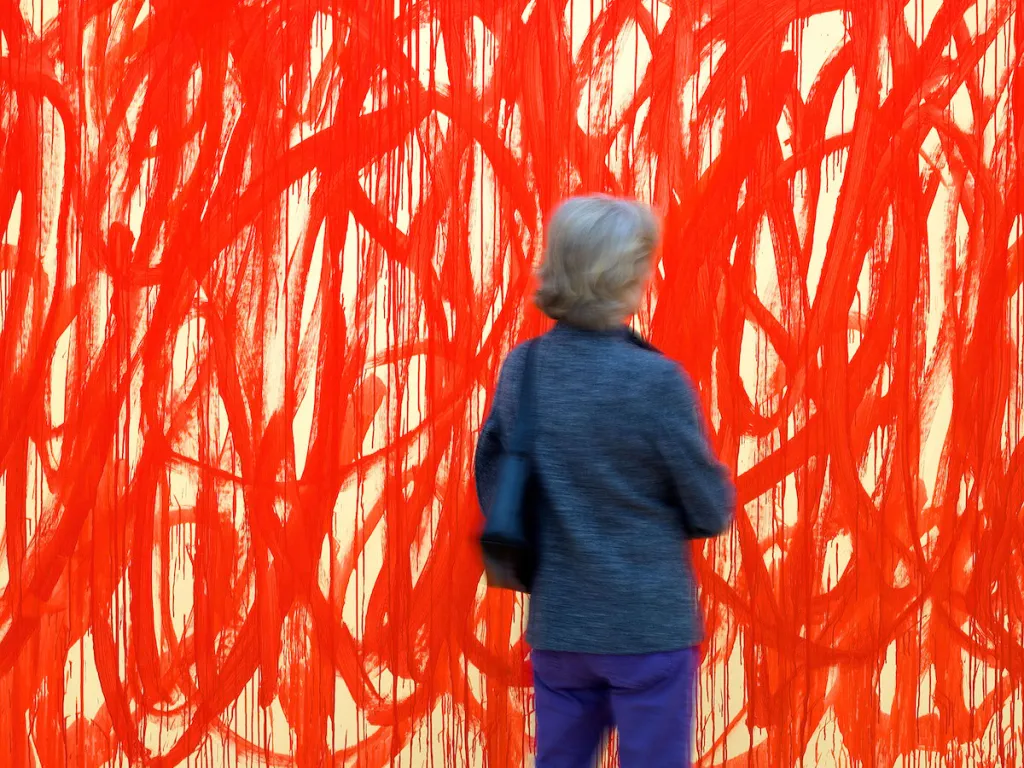
Critics have also come around on the vast paintings Twombly produced in the later stages of his career, which are distinguished by drippy swirls of red and graffiti-like marks. In 2015, for example, on the occasion of an exhibition at Venice’s Ca’ Pesaro, critic Travis Jeppesen wrote, “Cy Twombly was the greatest American painter of the twentieth century, and the greatest painter after Picasso, period.”
Born in 1928 in Lexington, Virginia, Twombly attended Black Mountain College, the art school that became a hotbed of experimental activity during the 1950s. His circle ended up including Robert Rauschenberg, John Cage, and other giants of the era. In 1957, Twombly relocated to Rome, where he would spend the rest of his career. He died there in 2011 at age 83. He received the Venice Biennale’s Golden Lion for Lifetime Achievement in 2001.
While we await definitive word on whether the Met is organizing a Twombly retrospective, you can, at least, visit the Menil Collection, which has an entire pavilion dedicated to the artist’s work, including his “blackboard” paintings and his less widely seen sculptures. The Menil bills that space as the “only permanent retrospective exhibition” devoted to Twombly.


