







Cultural and economic ties between Mexico and Asia receive a deep dive with El Galeón Acapulco – Manila Somos Pacífico: El Mundo que emergió del Trópico. Launched at Mexico City’s Colegio de San Ildefonso in early December and timed to coincide with the 50th anniversary of Mexico and Singapore’s diplomatic relations—as well as Singaporean president Tharman Shanmugaratnam’s first state visit to Mexico—the exhibition’s 300 works include 80 objects from Singapore’s national collection.
The exhibition navigates “a global Southeast Asia by placing Mexico City and Manila at the heart of a centuries-old world trade network”, says Clement Onn, the director of Singapore’s Asian Civilisations Museum (ACM) & Peranakan Museum, which co-organised the show with the National Gallery of Singapore (NGS).
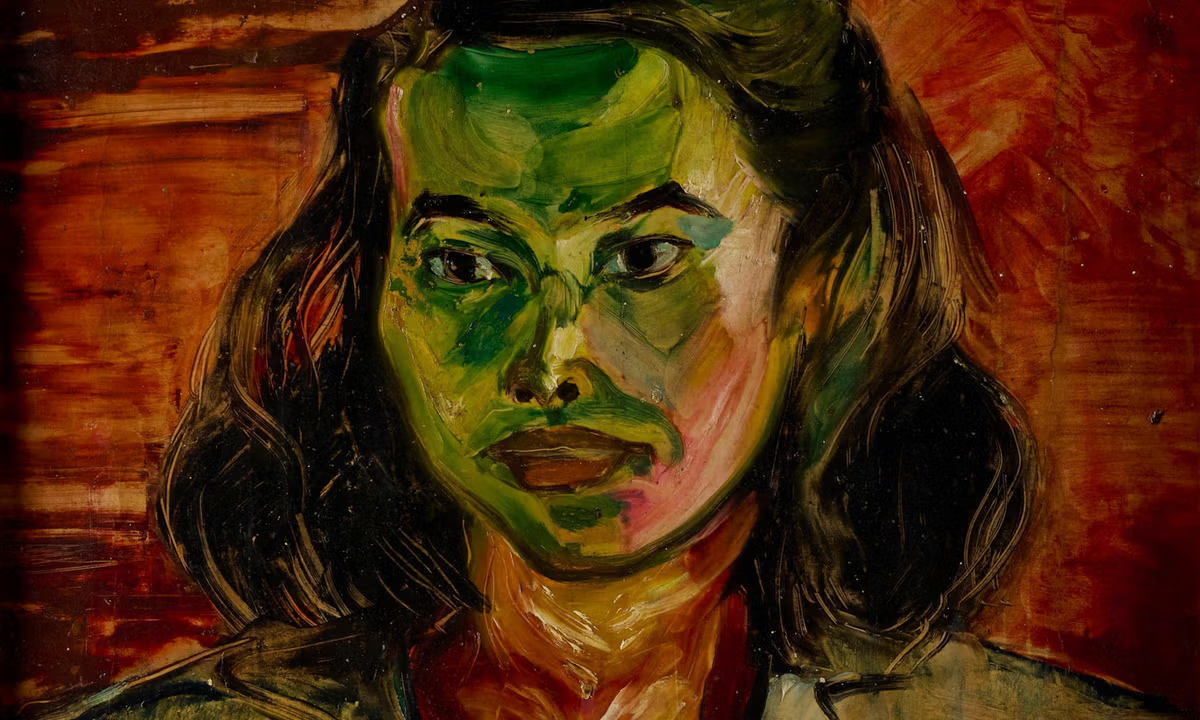
Modernist paintings Boy with Bird (1953), by Cheong Soo Pieng of Singapore, features in the show Courtesy of National Heritage Board, Singapore
“Port cities like Acapulco and Manila, alongside artistic production centres like Mexico City, were instrumental in fostering dynamic exchanges between Asia and the Americas. The fusion of cultures—much like the galleon trade itself—serves as a powerful reminder of the interconnectedness that transcended geographical borders,” Onn says. “In a time of increasing fragmentation and division, art and culture serve as universal languages that connect people across regions and histories.”
Somos Pacífico draws upon two 2023 exhibitions in Singapore—Manila Galleon: From Asia to the Americas at ACM and Tropical: Stories from Southeast Asia to Latin America at the NGS—and those two institutions plus the host also collaborated with the Ayala Museum and the Intramuros Administration Collection from the Philippines. Supporting Mexican institutions include the Franz Mayer Museum, the Bank of Mexico Museum, the National Archives and the Maya Museum of Cancún. Works included range from functional and devotional objects created in the 17th, 18th and 19th centuries to Modernist paintings from the 20th century.
Started in 1565, the galleon trade system between Mexico and the Philippines ended in 1815, four years before Singapore was established as a British colonial port, creating a new dominant route that, like most of Asia, used the Mexico-mined and -minted Spanish dollar. From “silver, porcelain and silk to the equally transformative exchanges of natural products like cocoa, chillies, tomatoes and maize (corn)”, Onn says, “these items not only shaped economies but also influenced our daily lives, artistic expressions and cultural traditions. More poignantly, we see that we are still living in the legacy of the galleon trade, with these historical connections woven seamlessly into our shared linguistic and culinary traditions, and everyday experiences.” He adds: “Singapore, like Mexico and the Philippines, is a mixed culture.”
“The parallel sensibilities extend to the post-colonial phase as both Mexico and the Philippines searched for their identity, a sentiment that can also be applied to Singapore,” says Eugene Tan, the director and chief executive of the NGS. “Much of the global discourse has been shaped by the Eurocentric viewpoints, but the Pacific has generated its own shared cultures, intellectual traditions, aesthetic strategies and anti-colonial solidarities.”
The project, says Tan, “pushes [Singapore’s] understanding of art history beyond the frame of nation and colony. It reminds us that Southeast Asia’s modernisms were always part of larger global currents [and] reinforces how artists across regions responded to parallel forces: colonialism, nation-building, migration and the search for cultural identity.” The NGS aimed to challenge the established hierarchies of global art history. “Rather than routing these narratives through Euro-American viewpoints,” Tan says, “we are creating a space where the Global South can speak for itself.”
- El Galeón Acapulco – Manila Somos Pacífico, Colegio de San Ildefonso, Mexico City, until 31 May


