


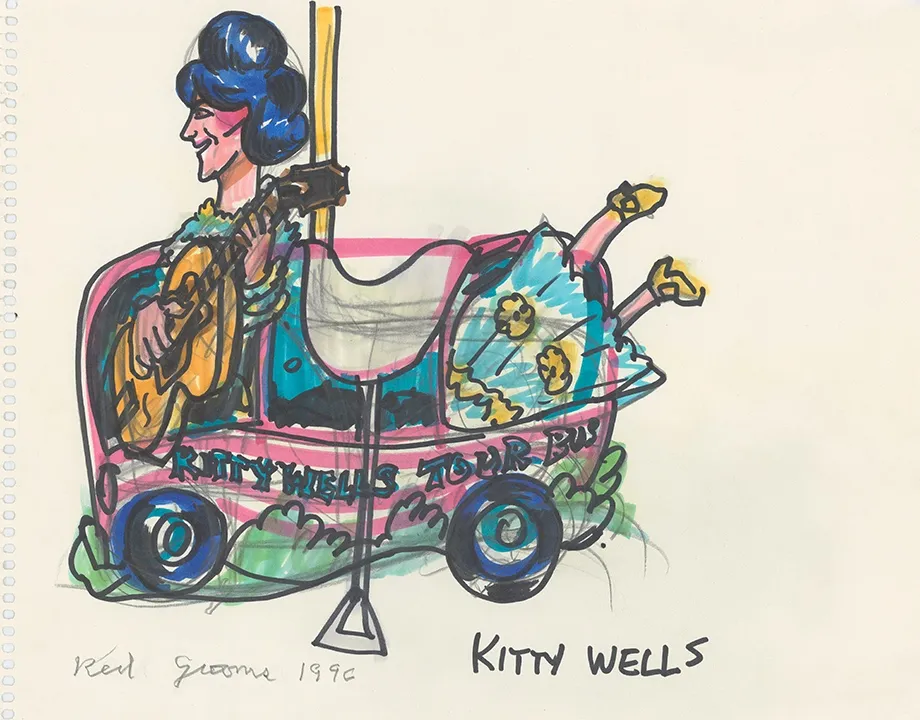
In 1995, armed with a grant from a Nashville nonprofit, New York–based artist Red Grooms set out to create a working carousel for the city of his birth. Three years later, the Tennessee Foxtrot Carousel opened to the public on city land at the base of Nashville’s Broadway.
Instead of the usual horses, the ride featured mounts modeled after figures from Tennessee’s history, all rendered in the Pop artist’s cartoonish style. The 36 characters included both the famous and the obscure: frontiersman Davy Crockett wrestling a bear, musician Chet Atkins riding a guitar, grocery magnate H.G. Hill steering a shopping cart, self-taught sculptor Charles Edmundson at work with his chisel, and Charlie Soong, Vanderbilt University’s first Asian graduate, with his diploma.
In 2003, five years after it opened, the debt-ridden carousel closed. In 2004 it was acquired by the Tennessee State Museum, dismantled, and stored. At one time, it was thought that after the museum moved into its planned new headquarters, the carousel would be restored and installed there. But though the museum reopened in a $160 million building in 2018, the carousel still languishes in storage.
Now, however, as reported by the New York Times this week, there has been some movement in the push to return the carousel to the public eye. This month the Tennessee State Museum issued a request for information, seeking responses from parties interested in partnering with the museum in the restoration and operation of the carousel.
“The Tennessee State Museum understands the deep cultural significance of the Red Grooms Fox Trot Carousel to the Tennessee community, and its place in cultural history,” the museum’s executive director Ashley Howell said in a press release. “We have for many years received inquiries as to the status of the carousel, along with suggestions as to how and where it ought to be installed. … If you have a realistic and feasible plan for the carousel, and can implement that plan, we’d like to hear from you.”
Questions still remain about how to display the carousel should the money be found to repair it. Would it be operable or static? If it was operable once more, where would it be sited? And should the figures be restored or duplicated? Grooms himself seems pragmatic. “Just put the thing back together,” he told the Times. “Don’t be precious about a carousel.”
