





Opening just over two months after Art Basel Miami Beach and in the wake of the debut of Art Basel Qatar, Frieze Los Angeles is the latest stop on the global marathon of art events that are leaving some dealers increasingly wary of the financial burden of fair participation. While fair organisers are often tight-lipped about the exact costs of exhibiting, entry into fairs like Frieze Los Angeles can come with five- and six-figure price tags for galleries. Compounding the financial strain is the fatigue that visitors and dealers face in keeping up with the rate at which these events come around. Last year, a handful of exhibitors dropped out of Art Basel Miami Beach in the months between the announcement of participating galleries and the event, citing higher operatin costs and the softer market.
Seemingly unfazed, a group of enterprising art fairs is taking root across Los Angeles to coincide with Frieze. Enticed by lower overheads and eager to capitalise on the influx of collectors and curators, these ventures offer exhibitors an alternative to the competitive and costly main event.
Commission-free sales
While 2025 saw the launch of Post-Fair (26-28 February), this year welcomes several additional players: the Indianapolis-based Butter Art Fair (26 February-1 March), the photography-focused Show LA fair (26 February-1 March) and New York-flavoured Enzo Art Fair (25-28 February).
Landing in the Inglewood neighbourhood, Butter launched in the Indiana capital in 2021 to support artists from the African diaspora. “In 2020, the surge to exhibit and collect works by Black artists felt haphazard and temporary,” Mali Bacon, a co-founder and the creative director of Butter, tells The Art Newspaper. “This moment in time prioritised the artwork and the gaze more than it did the life or experience of the artists behind the work.”
With Butter’s artist-centric model, artists were invited to submit their portfolios on the fair’s website and were selected by a curatorial team, including Bacon and Kimberly Drew, among others. The expansion to Los Angeles, Bacon explains, follows enthusiasm from the city’s “cultural aficionados and curators” who experienced the fair in Indianapolis as well as a small pop-up in Los Angeles last year. Butter’s inaugural edition features artists like April Bey, Mr Wash and vanessa german. Artists receive 100% of their sales and do not pay a commission to the fair.
The Butter Art Fair’s pop-up in Los Angeles in 2025 Photo by Talon Cooper, courtesy Butter
“Butter was designed to challenge value and worth,” Bacon says. “The new model exists to remind us that artists have already earned what they’re asking. The least we can do is pay the artists—and pay them full price.” The fair relies on tickets, donations and corporate and civic sponsorships to cover costs. Exhibiting artists can also elect to donate a portion of their sales to the fair if they choose.
A fellow art-week newbie, Enzo launches in Echo Park as a zero-fee fair focused on New York-based galleries. Conceived by the collector and arts patron R. Parmar, Enzo aims to provide a low-risk entry point for emerging East Coast galleries seeking exposure in Los Angeles. However, its exhibiting galleries include some businesses with significant global reach, like the Shanghai- and New York-based Bank, which is also participating in Frieze Los Angeles.
“We decided on a small, free art fair as a response to the current state of the art world,” Parmar says. “Emerging, mid-career and blue-chip artists and galleries are all having a tough time in today’s art economy. A smaller fair feels more intimate, casual and personal. We thought it would be nice to offer something different and on the East Side.”
Housed in a converted warehouse, Enzo juxtaposes intimate presentations with discursive formats—including performances, digital media and talks—positioning itself as both a fair and a forum.
A Northern California comeback
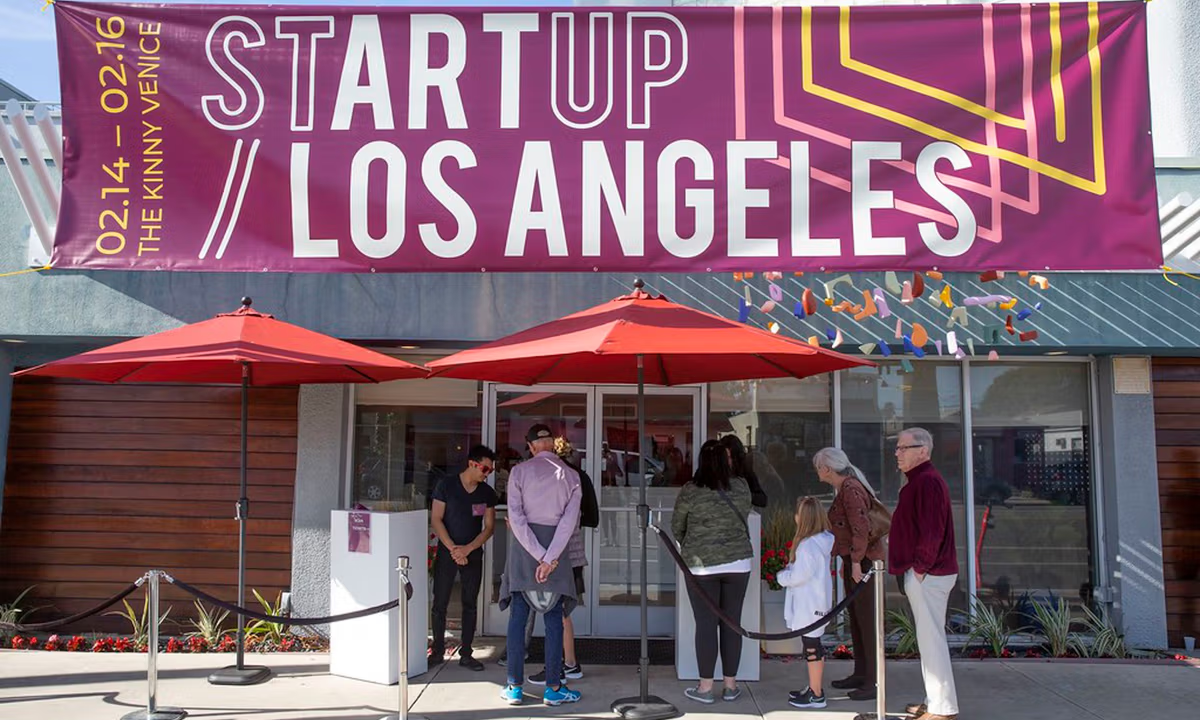
Joining Enzo, Show LA and Butter is a fair returning after a fallow period. The Startup Art Fair is back after five years. The artist-founded and -centric fair launched in San Francisco in 2015 and expanded to Los Angeles from 2016 to 2020.
“After a five-year hiatus, I realised how much I genuinely missed the excitement, generosity and community that Startup fosters,” says the sculptor Ray Beldner, a co-founder of the fair. “Given the state of the world, it feels like we need art—and artist-centred spaces—more than ever.”
Taking place at The Kinney Venice Beach hotel, Startup is embracing the intimate hotel-fair model that has become popular with ventures like the concurrent Felix Los Angeles. Each artist in Startup is transforming a room into a small exhibition. Given its proximity to Frieze, Startup is offering shuttles between the
two sites.
Startup exhibitors include the quilt-maker Barbara Danzi and the mixed-media artist Mark Wagner. Emphasising equity, Startup charges a flat fee to exhibit, and artists keep 100% of their sales. “By giving artists full control over their presentations and sales, we remove much of the financial uncertainty built into traditional fair models,” Beldner says. “The traditional art-fair model often places artists at the bottom of the hierarchy; an artist-centric fair flips that dynamic.”
Indeed across Los Angeles, satellite fairs are increasingly challenging the status quo and providing more opportunities for artists. While the established blue-chip dealers might find that fairs like Frieze remain indispensable, for emerging figures and smaller galleries, lower overheads and alternative models may represent a more equitable future.


