







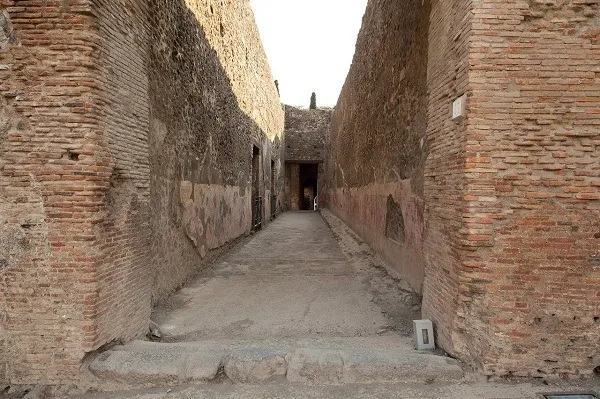
Researchers at the Pompeii Archaeological Park have utilized cutting-edge imaging technology to decipher centuries-old graffiti—both textual and figurative, some of it quite spicy!—written on the walls of a theater district corridor in the ancient city. The project, called Bruits de coulous (Rumors) was initiated by a team from the Sorbonne in Paris and the University of Québec in Montreal during two field campaigns, in 2022 and 2025.
The goal of the project is to “restore these inscriptions to their spatial context, revealing through graffiti thematic/spatial clusters, interactions, and multiple forms of sociability within a public space.” The space, it turns out, ran the gamut of sociability, with inscriptions and drawings documenting gladiator battles, sports slogans, petty insults, and erotic trysts (some of the paid variety) covering the 230-foot-long corridor.
A paper about the new discoveries translates many of the messages. (Most are in Latin, with some being in Greek and a few written in Arabic languages.) One, written in a “heroic-comic tone,” documents sex between three men and a prostitute named Tychè, who was taken ad locum (“to this place,” meaning the corridor). There are several examples of people professing their love for another.
The passageway in question is covered in graffiti and was first excavated in 1794. Many of the nearly 300 inscriptions are known, but 79 are newly legible, thanks to a Reflectance Transformation Imaging, a new technique that involves taking multiple photographs of a subject wherein the camera and object positions are fixed, but the light source varies. The RTI software can then merge multiple images into one file incorporating various light positions.
Gabriel Zuchtriegel, director of the Park of Pompeii, noted that there are over 10,000 known examples of graffiti throughout Pompeii. “Only the use of technology can guarantee a future for all this memory of life lived in Pompeii,” he said in a statement about the project.


