







Donatello’s Gattamelata, one of the most important bronze statues of the Renaissance, has been moved indoors from its piazza in Padua for only the third time in almost six centuries. It remains uncertain whether the corroded statue will return to its traditional outdoor setting or be displayed in a museum once a €1m restoration, funded by two non-profit organisations, is complete.
Completed in 1453, the statue commemorates Erasmo da Narni, better known as Gattamelata (“the honeyed cat”), a formidable 15th-century condottiere, or mercenary military leader, in the service of the Venetian Republic during its wars with Milan. Donatello depicted him as an idealised life-size figure sitting astride a powerful horse, drawing on the ancient statue of Marcus Aurelius on Rome’s Capitoline Hill sculpted more than 1,200 years earlier. Cast from 36 pieces, the statue stands on a stone podium nearly 8m high outside the Basilica of Saint Anthony of Padua.
Bronze cancer
Previously brought indoors for temporary safekeeping during the First and Second World Wars, the statue was moved again last October amid concerns it was suffering from “bronze cancer”, a corrosive condition affecting copper alloys that produces dark green staining.
The relocation, ongoing analysis and future restoration is being funded by Friends of Florence and Save Venice, two American organisations supporting heritage preservation, which have each contributed €550,000. “Gattamelata is one of the most important equestrian monuments in the world,” Simonetta Brandolini d’Adda, the president of Friends of Florence, tells The Art Newspaper.
Questions about the statue’s location have long been contentious. In 2022 the basilica’s Pontifical Delegation—the work’s custodians—considered moving the original indoors permanently and replacing it with a copy. Vittorio Sgarbi, an art critic who was then a junior culture minister, publicly objected. “The creation of a faithful copy to replace the original must be categorically ruled out,” he told journalists at the time, praising the “indomitable resilience of Donatello’s masterpiece”.
Endoscopes and 3D models
Instead, the statue initially remained in the square, with scaffolding erected while conservators carried out preliminary assessments of its condition and structural stability. Using visual inspection, micro cameras, endoscopes and 3D modelling, experts concluded that more extensive investigation and restoration should continue indoors. The chosen site was the grand hall of a former museum about 80m away.
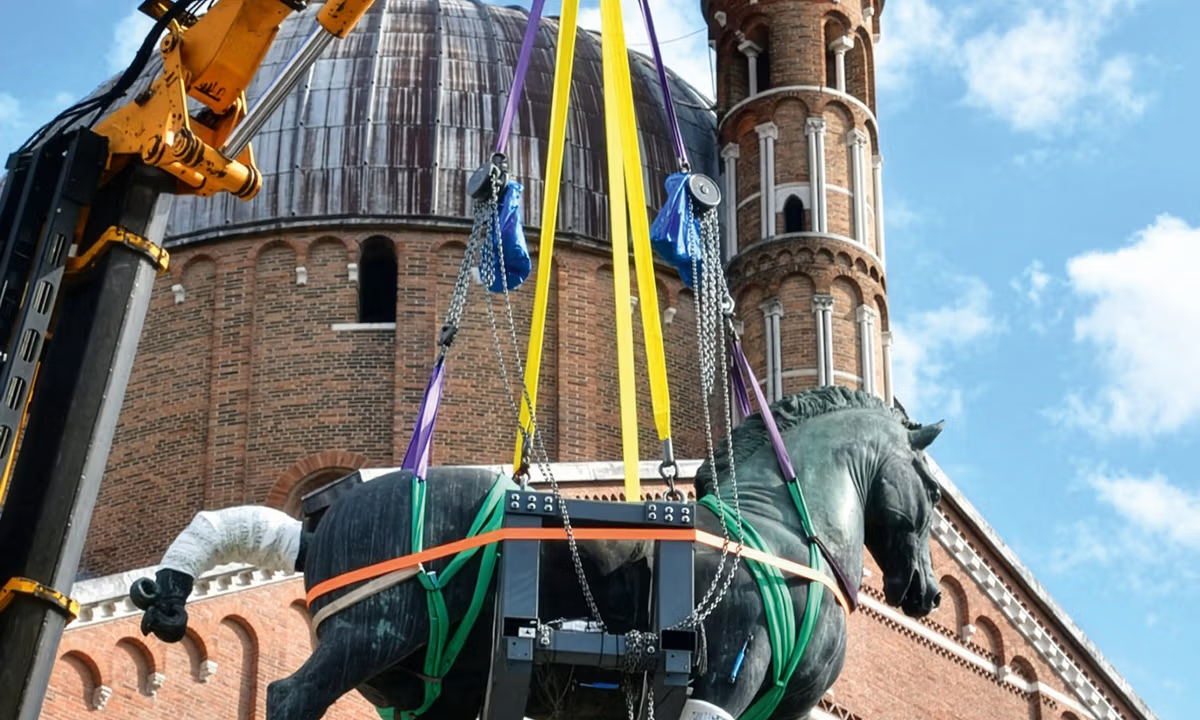
In a delicate two-day operation last October, conservators first removed the mounted figure, placing it in a bespoke wooden and metal support, before lifting the 1.6 tonne horse by crane. The move has eased access to the bronze’s interior, where gaps between horse and rider had allowed for rainwater, pigeon droppings and animal remains to gather. Advanced tests using ground-penetrating radar and ultrasound have also been carried out.
“We can say its condition is not great, but it’s not disastrous either,” says Ugo Soragni, the project’s scientific director.
Post-war reinstallation problems
Meanwhile, work is under way on restoring and stabilising the monument’s outdoor pedestal, which has developed cracks due to weathering, vibrations from traffic, and its previous repositioning in 1945, after which the horse leaned heavily on two hooves. “Many of these problems derive from when they put it back up after the Second World War,” says Melissa Conn, the Venice office director for Save Venice. Conservators are also fixing the base more securely to the ground to reduce the risk of collapse in the event of an earthquake.
Ongoing analysis has deepened understanding of Donatello’s techniques, including his use of gilding on the saddle outline and elements of the armour, as well as the precision with which individual bronze sections were fused. On the basis of the final results, the Delegation and the Soprintendenza, the culture ministry’s heritage protection body, will decide where the statue should ultimately be displayed.
Methods used during the restoration, which is due to begin in May and last 12 months, will depend on where the work will be displayed. Nicola Salvioli, the head conservator, says they will include a mix of mechanical, chemical and laser techniques.
Bringing it inside
Soragni argues in favour of a museum display, which would allow visitors to view the sculpture’s finer details up close, including folds of skin beneath the rider’s neck, the horse’s open mouth and its saddle decorated with garlands, putti and horsemen inspired by the Parthenon’s Panathenaic frieze. A replica could be made in bronze or resin, with the latter cheaper to produce and requiring less frequent maintenance. By contrast, placing the original outside would require regular restoration every three or four years. “The costs would not be insignificant,” Soragni says.
Keeping originals indoors is a well-established practice. Florence’s Piazza della Signoria has displayed a copy of Michelangelo’s David since 1910, with the original now housed at the Galleria dell’Accademia. Rome’s second-century Marcus Aurelius equestrian statue was restored and transferred to the Capitoline Museums in 1981 due to traffic vibrations and pollution. In October, The Times quoted Salvioli as saying that Gattamelata was the world’s last Donatello bronze displayed outdoors.
Whatever the statue’s fate, the public will be able to see it when the Delegation opens the former museum on weekends as part of an educational programme supported by the US donors. While Friends of Florence and Save Venice have collaborated before, including on the conservation of 48 drawings by Giovanni Battista Tiepolo in 2016, the Donatello partnership is particularly apt; while Donatello was a Florentine, Padua is in the Venice region. “It made sense,” Melissa Conn says. “This was a great opportunity to work together.”


