






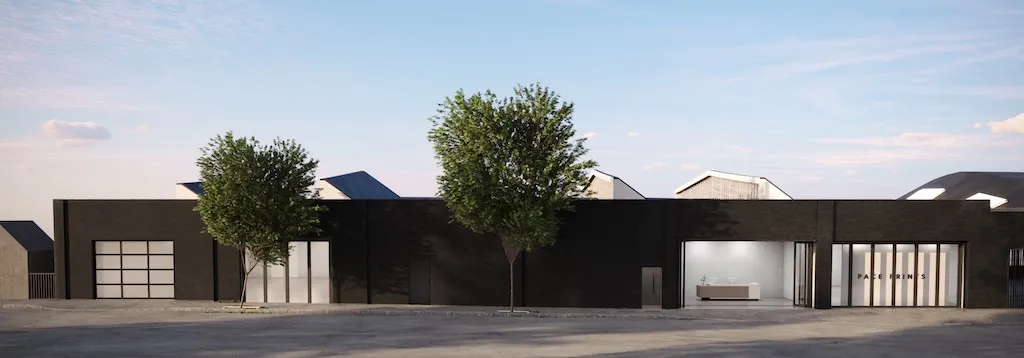
Pace Prints is heading to Hollywood.
The New York–based print publisher and workshop has taken a space in Los Angeles and plans to open a production facility this fall with a small accompanying gallery, expanding its footprint at a moment when the L.A. art scene feels, to some, unsettled.
Unlike a traditional gallery outpost, the L.A. location will function first as a production facility. The goal is to give West Coast artists time and space to experiment rather than flying in for quick, transactional projects.
Pace Prints has worked with a wide range of artists in recent years, from Jonas Wood to Nina Chanel Abney, Shahzia Sikander, and Kennedy Yanko. CEO Jacob Lewis, who started at Pace as an intern in 2001 and has now been there nearly 25 years, has watched the medium shift dramatically during his tenure.
“Prints have had a funny history,” Lewis said. They surged in the 1960s and ’70s, cooled in the ’90s, and are now back with force. What’s different, he argues, is the way artists think about them. “Most at this point, they’re approaching it as part of their art practice,” he said. “They’re coming in and seeing this as an extended hand.”
That change has coincided with a market reality. As prices for unique paintings have climbed, they have, in many cases, become out of reach for even committed fans. “They’ve grown to a point where sometimes they’ve become unattainable,” Lewis said of paintings. Prints, he added, have “become part of the conversation again” because artists are treating them as serious works, made by hand, and presented “at a value point… where more people can participate.”
The numbers back that up. Last year, two New York print fairs drew record attendance, with the IFPDA Print Fair topping 21,000 visitors and VIP registrations soaring. High-net-worth buyers increased their acquisitions of prints and multiples by more than a third in 2023 and early 2024, and sales in the print sector rose even as the broader market contracted. Prints have become a bright spot in a cooling art world.
Lewis frames that resurgence in practical and philosophical terms. “Printmaking is about accessibility,” he said. It offers “a way to be introduced into the overall art market,” allowing a new collector to buy something for a few thousand dollars, live with it, and grow from there.
Jacob Lewis, Courtesy Pace Prints.
That ethos will be on display later this month at Frieze Los Angeles, where Pace Prints will exhibit for the first time. Its booth will spotlight Los Angeles–based artists including Ross Caliendo, Brian Calvin, Elliott Hundley, Friedrich Kunath, Spencer Lewis, Jake Longstreth, Hilary Pecis, and Jonas Wood. Wood’s Ukiyo-e woodcut suite Five Bonsais will be a highlight, alongside Pecis’s handmade paper works, a jigsaw relief monoprint by Caliendo, and monoprints by Hundley.
The presentation extends beyond L.A. names. Works by Nina Chanel Abney, Jules de Balincourt, Nigel Cooke, Tara Donovan, Derek Fordjour, Keith Haring, Yoshitomo Nara, David Salle, Shahzia Sikander, James Turrell, and Kennedy Yanko will also be on view, underscoring how broad the print conversation has become.
If Frieze shows where prints are headed, a concurrent exhibition in New York looks at how they got there. On February 12, Pace Prints opens Chuck Close and Pulp at 536 West 22nd Street, organized with the Chuck Close Estate. The exhibition runs through March 14 and includes major paper-pulp works alongside the matrices and tools used to make them.
Close’s engagement with printmaking began in the early 1960s at Yale, where he studied painting and printmaking. In the early 1980s, he began collaborating with printer and papermaker Joe Wilfer at The Spring Street Workshop, eventually producing 18 paper-pulp editions and numerous unique works. Large-scale gridded stencils, including repurposed fluorescent light covers and custom brass shims, allowed Close to translate his meticulous painted grids into pulp.
“Virtually everything that has happened in my unique work can be traced back to the prints,” Close once said.
After Wilfer’s death in 1995, Close returned to paper-pulp in 2001 to create Self Portrait/Pulp, this time working with Ruth Lingen, founding director of Pace Paper. A progressive proof of that work will be on view, revealing how layers of paper pulp were built up using mylar sheets. “Working with Chuck Close on a print project was like creating magic,” Lingen said. “Chuck’s incredible eye, combined with his willingness to push the limits of scale and technique, made his projects some of the highlights of my working career.”
For Lewis, that spirit of experimentation is the through line. Artists come into the shop not simply to reproduce an image but to test the limits of what paper and process can do. What they learn there often feeds directly back into their paintings and sculptures.
In Hollywood, that laboratory will now have a new address.


