







The past is always with us, as the artist Enrique Martínez Celaya has shown in his trilogy of exhibitions exploring and evoking his childhood in Cuba. Conceived and realised over the past decade, the first exhibition was at the National Museum of Fine Arts in Havana, and the second at the Hispanic Society Museum and Library in New York. The final exhibition is currently on view at the Wende Museum in Culver City.
Filling the Wende’s main gallery space, The Sextant centres on a full-scale re-creation of the artist’s childhood home, a small Modernist house designed by his father. Everything has been coated with 6,500lbs of sugar, reflecting its industrial production in his hometown. A horse sculpture in front of the house pulls a sleigh piled with sugar, transported to the top of the house via a conveyor belt and crashing through the roof. In and around the building are paintings and drawings, with elements drawn from young Enrique’s letters to his father, who was able to resettle in Spain ahead of the rest of the family. (Martínez Celaya now lives in Los Angeles.)
The Sextant reflects the impact of the Cold War and Cuban history on the artist and his family. It is suffused with themes of memory, exile and the passage of time. The artist will lead a public walkthrough of the show at 9am on Friday (27 February).
In the Wende’s main gallery space is a full-scale reconstruction of the artist’s childhood home, which was designed by his father Courtesy Wende Museum
The Art Newspaper: Why did you decide to stage this exhibition at the Wende, known for its focus on the Cold War?
Enrique Martínez Celaya: Because this house was built between 1957 and 1963—the height of the Cold War, right? The embargo, the missile crisis, all of that. Here, it’s speaking with the Wende’s Cold War collection and all that history, which informed our entire experience of the period. My father left in 1970 and we left in 1972, but almost the entire time we were in this house, we were waiting for that exit.
A lot of your work is autobiographical. You often use images referring to your childhood, such as a person pulling or carrying a burden, and in this installation the horse and sleigh seem to be part of that metaphor.
My work is connected to poetry and philosophy, and it uses elements from my life—but always as a means and not an end. I don’t want my work to be confessional as much as using things that are meaningful to me, to try to use them to unfold some truth, some revelation.
Perhaps to tell one’s life truly is to talk about a person’s life. This relates to many people in the 20th century who have had to leave their home country.
Absolutely, and I have connected with other people’s experiences, too. Subjectivity is the way through to something beyond yourself. Here you have a horse with a sleigh, even if you don’t realise that the sleigh is a pair of lungs. [As a child, the artist suffered from asthma.] There’s something organic happening, and something also strangely disruptive—the sleigh and horse and those things.
When did you start working on this exhibition?
I’ve been thinking about it a long time, but I’ve been physically working on it for about a year and a half. We started building at my studio, then building here for 14 days nonstop. All this wood coated with sugar—it’s not easy, it’s very heavy.
It is like a big piece of sculpture.
That’s how I think of it. And the way the light hits it—because it’s sugar, it has such a particular quality.
It is ghostly. Was that the intention?
Yes, very much so.

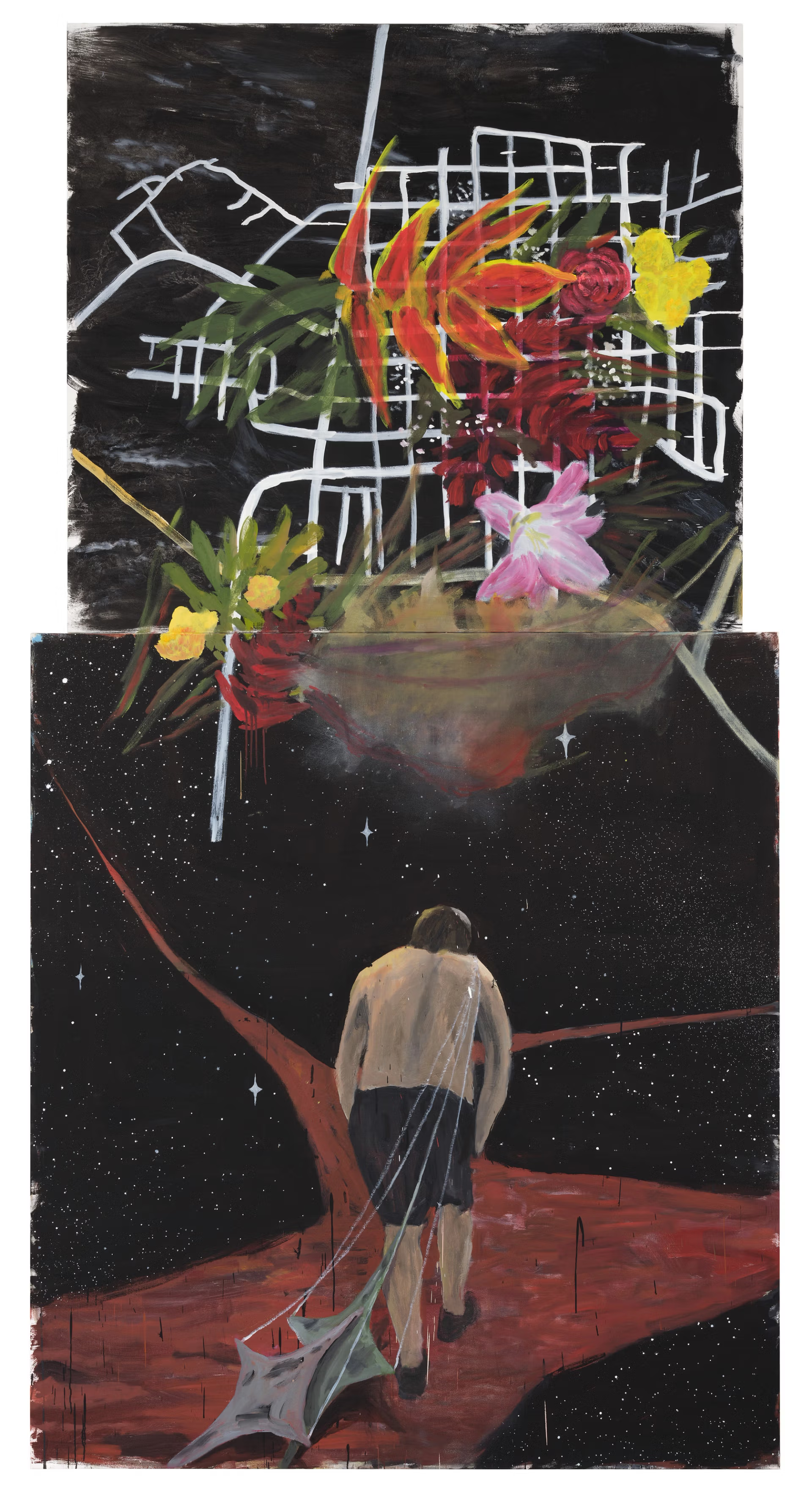
Enrique Martínez Celaya likens the painting The Vigil of Extinguished Stars (2022), which appears in the exhibition, to a poem Courtesy Wende Museum
As for the paintings on the walls around the installation, The Vigil of Extinguished Stars (2022) shows a man pulling kites or stars down a road.
I think of this as a poem. With a lot of my work, that’s the way I think of it.
It certainly has a poetic feeling. It seems all your paintings have a reference to memory, wistfulness, sometimes sadness.
All these paintings feature travellers and wanderers, and there’s an element of longing in them but, in some ways, we project onto them a lot of emotion.
Every so often, a critic says that painting is dead. Why is it still relevant to you as an art form or medium?
Partly because all that problematic history makes painting very charged. The fact is that painting continues to be viable, despite how many times it’s said to be dead. I’m interested in the materiality of painting and the illusion of painting. The way I use it, of course, is semi-representational, so I’m also interested in those allusions that reference real life.
I started painting when I was 11. It’s not only relevant, but very, very challenging above almost anything else. And now that we have things like AI, everything seems to be less demanding than painting. The problem with painting, of course, is it has a decorative element, which can easily kidnap it into a different territory.
Did you make the paintings specifically for this show?
The Vigil of Extinguished Stars existed before and became the influence for the other paintings, but the ones inside the house were made just for the show. I make many of my paintings over years; I paint and repaint them. This is why I never have my assistants make them, because I always feel like I wouldn’t know what to tell them, right? So, process is critical—the process of discovering what the painting is going to be.
• Enrique Martínez Celaya: The Sextant, Wende Museum, Culver City, until 11 October


