






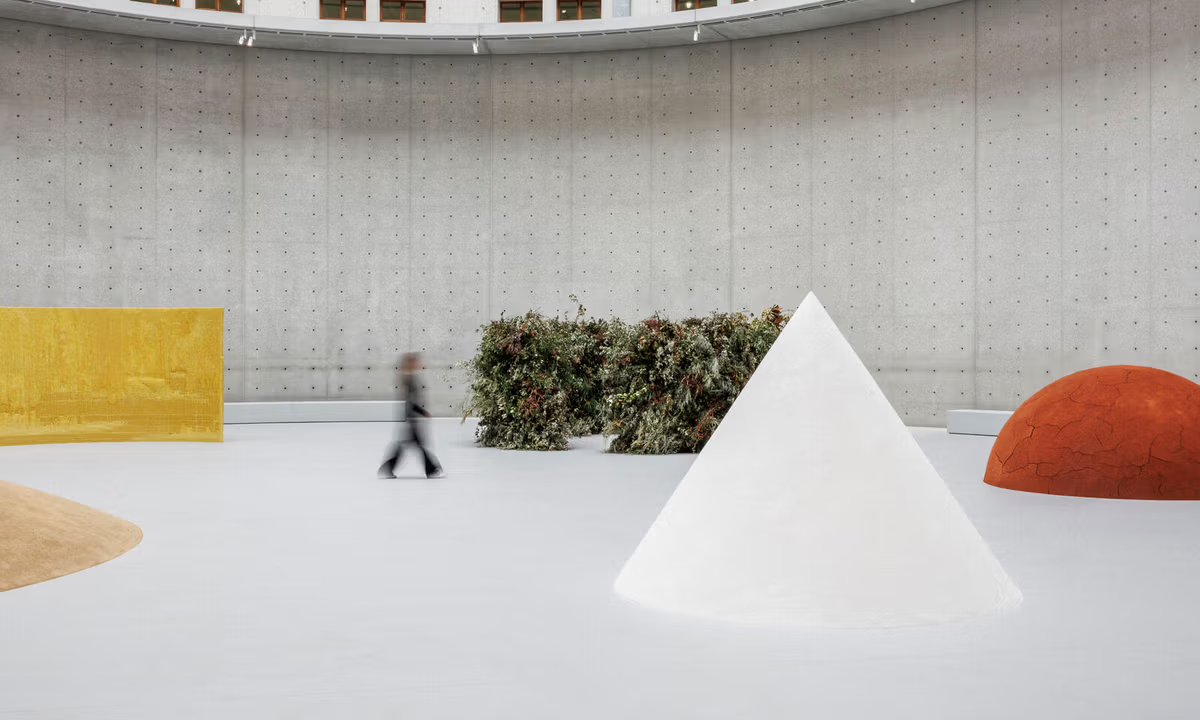
Under the grand glass dome of the 19th-century Bourse de Commerce in Paris rises a pristine cone of salt, nearly two metres high. Nearby, a low circular mound of powdery yellow ochre sits next to a hemisphere of cracked red clay. Opposite, a wall of translucent fragrant beeswax curves away towards a circular enclosure formed from interwoven branches, foliage and berries. This dramatic, delicate quintet of works by the 81-year-old US artist Meg Webster forms the striking centrepiece of Minimal, a groundbreaking exhibition curated by Jessica Morgan, the director of the Dia Art Foundation—a show devoted to demonstrating that the language and aims of 1960s and 70s Minimalism extended way beyond the usual white, male US suspects.
“Meg is an incredible figure whose work deserves to be better known,” declares Morgan as we walk through the Bourse’s huge building. “Her work continues to investigate geometric forms but only using natural materials that are entirely locally sourced.” Webster was taught by Richard Serra and Donald Judd and for years her poetic and environmentally conscious work was eclipsed by these mentors—but in Minimal it takes centre stage. Judd is only represented by a pair of 1963 painted structures in the upstairs galleries, and Serra by a single Right Angle Prop (1969) leaning against a wall.
For this is a show devoted to complicating art historical categories and mixing things up by looking further afield and throwing a spotlight onto the lesser known and often marginalised. “I wanted to offer a more expansive view across culture, geography and age, to incorporate the many voices that were engaged with thinking about what is a minimal form, and what is a minimal process,” Morgan tells me.
To this end she’s brought together more than 100 works by over 50 artists, all of whom were, in various ways, rejecting illusion and personal expression in favour of pared-back forms and a more direct engagement with their viewers and surroundings. While around 80% of the show is drawn from the Pinault Collection’s extensive Minimalist holdings, these have been augmented by loans from institutions worldwide to achieve Morgan’s aim of “broadening perspectives”.
There are thematic sections devoted to light, balance, surface, grid, monochrome and materialism, a gallery entirely devoted to the Japanese Mono-ha (School of Things) movement of the late 1960s and a series of spaces dedicated to individual artists. A gallery has been devoted to Agnes Martin and what amounts to a full retrospective given to the Brazilian Neo-Concretist Lygia Pape. Filling the Bourse’s 1860s display cases that encircle the rotunda are a series of date paintings from On Kawara’s Today series, and corresponding newspaper clippings.
Varying interpretations
These myriad voices show how minimal means and materials have been used in strikingly different contexts to trigger a variety of readings and associations. In the “Balance” section the austere Serra keeps company with the shape-shifting, bodily sensuality of Senga Nengudi’s Water Compositions of 1970, made from transparent vinyl filled with coloured water. These works, which slouch and sag as they hang from heavy ropes, in turn strike up a powerful conversation with Melvin Edwards’s barbed wire and chain Curtain (for William and Peter) of 1969, with its associations of oppression and brutality against Black people in the US. Another unexpectedly elegiac, emotionally charged encounter occurs between a row of choppily executed late Robert Ryman paintings and Félix González-Torres’s Untitled (Portrait of Dad) (1991)—a glistening milky-white carpet of constantly replenished white candies from which viewers are invited to help themselves.
This canon-busting is a wider reflection of Morgan’s past decade at the helm of Dia, which she describes as being “the epitome of a dead-white-male institution” when she arrived in 2015. “We inherited a collection with two female artists in it and the only artist of colour was On Kawara,” she says.
Today Dia owns work by 84 artists, 29 of whom are women and 23 of whom are Asian, Black, Latin American/Latino/a. Last year it made its first acquisition and display of González-Torres and it currently has a number of works by Nengudi and Webster on long-term view. The same iteration of the Mono-ha artist Kishio Suga’s large-scale work in wax, Parallel Strata, is also being exhibited at both venues.
Surrounded by Dia’s other displays, however, all these works have a different life and reverberate in other ways. Whether in Minimal or across the programmes and collections of Dia, by challenging established traditional categories, extending parameters and digging deeper into less documented histories and established figures, Morgan is setting an important example to institutions worldwide as to the treatment of art of the past and present.
• Minimal, Bourse de Commerce, Paris, until 19 January 2026


