





Artist Pat Oleszko has been awarded the Whitney Museum of American Art’s 2026 Bucksbaum Award, a $100,000 prize recognizing an artist in the Whitney Biennial whose work demonstrates exceptional talent and the potential to make a lasting impact on American art.
Oleszko was selected from the 56 intergenerational artists and collectives featured in this year’s biennial. The award, established in 2000 by the late collector and Whitney trustee Melva Bucksbaum, is presented during each Biennial and has previously honored artists including Mark Bradford, Zoe Leonard, Pope.L, Ralph Lemon, and Nikita Gale.
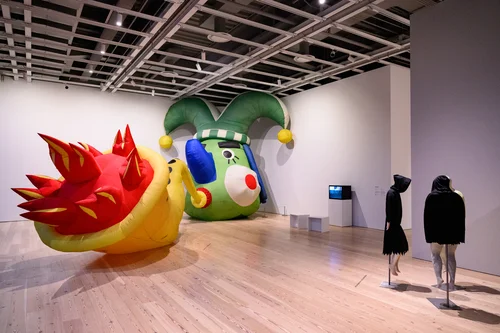
For more than five decades, Oleszko has cultivated a singular interdisciplinary practice that merges sculpture, performance, costume, installation, film, and public participation. Combining slapstick humor with pointed social critique, her elaborate handmade inflatables, costumes, and sculptural environments address subjects ranging from feminism and labor to environmental crisis, consumer culture, and political spectacle.
Her presentation in Whitney Biennial 2026 encapsulates the breadth of that practice. The installation pairs Blow Hard (1995), a monumental inflatable clown head originally commissioned for the World Trade Center Plaza, with Footsi (1979), a black-and-white film in which a pair of fingers dressed in doll-sized socks and shoes wander across the artist’s body and through the streets of New York. Together, the works blur the boundaries between sculpture and performance, comedy and critique, and audience and participant.

“Pat Oleszko is a singular force in American art, who has delighted, inspired, and challenged her audiences for half a century,” Whitney director Scott Rothkopf said in a statement. “By honoring Oleszko with the Bucksbaum Award, we continue the Whitney’s longstanding commitment to recognizing artists whose work expands the field, animates the present, and opens new ways of seeing the world around us.”
Whitney Biennial co-curators Marcela Guerrero and Drew Sawyer said the jury was unanimous in its decision, praising Oleszko’s originality and enduring influence. “Throughout the Biennial, it became clear that Oleszko’s work resonated not only with audiences but with many of the participating artists, who recognized in her practice a remarkable model of artistic freedom and invention,” they said in a joint statement.
Born in Detroit in 1947 and based in New York, Oleszko emerged in the early 1970s with exuberant performances that defied disciplinary boundaries. Though long regarded as an influential figure in performance art, her work has received renewed institutional attention in recent years. Earlier this year, SculptureCenter presented “Fool Disclosure,” the artist’s first major New York institutional exhibition in decades, while Artsy recently highlighted Oleszko among the artists having breakout moments in 2026 as museums and galleries reassess her contributions to contemporary art.


