






With the International Fine Prints and Drawings Association’s (IFPDA) annual Print Fair returning to the Park Avenue Armory this week (9-12 April), dealers and collectors are flocking to New York to see the newest and most coveted prints and drawings on offer. Exhibiting in the fair’s invitational section for non-profits is the National Gallery of Australia (NGA), which is showcasing a selection of its publications, including a new three-volume catalogue raisonné of the influential master printer Kenneth E. Tyler. Published in October 2025 after years of extensive research, Tyler Graphics: Catalogue Raisonné, 1986–2001 is the latest milestone in the close relationship between Tyler and the NGA, which holds the largest collection of his workshops’ art, research and archival material from 1965 to 2001.
“The catalogue raisonné is incredibly meaningful to me,” Tyler, who is 94 years old, tells The Art Newspaper. “It’s a nice reminder of the many things I’ve done, and seeing the documentation of decades of work allows for reflection and new insights.”
In the world of printmaking, Tyler’s mark is indelible. Born in 1931 in Indiana, Tyler emerged as a printmaker in the 1960s in the milieu of the Tamarind Lithography Workshop, a studio that helped revive fine art lithography in the United States (now the Tamarind Institute at the University of New Mexico in Albuquerque). Yet it was through the founding of his own workshops that Tyler transformed what was then considered a modest reproductive medium into a site of ambitious production for limited-edition prints. In 1965, Tyler started a studio in Los Angeles called Gemini Ltd, which the following year became Gemini GEL with the partnership of Stanley and Elyse Grinstein and Rosamund and Sidney Felsen. Gemini quickly earned a reputation for high-quality editions made with some of the leading names in Modern and contemporary art, including Robert Rauschenberg, Joseph Albers and Jasper Johns. In 1973, Tyler left Gemini (which celebrates its 60th anniversary this year and is still run by members of the Grinstein and Felsen families) and set out to start a new workshop on his own.
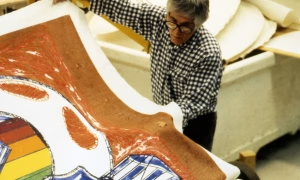
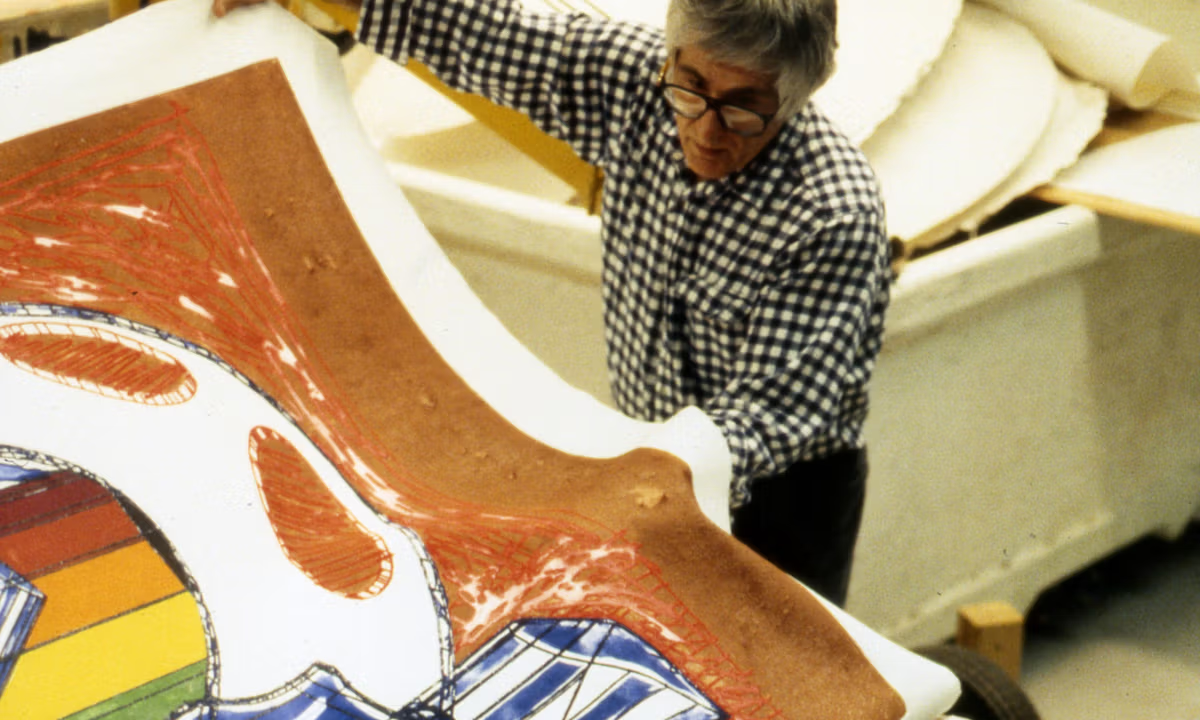
Helen Frankenthaler, assisted by Kenneth Tyler, reworking the image on a lithography stone used in proofs for Reflections XII, from the Reflections series, Tyler Graphics, Mount Kisco, New York, in February 1995. National Gallery of Australia, Kamberri/Canberra, Gift of Kenneth Tyler 2002. Photo: Marabeth Cohen-Tyler
In need of funding for this endeavour, Tyler decided to sell one impression from each edition he made, which caught the attention of the art critic Robert Hughes. Knowing that the NGA, which had recently opened in 1967, was building its collection, Hughes suggested the museum buy Tyler’s work. “What had been a considerably challenging period for him professionally proved a rare opportunity for the newly formed NGA,” says Jane Kinsman, the museum’s adjunct curator and editor of the catalogue raisonné.
The NGA’s inaugural director, James Mollison, met with Tyler and “saw the value of modern printmaking as an art form”, Kinsman says. “The seeds of the National Gallery’s Kenneth E. Tyler Collection were sown, and in 1973 Mollison acquired 621 prints, rare proofs and related drawings from Tyler.”
With this sale, Tyler established what would become known as Tyler Graphics in New York in 1974. Over the next nearly three decades, until it ceased operations in 2001, Tyler Graphics worked with artists including Helen Frankenthaler, Roy Lichtenstein and Donald Sultan.
“Working with Ken was really a collaboration,” Sultan says. “He was so technically invested that he helped invent complex techniques to achieve the best results for the projects. When I first went to Tyler Graphics, Ken showed me the facility and all the presses and printers, and the ability of each one to do amazing things. I immediately forgot any idea I brought with me and suddenly went blank. However, once started, the process began to coalesce into marvellous works. I often wish we had run small editions of the pieces as we went along because at every step, remarkable things happened.”

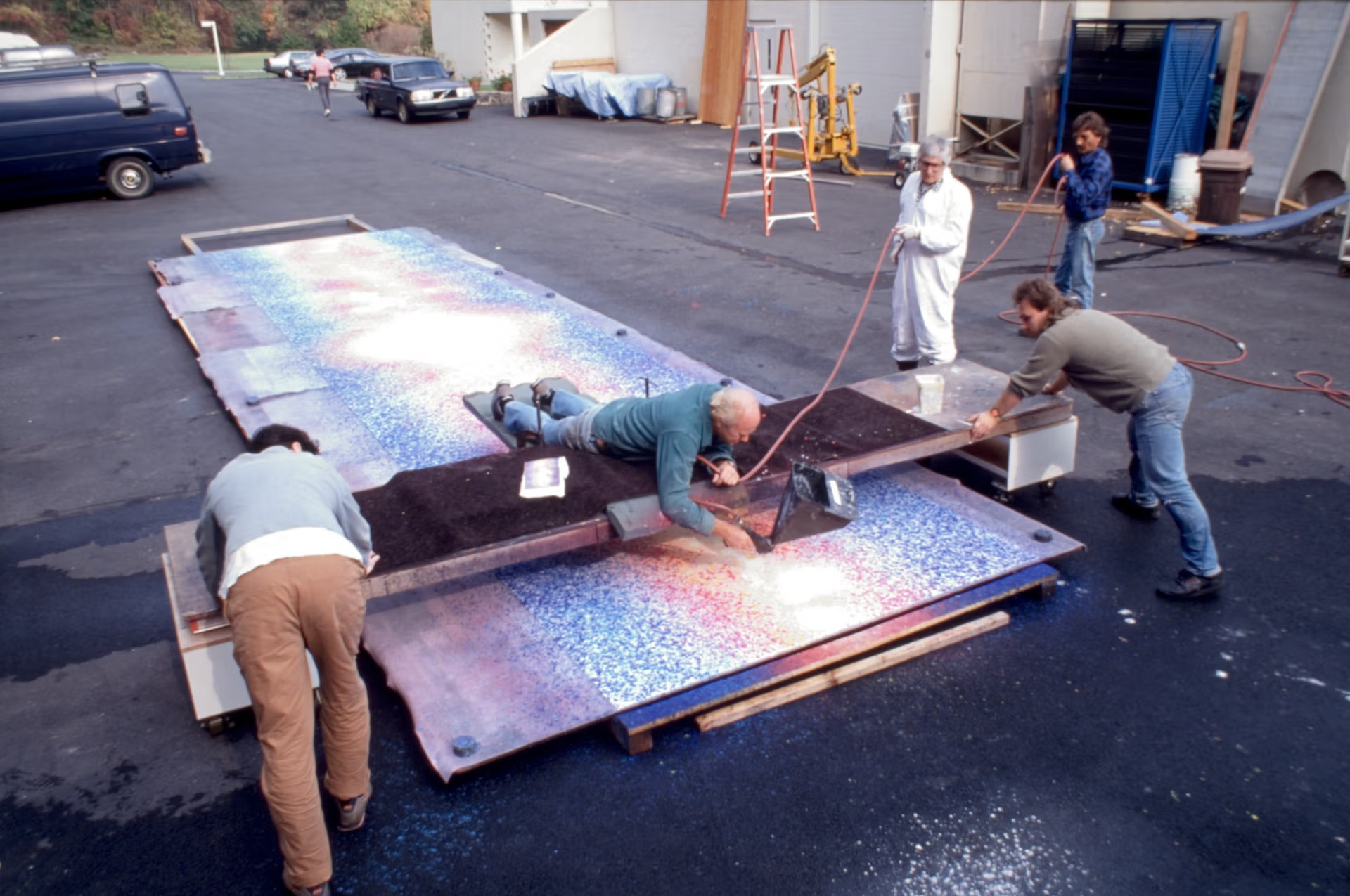
James Rosenquist, on top of a moving platform held by Paul Stillpass and Michael Mueller, using a pattern pistol to spray coloured paper pulp onto base sheets for Time Dust (1992), assisted by Kenneth Tyler and an unidentified person, in the Tyler Graphics workshop driveway, Mount Kisco, New York, in 1990. National Gallery of Australia, Kamberri/Canberra, Gift of Kenneth Tyler 2002. Photo: Marabeth Cohen-Tyler
Tyler’s workshop was known for innovation and even developed new presses, papers and techniques. “A key example of Tyler’s experimental approach was his development of pulp‑paper works in the mid‑1970s, which merged printmaking with painterly and sculptural methods,” says NGA curator Warwick Heywood. “This allowed artists such as Kenneth Noland to create tactile tonal works that celebrated the expressive qualities of paper pulp.”
The catalogue raisonné highlights how these projects came to fruition. “The documentation includes proof stages leading to the final editioned artwork and makes visible the ways the workshop supported, problem‑solved and helped shape each project,” says Nick Mitzevich, the NGA’s director.
Coinciding with the catalogue raisonné’s debut at the IFPDA, Sultan will be in conversation with Heywood and the scholar J. Cabelle Ahn on April 11 at 4pm. The NGA is also celebrating Tyler’s legacy with Proofs and Processes: The Kenneth Tyler Collection, an exhibition on view at the museum in Canberra until 2 August.
“I often think of the energy and electricity in the workshops,” Tyler says. “I am grateful to the NGA for the making of the catalogue raisonné and for capturing that spirit and energy. I hope this publication provides inspiration for generations to come.”
- IFPDA Print Fair, 9-12 April, Park Avenue Armory, New York


