
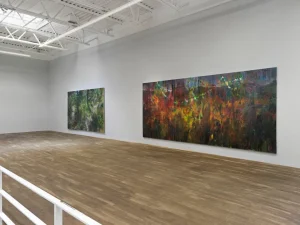





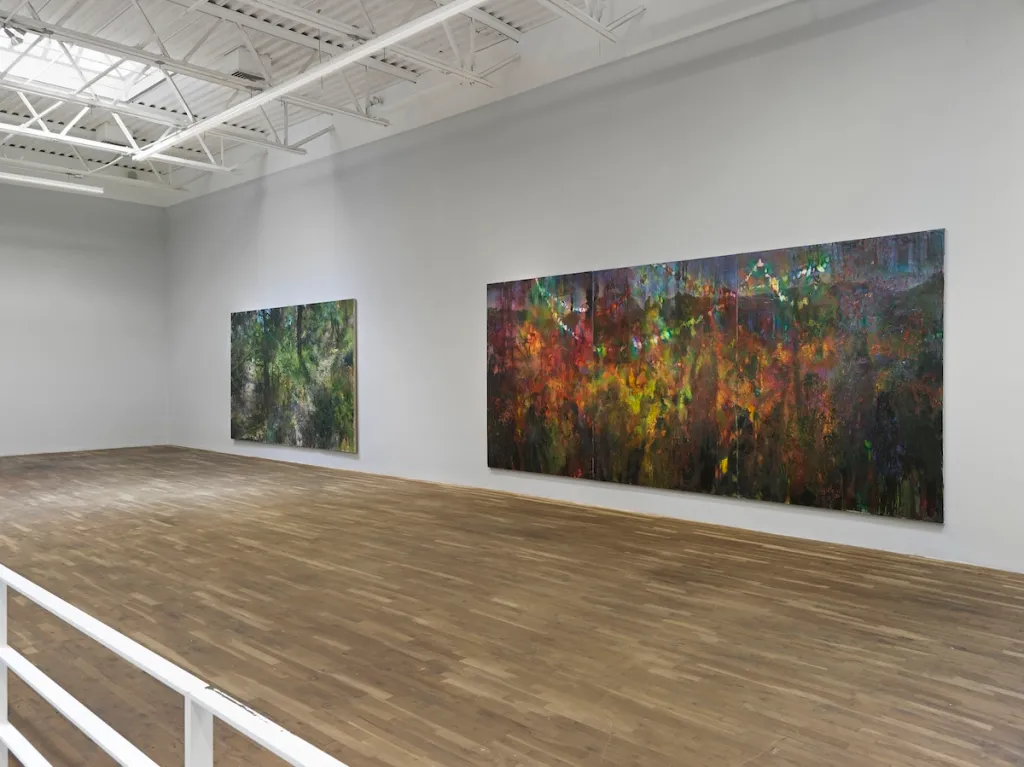
On Friday, Doron Langberg, one of the most successful and well-known Israeli artists working today, will open his first New York exhibition in seven years at Jeffrey Deitch’s Tribeca gallery. For the occasion, Langberg has so far opted to give a single interview—to the New York Times—and to publish an accompanying 750-word text on Deitch’s website addressing how his new body of work reflects the Israel-Palestine conflict.
Langberg has not spoken extensively about the issue in the past. The body of work for which he is best known consists of portraits and domestic scenes that explore queer life, gender, and sexuality. He has cited David Hockney, Wolfgang Tillmans, and Mickalene Thomas as influences; in a 2019 Jewish Currents feature, Langberg and several other LGBTQIA+ painters, including Louis Fratino and Salman Toor, were described as part of a movement dubbed “New Queer Intimism.”
A graduate of Yale University’s prestigious art school, Langberg has been featured in exhibitions at the Leslie Lohman Museum in New York and the Schwules Museum in Berlin, had a piece commissioned by the Public Art Fund in New York, and a painting acquired by the Metropolitan Museum of Art, which briefly had it on view before closing its Modern and contemporary art wing, while it completes renovations.
But, as Langberg told Times interviewer Julia Halperin, footage of the destruction of Gaza in the years after the Hamas attack on October 7, 2023, left him with a creative block and the sense that he could no longer find “the same meaning” in his work. The new body of work consists of monumental landscapes drawn from places of personal and political significance, including Drohobych, Ukraine, where his father was born and survived the Holocaust. Langberg said the works trace his process of questioning the meaning of his own Jewishness and the nature of home when that home “perpetrates atrocities.”
While the choice of subject matter might make the connection to the conflict seem oblique, Langberg told Halperin that he wanted to be unambiguous about his political position. “No matter the circumstances, Palestinians deserve justice and liberation,” he said. “By choosing to look away from unspeakable horrors under the auspices of protecting Jewish life, we destroy ourselves and countless others.”
In the accompanying text on Deitch’s website, Langberg described how visiting and painting the site connected to his family’s Holocaust history, and then returning to New York, helped him see “a worldview outside of the ideological vortex in Israel, with its intractable logic.”
“Bearing witness to the incalculable loss and cruelty that took place there through these small paintings, I thought of Gaza,” he writes. “The large works I made when I returned to New York—one describing a shadowy expanse of tree trunks, and the other illuminated treetops at night seen from the perspective of falling—materialized both the life and death of my family in the forest they surely loved. Making these works allowed me to mourn them, grounding my grief as a personal experience rather than a means to justify endless cycles of bloodshed. Untangled from ideology, my history became a source of moral clarity.”
While Israel and Hamas agreed to a US-brokered ceasefire last fall that has largely held through multiple phases, the Israel Defense Forces have periodically conducted airstrikes on Gaza, killing 509 Palestinians since the October ceasefire was signed, according to Gaza’s Health Ministry. Israel has said the strikes are in response to Hamas violations of the ceasefire. More than 70,000 Palestinians have been reported killed since October 2023, a figure the IDF has said it accepts.


