







Avant-garde dance can be much sillier than it seems. I was reminded of this—much to my delight—at a recent rehearsal for Set and Reset, a collaboration between icons that premiered at the Brooklyn Academy of Music (BAM) in 1983. Trisha Brown did the choreography, Laurie Anderson did the music, and Robert Rauschenberg did the costumes and the sets. Talk about a dream team!
This weekend, it’s back at BAM as part of an international tour celebrating Rauschenberg’s 100th birthday. Charmingly named “Dancing with Bob,” the tour runs through May, with a program that also includes Travelogue (1977). That piece was choreographed by Merce Cunningham and is being restaged by Trisha Brown Company—for the first time, by a professional dance company, since 1979. Meanwhile, another set Rauschenberg made for Brown’s Glacial Decoy (1979) is also on view at the Walker Art Center in Minneapolis through May.
Set and Reset is not only the brainchild of three stars but also a moving portrait of collaboration itself. Here, there are no committees making bad decisions; rather, three artistic visions are each given adequate autonomy even as they are delivered simultaneously. At the time, Rauschenberg described himself as “well aware of the independence of each artist,” referring to Anderson and Brown.
Set and Reset, choregraphed by Trisha Brown in 1983 and performed in 2025 by Trisha Brown Company.
©Ben McKeown
It’s as if the dancers act this autonomy out: their dissonances and disorder never cohere into anything like harmony, but they aren’t eyesores either. For the most part, dancers do their own thing, breaking off into trios and duets only occasionally and briefly. Onstage, trust falls end in surprising twists, but no one ever gets hurt. At one point, the whole crew lines up tidily before their formation dissolves shambolically.
The feel owes a lot to how Brown planned it out, improvising moves before recording and repeating them in an attempt to capture movement that felt alive: both intentional and improvisational. Maybe 15 minutes in, a prolonged duet sees dancers find unison that feels utterly remarkable following the free-for-all that preceded: picture the two-dancer-with-bunny-ears emoji (👯). Soon, they split apart and mirror each other instead of dancing side-by-side.
It might be minimalist dance, but it is hardly dry. In Set and Reset’s peppy staccato score, Anderson chants “long time no see” with exaggerated iambic pentameter, its upbeat synthy sounds almost emulating a G-rated haunted house: slightly spooky but sure to keep kids from going home with nightmares. About the collaboration, Rauschenberg said, “None of us are into extravagant spectacles.” And yet clearly they were not opposed to a little entertainment. Case in point: as the soundtrack starts to sound like a train whistle, we watch pique turns end in trust falls and arabesques give way to playful ass kicks before dancers somersault backward offstage, one-by-one, looking like babies all curled up on the floor.


Set and Reset performed in 1983 byTrisha Oesterling, Carolyn
Lucas, David Thomson, Gregory Lara with choreography by Trisha Brown, Music by Laurie Anderson, and costumes by Robert Rauschenberg.
Rauschenberg designed translucent scrims to mark the stage’s wings, where opaque velvet curtains tend to live. The intervention lets you savor those delightful somersaults a little longer. Brown said she wanted the stage to feel like a conveyer belt, with dancers constantly barreling in and out, side to side. Rauschenberg understood the assignment, enabling them to fade away. The dancers are dressed in loose, sheer, printed ensembles whose gridded geometries create the illusion of surprisingly befuddling anatomies.
All in all, the trio’s intervention was no mere stripping down of traditions into something hollow or bare. Instead, they cleared the way for a collaborative kind of play, enabled by open-ended prompts that allowed for both structure and surprise.
Travelogue, with a soundtrack by John Cage, is also structured by scores. Using a random number generator, musicians are prompted to play either bird calls or phone calls—the latter live, by dialing any number of their choosing. Then they are given details as to volume and duration; the results are different every time. When I watched during a rehearsal, most if not all the calls went to voicemail or else involved elaborate instructions for reaching real humans. Surely it sounded different in the ’70s.

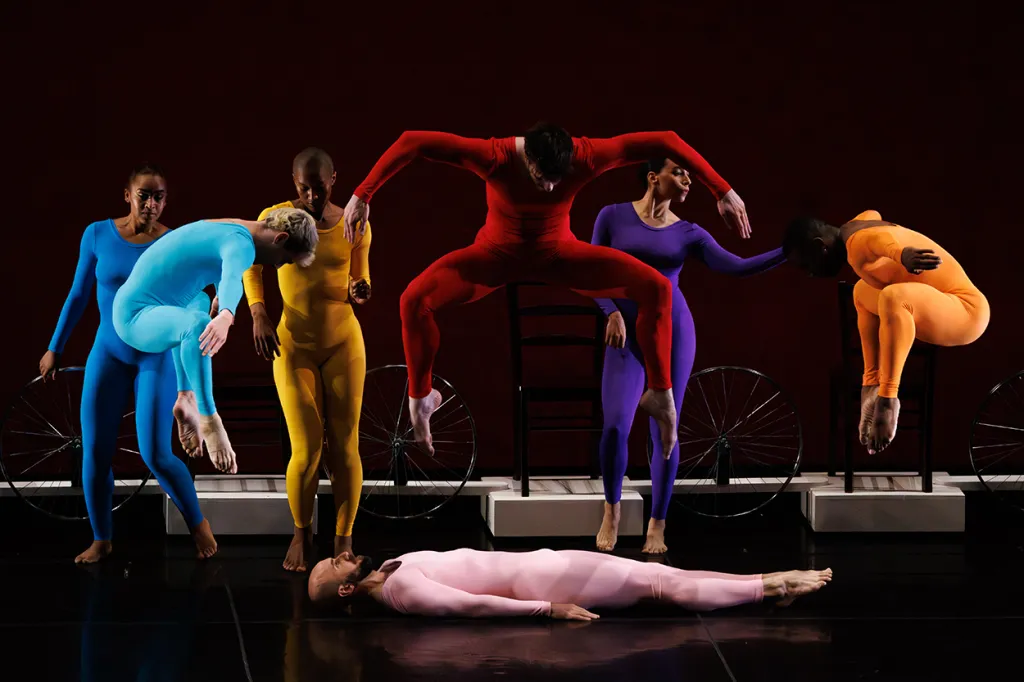
Travelogue, choregraphed by Merce Cunningham in 1977 and performed in 2025 by Trisha Brown Company.
©Ben McKeown
Watching, I found it surprisingly difficult to use the verbal-language part of my brain and the body-language part simultaneously, perhaps a personal deficiency. But briefly I managed it: something clicked when a call reached a wild bird clinic, prompting the caller to press 1 if he found a sick or injured bird, 2 if he found an orphaned baby bird, or 5 to inquire about volunteering. Mixed in with the bird sounds, it was hard not to see the dancers as injured birds, with their wiggly arms; their stunted, jumpy arabesques; and their trust falls ending on the ground with arms crossed, sarcophagus-style. Then I wondered if the score interpreter was deliberately choosing endangered things more generally, phoning the Museum of African American History and Culture, then public libraries, then the National Weather Service. Apparently, some texture of the times always creeps in—government shutdowns and weather emergencies close lines—but how hard it was to unsee what I had heard.
For Travelogue, Rauschenberg dressed the dancers in color-blocking unitards that unfold into delightful surprises. Set-wise, Cunningham asked him to make something “freestanding,” and the result, dangling from the ceiling, is considered one of his first “combines”—those signature combinations of painting and sculpture that launched him to fame.
It was a fruitful collaboration, but it wouldn’t last long. Let’s face it: it’s rare and special when creative collaborations do. As the story goes, a rift ensued when a newspaper quoted Rauschenberg calling the Cunningham’s dance company his “biggest canvas.” So they replaced Rauschenberg with his ex, one Jasper Johns—the ultimate revenge.


