


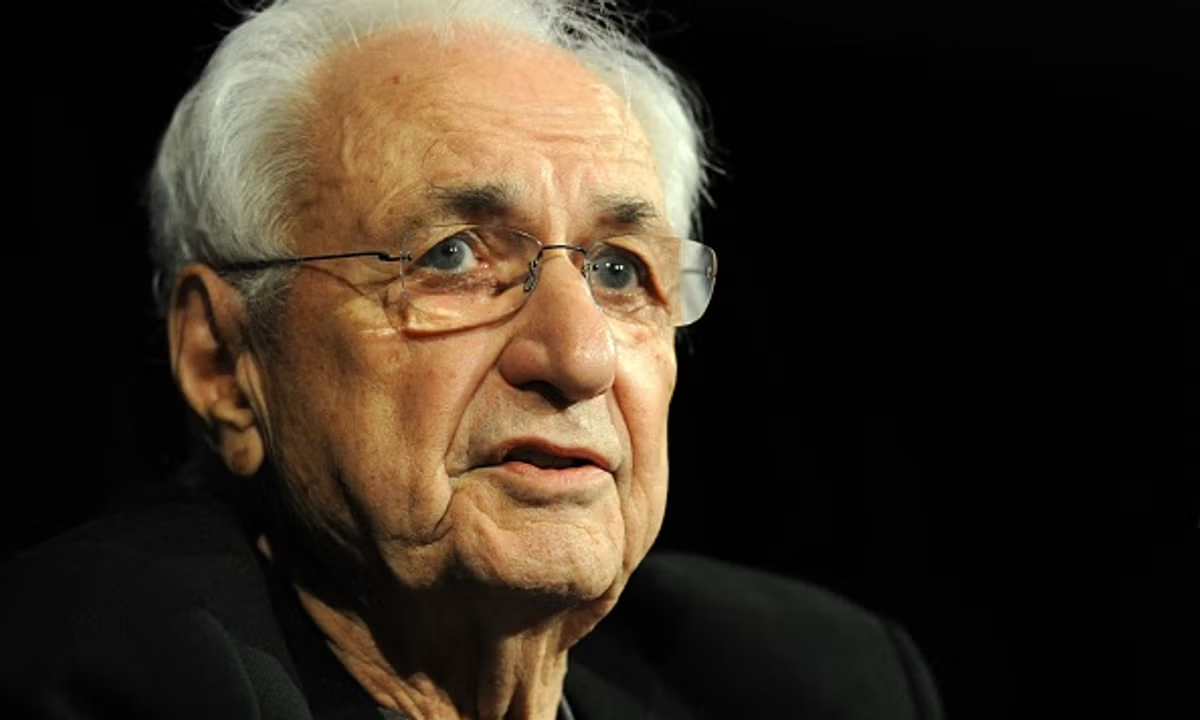
In 1977, as he weighed up his “dumb little house with charm,” the modest pink Dutch-colonial bungalow in Sonta Monica that he had bought with his wife Berta, with its green asphalt shingle roof and row of Lebanon cedars, Frank Gehry decided it was time for a change.
He resolved to build around this suburban house, transforming it into a sculptural labyrinth of readily available materials like corrugated metal, exposed raw plywood, and even chain-link fencing, which interested him because it “was so ubiquitous and because it was so universally hated.” Gehry’s son, Sam, said his friends used to make fun of him because “The Tin House” always looked under construction. “The neighbours got really pissed off”, Gehry later recalled, with a shrug. “The guy across the street with the trailers, and the corrugated metal fence and the cars on the lawn came across one day, and asked ‘What the hell is this all about?’ I said, ‘Look, you’ve got all your stuff here and I’m just relating to you.’” The neighbour responded, increasingly baffled: “‘Yeah, but mine is normal.’” Others called it an “eyesore” and “a Tijuana sausage factory.” It got worse. The neighbour two doors down, a lawyer, went to the city council to try and stop him. Lawsuits were threatened.
Rather than take offence, Gehry was amused; all the huffing and puffing merely confirmed that his unconventional renovation had successfully unsettled his cookie-cutter Californian neighbourhood. The experience reaffirmed his attraction to buildings that appeared unfinished, caught in a state of continual formation rather than fixed or neatly resolved.
For decades now, the Frank and Berta Gehry Residence has been a pilgrimage for design students and architecture aficionados the world over. The disapproving lawyer even built a house and remodelled around the house, copying Gehry’s idea. His unique sensibility, which he sometimes called his “cheapskate” approach, became a defining feature of his work—playful, defiant, and distinctly his own, marking the arrival of a new architectural language.
Gehry, the architect who would go on to be the reluctant poster boy of the post-Modern “deconstructivism” movement, which critics celebrated and decried as a fragmentary style of asymmetrical proportions, died in Santa Monica on 5 December.
Gehry was born Ephraim Goldberg in Toronto in 1929 and, as a teenager, emigrated to Los Angeles where he studied architecture at the University of Southern California (1949–51; 1954) before briefly pursuing city planning at Harvard University (1956–57). He worked for several architectural firms, including Victor Gruen in Los Angeles and André Remondet in Paris, but always sought his own practice and he founded, Frank O. Gehry & Associates, in 1962.
For over 60 years, Gehry pushed against the cold minimalism and formulaic rigidity of Modernist architecture, instead championing buildings that embraced human emotion, movement, and the unexpected. In 1989, Gehry received the Pritzker Architecture Prize, widely considered the highest honour in his field. The Pritzker panel lauded his work as “refreshingly original and totally American,” recognising his ability to marry audacious formal inventiveness with the spirit of architectural renewal. The jury believed that his constructions “could best be likened to Jazz, replete with improvisation and a lively unpredictable spirit”, while juror Ada Louise Huxtable, the first ever winner of the Pulitzer Prize for Criticism, observed that his buildings “lift the spirit with revelations of how the seemingly ordinary can become extraordinary by acts of imagination.”
The Pritzker jury hoped that the award would serve as “encouragement for continuing an extraordinary ‘working in progress’”, a statement that would prove prophetic. It was in the 1990s and beyond that Gehry’s most iconic creations reshaped global skylines. Resembling a shimmering ship tanker, the Guggenheim Museum Bilbao (completed 1997) remains his most celebrated work—a building that seems to fuse the hard rigidity of cold titanium with carefree horizontal lines that suggest sweeping brushstrokes arcing up to Mount Artxanda.
Guggenheim Museum Bilbao © the museum
Gehry was an early pioneer of computer-led design, especially the 3D modelling software CATIA, which was originally designed for the aerospace industry, and he combined these new technologies with a sensitivity to the local environment in his creation of a truly dramatic piece of urban sculpture along the banks of the Nervión River.
The controversial American architect Philip Johnson, who had included Gehry in an exhibition of “deconstructivism” at the Museum of Modern Art in 1988, declared the Guggenheim Bilbao “the greatest building of our time.”
After the museum opened, a media frenzy followed. Not all of it cheered Gehry on. “You know, when Bilbao was presented publicly, there was a candlelight vigil against me”, Gehry explained. “And then there was a thing in a Spanish paper saying, ‘Kill the American Architect.’ That was scary.” But within two years, Gehry’s museum catalysed a new approach to urban renewal: the “Bilbao effect” entered the architectural dictionary, as city planners and billionaire philanthropists looked to adapt the model for their own cities.
According to some estimates, the museum was said to have contributed some $400m to the formerly declining Basque city’s revenues. Almost immediately it became an icon of world architecture, even featuring in the first few moments of The World is Not Enough (1999), as James Bond (Pierce Brosnan) pursues a Swiss banker through the regenerated streets near the seaport. Even Marge Simpson sought to inaugurate a “Springfield effect” by inviting Gehry, who played himself in the cartoon but later felt “haunted” by the experience, to build the middlebrow American town a new concert hall.
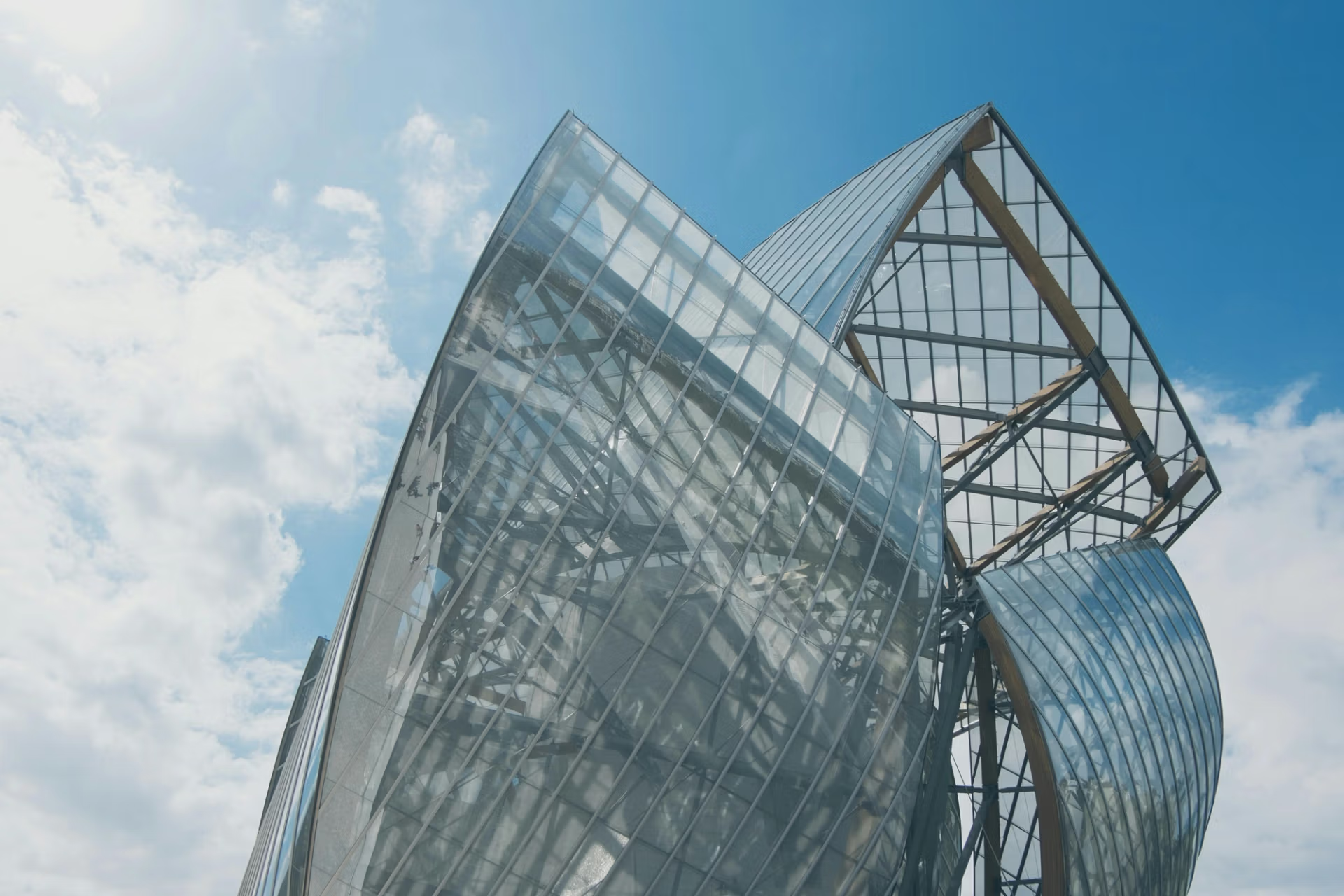
Fondation Louis Vuitton in Paris Image: © Thomas Loizeau
Other masterpieces followed: the sweeping curves of the Walt Disney Concert Hall in Los Angeles (2003), the playful towers of the Dancing House in Prague, the striking residential skyscraper 8 Spruce Street in New York (completed 2011), and the fluid, luminous Fondation Louis Vuitton in Paris (2014), which Gehry characterised as “a cloud of glass—magical, ephemeral, all transparent.”
Bernard Arnault, the chairman of the LVMH group, described the commission as a “personal dream”, while Jean-Paul Claveria, Arnault’s adviser, coronated Gehry as the “King of Paris” when the building opened to the public.
The FLV has gone on to stage some of the most widely celebrated exhibitions of the past two decades, including major retrospectives of Joan Mitchell, Mark Rothko and David Hockney, as well as various commissions by contemporary artists. “Making a painting directly on the walls of Gehry’s creation was a formidable challenge”, reflects the artist Megan Rooney, who made a site-specific installation as part of the group exhibition Fuges in Colour in 2022, “but one that undoubtedly had shaped my understanding of what it means to live inside art.”
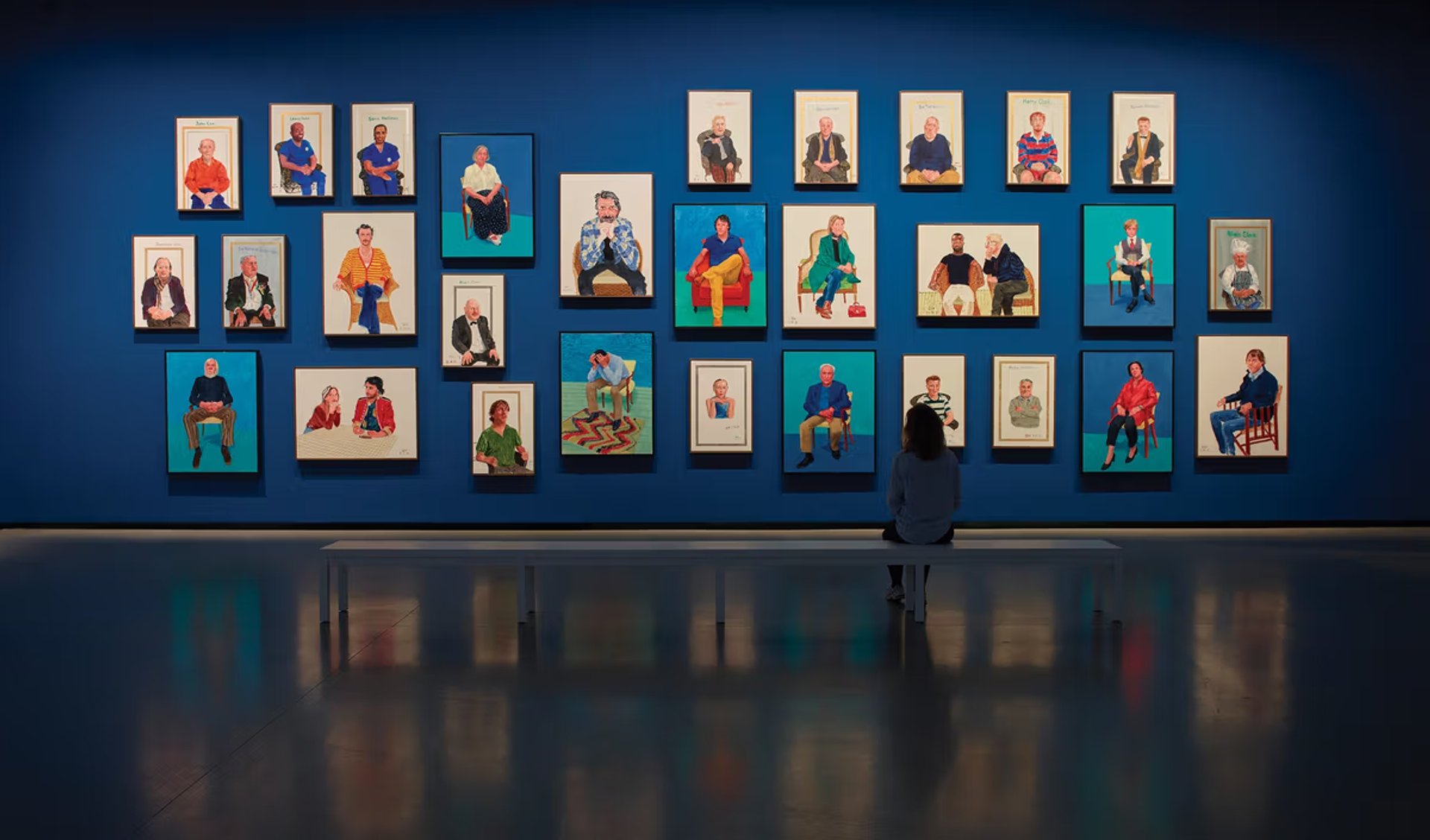
David Hockney at the Fondation Louis Vuitton in Paris © David Hockney/Fondation Louis Vuitton/Marc Domage
Beyond the scale and spectacle of his buildings, Gehry’s brilliance rested on his capacity to rethink what architecture could express—to treat a building as a “sculptural object, a spatial container, a space with light and air,” as he once defined it. His work restored emotion, playfulness, and humour to architecture at a time when many structures were dominated by austerity and function.
Critics sometimes accused him of excess, of prioritising radical aesthetic form for its own sake, or alienating local people with his eccentric designs, or creating “tourist-friendly” spectacle rather than sober civic architecture. Yet more often, his work tended to evoke a sense of openness and joy—buildings animated by the appearance of perpetual construction, as though still searching for their final shape.
“Frank will forever be remembered as a treasured friend, a visionary partner, and a shining star in my life”, reflected Maja Hoffman, President of the Luma Foundation in Arles (completed in 2021), whose stainless steel tower of snaggy steel panels was inspired by local boy Vincent van Gogh’s marks of paint: “He was an extraordinary architect, but more than that, he was a kindred spirit, a beacon of generosity, and a source of inspiration.”
