
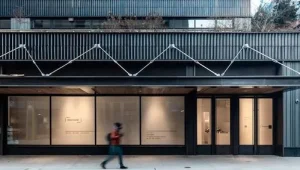






When U.S. Border Patrol agents subdued, disarmed, and then killed nurse Alex Pretti on January 24, it was on the doorstep of the Minneapolis College of Art and Design (MCAD) and just a few blocks from the Minneapolis Institute of Art (MIA). Multiple flash-bang grenades and chemical munitions deployed by federal agents in the aftermath resulted in an eleven-hour shelter-in-place order for the MCAD community, which numbers about 800 students from 13 countries. The school has had one employee apprehended by Border Patrol agents, says president and CEO Gwendolyn Freed.
“We are rooted in the Whittier neighborhood, and there has been heavy ICE enforcement throughout the area,” she told ARTnews in a phone interview recently. The school will go remote through mid-February.
That’s only one example of how the arts community in the Twin Cities has been impacted by Operation Metro Surge, the U.S. Border Patrol’s enormous operation in which some 3,000 federal agents have overwhelmed the city in what is supposedly an immigration enforcement operation but appears intended to terrorize a left-leaning populace. (Minnesota has consistently voted Democratic in past presidential elections; Trump lost the state twice. Democratic governor Tim Walz has been outspoken against the ICE invasion.)
Two American citizens have died at the hands of federal agents in this one city, just in January; ICE agent Jonathan Ross shot legal observer Renee Good, a poet and mother of three, in her car on January 7 as she tried to drive away, and more than one agent—none of whom have been identified—shot Pretti as many as ten times on January 24. (One agent has been seen on video applauding in the moments after Pretti’s killing.) Both victims were observing federal agents at work; both deaths were caught on numerous cell phone videos; in the days and even the moments following their deaths, both victims have been viciously smeared by President Donald Trump, Department of Homeland Security secretary Kristi Noem, U.S. Border Patrol chief Gregory Bovino, and other Republicans, falsely claiming (in the face of contradictory evidence) that they were “domestic terrorists” who attacked federal agents.
The killing of Alex Pretti took place on the doorstep of the Minneapolis College of Art and Design.
Artists have been doing all the things you might expect them to do in such moments: making signs, banners, posters, flyers, buttons, and all the rest. Beyond that, they’re involved in extensive mutual aid programs, getting food and rent assistance to people who have been too terrified to leave their homes for as much as a month. They’ve also been physically intervening, putting their bodies and their lives on the line, trying to stop federal agents from abducting their neighbors.
For the moment, in some ways, “We have put the label of artist to the side,” Xavier Tavera Castro, a Mexican-born artist and assistant professor of art at Carleton College, in Northfield, south of the Twin Cities, told ARTnews.
The city is home to several noted art museums, and some have altered their hours during the crisis: the Walker Art Center closed on Friday, January 23 as part of a state-wide action, and the MIA closed for three days running “for the safety of staff and visitors.” The Minnesota Museum of American Art was the first local institution to announce that it would close on January 23. The only museum in St. Paul, it was founded as an art school in the 1890s. Its staff number only about sixteen. “I have been directly impacted as a Dakota mother,” said executive director Kate Beane (Flanders Santee Sioux Dakota and Muscogee Creek). “I had to take a day off work to make sure I had my children’s documentation, their tribal cards, as Native children indigenous to this area specifically. To go to the grocery store, we have to have all our documentation. When I drive, I keep my children’s birth certificates in the car. It’s a surreal experience.” The irony of Native people being caught up in an immigration dragnet hardly needs to be underlined.


The Minnesota Museum of American Art.
Peter J. Sieger
Polish-born artist Piotr Szyhalski has lived in Minneapolis for over thirty years. For him, the current situation echoes 1980s Communist Poland. With the enormous presence of federal troops, every unfamiliar car and every person walking on the street has to be assessed as a potential threat. “Those are the moments that bring me back to martial law in Poland—the sight of armed, uniformed people roaming the streets and randomly brutalizing folks or taking them who knows where,” he told ARTnews. He can go from calm to panic at a moment’s notice.
“I’m sick of fighting ICE every minute of the day,” said artist Sam Gould, who is on the MCAD faculty. “But that is our present reality here, so I just have to keep going.”
Artists Are Making Banners, Posters, and T Shirts
The denizens of the Minneapolis art world said they have no illusions about exactly why the Trump administration is targeting their city. “All the reasons I fell in love with this city and the people here,” said Szyhalski, “are the same reasons why this regime is trying to destroy the place, and that feels so sad and bewildering.”
Szyhalski has turned his artmaking tools to the purpose of standing up against the administration. Years ago, the artist created what he calls a “public-access letterpress printer.” It happened to be on view at the city’s now-defunct Soap Factory arts venue in 2015, when Minneapolis police, according to eyewitness accounts, arrested, subdued and then shot and killed Jamar Clark, an African-American man. He made it available then for people to print banners for the public protests that ensued, and has put it into use again during Operation Metro Surge. It gives him some sense of stability and purpose to contribute in this way, he says.

Piotr Szyhalski created a large letterpress to create artworks, which has been put to use by demonstrators against ICE’s occupation of Minneapolis. Installation view from his solo show “We Are Working All The Time!” at the Weisman Art Museum in Minneapolis in 2022.
Photo: Rik Sferra for the Weisman Art Museum 2022
Jessica Seamans and Dan Black run Landland, a Minneapolis studio for graphic design, illustration, and screenprinting. Their sales skyrocketed nearly 600 percent week over week, with orders coming in from multiple countries, after they published ads for posters and T shirts with the loon, the state bird, above the slogan “Don’t tread on MN.” That is a riff on the Gadsden flag, which bears the image of a coiled snake and the words “Don’t tread on me” and was designed by South Carolina delegate Christopher Gadsden during the American Revolution as a symbol against tyranny and government overreach. “It’s been coopted by the Right,” Seamans told ARTnews, noting that she often sees it alongside Blue Lives Matter flags. “So for me it seemed like a good moment to try to reclaim it. What’s happening in Minneapolis right now is nothing if not government overreach.”
All proceeds from sales of the merchandise will go to the Immigrant Law Center of Minnesota.

Jessica Seamans of Landland designed a poster that incorporates the state bird and riffs on a classic Revolutionary War-era banner.
At the same time that artists are taking action, there is a widespread feeling of paralysis among many in the community—“both artists I know and also students taking my classes,” said Tavera Castro, the Carleton College assistant professor of art. “There’s the feeling, Why are we doing this? I’m going to be in front of twenty-five kids and tell them, Let’s get excited about photography!, and they’re looking at me like, What the fuck is wrong with you? But I do believe that art is tranformative.” Keep making art, he tells them, “because I believe that if we stop doing it, they win and we lose.”
The Situation Is Worse Than You Might Know
Everyone in the art world is singing from the same hymnal about one thing: The situation on the ground is worse than you probably think, even in view of extensive press coverage and social media exposure.
“It’s very tense,” said Tavera Castro. A local for thirty years, he lives in South Minneapolis, just a few blocks from George Floyd Square and a few blocks from where Renee Good was killed. “It’s highly chaotic. It’s living in constant fear, not only for myself and my family but for neighbors and people we know in all of Minneapolis and St. Paul. The situation is rough.”
Said Beane, “This is an occupation. I’m mixed, and I’m afraid every time my full-blood [Native American] husband goes to the store. The indisciriminate stopping and targeting of people of color based on what they look like has been horrific.”
In the hours after ICE agent Jonathan Ross killed Renee Good in South Minneapolis, impromptu shrines took over three blocks of Portland Avenue.
Gould reports that “I don’t think any video can explain the level of violence and chaos they have brought to the neighborhood. Cars are left idling halfway in the street because they pulled people out of their cars and just left them there. I’ve had multiple neighbors kidnapped. They tried to take a young mom in the neighborhood, but people are putting their bodies between the people and the agents. They’ve been met by tear gas and concussion grenades. People are being beaten. This has been our daily reality for six or seven weeks.”
Asked if he has been in physical contact with ICE agents, Gould replied, “Multiple times.”
Much More Than ‘Minnesota Nice’ Binds the Resistance
When asked what made him fall in love with the community, Szyhalski unspooled a list of traits he sees there: “Care. Empathy. Mutual support. Joy. Understanding of the importance of environment, of culture, of art, of togetherness. Sincerity. As I hear myself say these words, all of them fall short because really it’s the sum of all those things and then some. Those are the things that are difficult to put to words. It’s how you feel, really.”
Just as Szyhalski looks back to the violence of Communist Poland amid the current brutality, Beane, too, brings up historical context. “My family and community were removed from the state after the Dakota War [in 1862] under military guard. Our people, our grandparents, were interned in a concentration camp by Fort Snelling, a mile away from the current detention center. Our family returned as adults, trying to restore connections in our home territory.”

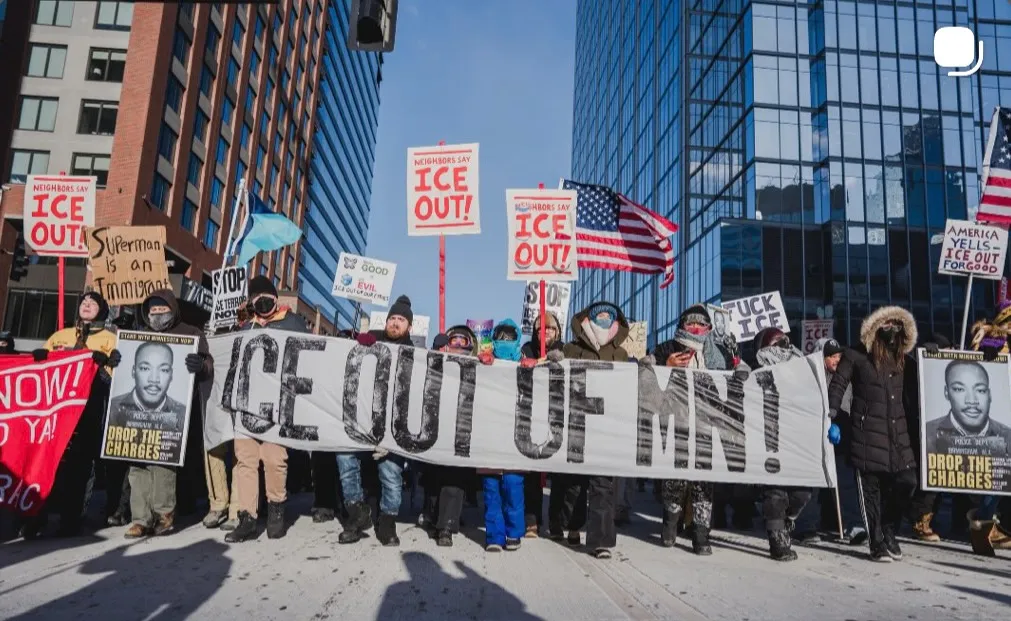
Protesters in Minneapolis carry a banner printed by a press devised by local artist Piotr Szyhalski.
You might think that the expression “Minnesota nice,” which champions the courtesy and politeness (if also passive-aggressiveness) of the local populace might rub someone the wrong way who has been the subject of such discrimination. “As a Dakota person I’ve always been very wary of that term because my people were treated so poorly,” Beane said before adding, “How I interpret ‘Minnesota nice’ has really changed in how I’ve seen my community come together and support one another. I can see the love and the care and sense of compassion that makes this a beautiful place to live and it makes me really proud to be a Minnesotan today and to come from the Indigenous people of this land.”
After noting his close contact with ICE agents, Gould quickly pivoted away from his own acts to the values of the community.
“That’s what this neighborhood is all about,” he said. “This is generational work. This is muscle memory for a lot of people. It’s a really polyglot neighborhood, and that’s one of the reasons we’re a focal point for the Trump Administration: because it is a picture of the inevitable future of America that they so desperately want to erase. It’s a neighborhood of immigrants, multiracial, multiethnic, economically diverse, politically forward-thinking and very supportive, very entangled. It’s not a perfect place but that’s what makes it beautiful.
“They’re literally right outside our door,” he said, “but there’s organizing and cooperation and support among neighbors. Risking your life is unbelievably inspiring, and that’s the energy that keeps people going.”


