





In 1980, an Isamu Noguchi sculpture was abruptly removed from the lobby of the Bank of Tokyo in New York. Some customers had found the looming presence of the suspended 17-foot cube unsettling, and the bank’s leadership shared their unease; one report likened the folded aluminum structure to a guillotine. Once it was removed, Noguchi quipped to a friend, “We are out in the street where we belong.” His tongue-in-cheek remark reflected his conviction: that sculpture belonged not in bank lobbies and stuffy galleries, but out on city streets.
Though widely acclaimed as a sculptor, Noguchi spent five decades working to pull sculpture off its proverbial pedestal, insisting that it be lived in—embedded in plazas, parks, and playgrounds as sites of civic interaction. He wanted his work to serve a social good, and to be enjoyed by the public rather than private collectors. An exhibition at The Noguchi Museum, aptly titled “Noguchi’s New York,” reads as an ode to this utopian vision.
Isamu Noguchi: Red Cube, 1968.
Photo Miguel de Guzmán and Rocío Romero. ©The Noguchi Museum / ARS
Born to a Japanese father and American mother in Los Angeles, Noguchi moved to New York in 1922 at age 17. The city would serve as his on-again, off-again home base for the next six decades. There, he’d keep proposing bold transformations of New York’s urban landscape—projects repeatedly thwarted by government officials and corporate institutions.
“Noguchi’s New York” unfolds like a tour through the artist’s imagination, where successful commissions give way to a far greater number of stalled proposals. Most were abandoned due to bureaucratic resistance or undone by developmental pressures: Ceiling and Waterfall (1956–57), made for 666 Fifth Avenue, was permanently removed in 2020 for the building’s renovation. The exhibition derives much of its force from this sense of unrealized potential, underscoring how Noguchi resisted treating his work as merely decorative. His ambition was to create total environments, in which every element had a relationship to the whole.
Only four of his large-scale projects remain publicly accessible in New York (not counting those in the museum’s garden or within art institutions). Most of these extant projects required navigating the compromises of corporate patronage, leaving Noguchi’s most enduring works in the city under institutional purview: News (1938–40) is a protruding plaque on the exterior of 50 Rockefeller Plaza; Unidentified Object (1979) sits just outside the Metropolitan Museum of Art; and both Sunken Garden (1961–64) at the Chase Manhattan Bank Plaza and Red Cube (1968) in Lower Manhattan persist as fixtures of privately commissioned public space.


Isamu Noguchi: Sunken Garden for Chase Manhattan Bank Plaza, 1960–64.
Photo Arthur Lavine. ©The Noguchi Museum / ARS
The exhibition, then, offers a revealing look not only at Noguchi’s lifelong effort to build a more generous urban world, but also at New York itself—its priorities, its constraints, and its failures of imagination. The curators brought his designs to life via animated films that demonstrate the scope of his vision—speculative playgrounds and futuristic, participatory landscapes gesturing to a New York that might have been.
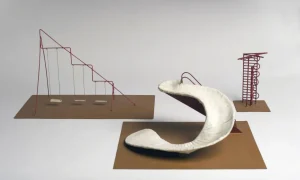
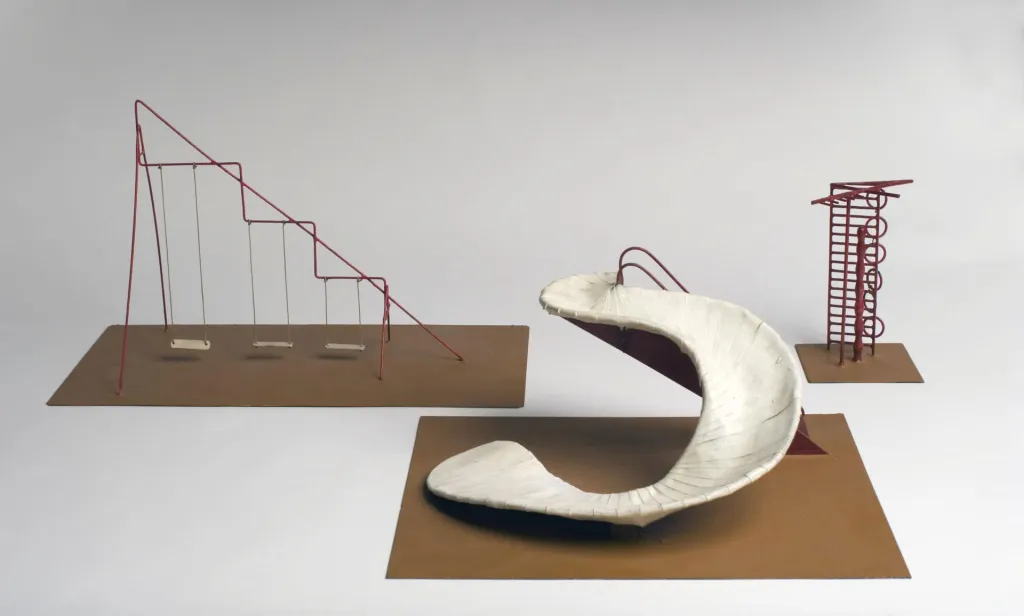
Noguchi’s first public works proposal, Play Mountain, dates to 1933 and was submitted to a New Deal–era program. It reimagined the playground as a triangular pyramid where children could play year-round: sledding down its slopes in winter, sliding into a pool in summer, and moving through interior spaces beneath its surface. He wanted to transform a city block into “a big play object,” integrating indoor and outdoor experience into a single sculptural form. Robert Moses, the city’s parks commissioner, reportedly dismissed the idea outright and laughed Noguchi out of his office. “That was the beginning of my experience with the New York City Parks Department,” Noguchi later recalled. “I have no use for them whatsoever.”
Yet for decades, Noguchi would still pitch the Parks Department—though largely to no avail. In the 1940s, he returned with a compact, 100-square-foot model playscape for Central Park. His Contoured Playground (1941) was to be built entirely from shaped earth—modulated ground, raised mounds, and organic forms comprising a continuous sculpted landscape. He described it as “fall proof,” since there was no equipment to fall from, only ground.

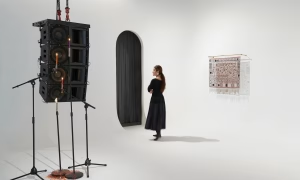
View of the 2026 exhibition “Noguchi’s New York” at the Noguchi Museum.
Photo Nicholas Knight. ©The Noguchi Museum / ARS
Not all of these projects were self-initiated. As Noguchi’s reputation grew, he was approached by architects and patrons. The president of the New York Zoological Society invited him to design open-air playscapes for apes at the Bronx Zoo. Residents of Beekman Place, including the philanthropist Audrey Hess, solicited Noguchi for ideas after construction of the United Nations headquarters displaced their neighborhood playground. He responded to this community with a sculpted terrain, reminiscent of Contoured Playground and resembling a Surrealist landscape. Instead of swing sets or seesaws, Noguchi imagined the land itself forming ridges, steps, and mounds that would invite free-form play. The plan was embraced by the community, but Moses intervened, installing a conventional playground (named after himself) in its place.
Noguchi’s most ambitious New York proposal came in 1961, when he envisioned a sweeping transformation of Riverside Park between 101st and 105th Streets in collaboration with Louis Kahn: a hybrid landscape consisting of a subterranean community center, an amphitheater, a skating rink, and a multifunctional “mountain” with steps and a slide. Models and sketches from 1961 to 1965 show the project’s parameters continually altering in response to public opinion and bureaucratic constraints. The proposal was ultimately derailed by a combination of political turnover and a lawsuit. But across these projects, Noguchi’s goal remained consistent: to carve out space in the city’s concrete jungle for collective play and congregation. He believed steadfastly in sculpture’s interactive and educational potential, especially where children were concerned.
As Noguchi himself noted, his best works were never created. In an overly optimized Manhattan now crowded with commercial storefronts and few public places to congregate or even sit down, it’s hard not to imagine what a Noguchi-built playscape could have made possible.


