

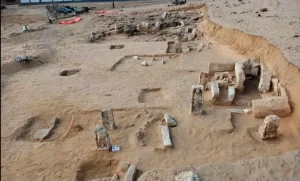






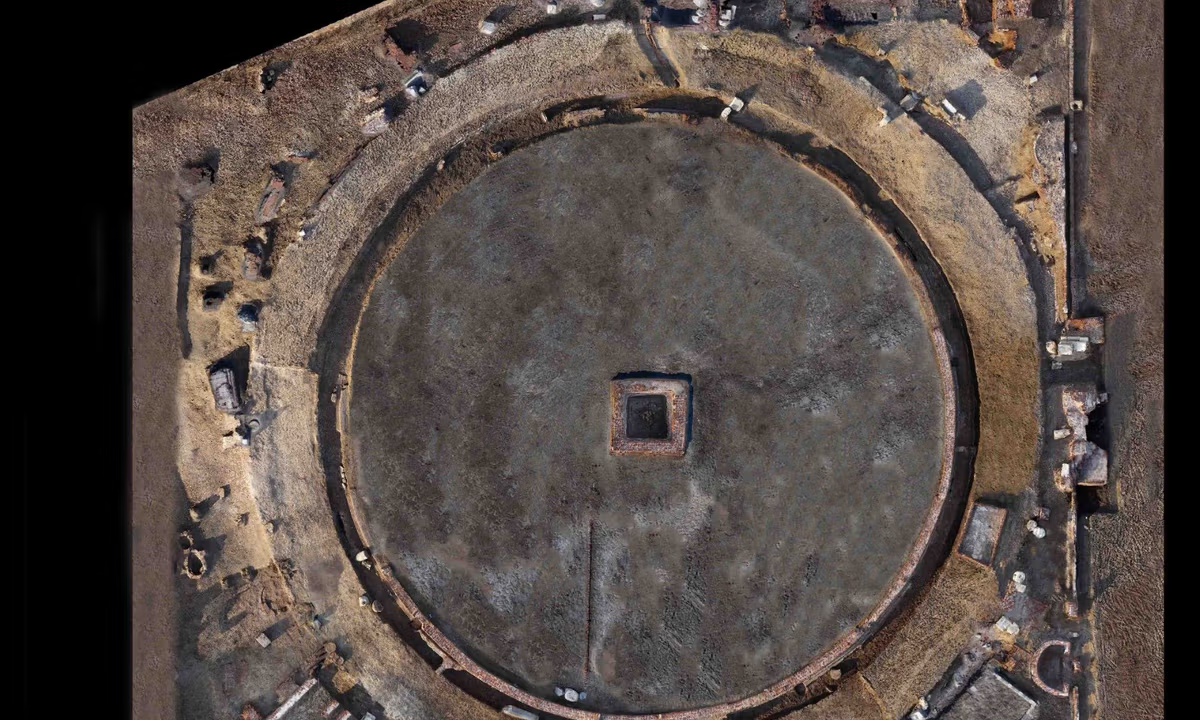
A temple discovered in northern Sinai, Egypt, offers an exceptional window on to “civilised interaction” between Egypt and the rest of the ancient world, the country’s antiquities council has said. An Egyptian archaeological team discovered the complex after six years of excavation at Tell el-Farama, the site of ancient Pelusium.
The temple’s remains comprise a large circular basin, approximately 35m in diameter, which would have been attached to a branch of the Pelusiac Nile (the easternmost branch of the ancient Nile Delta). According to Mohamed Abdel-Badii, the head of the Egyptian Archaeological Sector at the Supreme Council of Antiquities, the river may have been intended to reflect a symbolic connection between the temple and the local god Pelusius. As the god’s name is derived from the Greek word for clay, the Egyptian archaeology team speculates that he may have been a local fertility god, closely linked to the natural forces of the Nile.
Researchers first found evidence of the structure in 2019, unearthing a Greco-Roman building featuring three 60cm-thick circular benches inside it. The team initially believed it was the headquarters for the Senate Council of Pelusium.
However, following further excavations, consultation with experts at Sorbonne University in Paris and in-depth comparison of similar architectural models from the Hellenic and Roman eras outside Egypt, researchers now have an entirely different perception of its function.
Hisham Hussein, the head of Egypt’s Central Department for Maritime Antiquities and Sinai, who supervised the excavation, said in a statement: “Ongoing excavation and comparative studies have completely changed our understanding [of the site]. We now know this was a sacred water installation used in religious rituals, not a political structure.”
The city of Pelusium was founded in around 800BC, on previously submerged land between the seaboard and the marshes of the Nile Delta. It was always a cultural crossroads: over the centuries it served as both a fortress against invaders and a trading hub, with its strategic importance growing significantly by Egypt’s Late Period (around 664–610BC). It later became a Roman provincial capital and subsequently an important centre for Catholic and Eastern Orthodox communities. Today it is around 19 miles southeast of the modern Egyptian city of Port Said.
The walls of the structure are made of brick, suggesting Roman construction Courtesy of the Egyptian Ministry of Tourism and Antiquities
The newly discovered temple was built during the second century and the fact that the circular walls were made of brick indicates it is of Roman construction rather than Egyptian. Pointing out the structure’s “unique architectural design combining ancient Egyptian traditions and the Hellenic and Roman styles”, Hisham Lithi, the secretary general of Egypt’s Supreme Council of Antiquities, describes the site as “an exceptional embodiment of the civilised interaction between Egypt and the ancient world”. The archaeologist Hector Williams, a specialist in Ancient Greek religion and a professor emeritus at the University of British Columbia, says that more research needs to be done to flesh out the theories proffered by the Egyptian team. He points out that while the circular shape and water elements of the supposed temple are unique, in fact “the amalgam of Greek and Egyptian culture has been evident since the late fourth century BC Greek conquest of Egypt by Alexander the Great”.
For example, the Greco-Egyptian deity Serapis was created during the third century BC by the leader Ptolemy I Soter to bridge Greek and Egyptian cultures. Combining aspects of Osiris, Apis, Zeus, Isis and Hades, Serapis was worshipped as a god of fertility, healing and the underworld and “became very popular in the second century BC and spread from Roman Britain to Syria”, Williams tells The Art Newspaper.

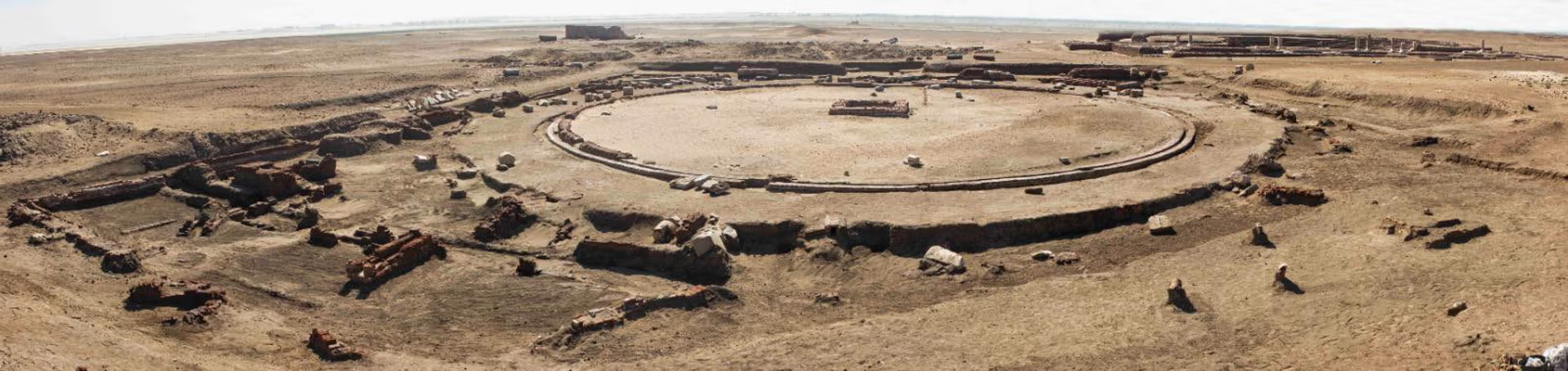
A panoramic view of the archaeological site Courtesy of the Egyptian Ministry of Tourism and Antiquities
The god Pelusius also exists outside of the normal pantheon of Egyptian deities, with his name originating in Greek. The circular basin is “mediated by a square base likely to have been intended to hold a huge statue of the god”, according to a statement from Egypt’s Ministry of Tourism and Antiquities.
The Egyptologist Steve Harvey tells The Art Newspaper that while he finds the round water temple intriguing, “the ascription of it to Pelusius doesn’t yet appear to be certain”. Pelusius is a “shadowy figure”, he says, closely linked in the Greek-Roman philosopher Plutarch’s account of the myth of the Ancient Egyptian gods Isis and Osiris. Learning more about the temple, he says, “might give us more insight into this deity, adding that “if this Roman-era cult structure can be confirmed to be dedicated to the city god Pelusius, it would be a stunning example of the presence of a temple for a deity previously attested only in Classical sources”.
The Egyptian archaeology team hopes to continue their research exploring Pelusium’s interaction with the wider Mediterranean world. Sherif Fathi, the Egyptian Minister of Tourism and Antiquities, said in a statement that the ministry was “keen to continue excavation work and studies on the site”, noting that the entire North Sinai region “still holds many secrets”.


