


As the cultural landscape in Saudi Arabia takes shape at a scale and speed extraordinary even in the wealthy Gulf region, some artists and cultural professionals are questioning the ubiquitous use of Western consultancies in strategy and delivery.
The development of the cultural scene is a major pillar of Crown Prince Mohammed bin Salman’s “Vision 2030” to reform the Saudi state, which is now around five years into implementation. Where other Gulf governments have relied on collaborations with Western entities in developing domestic art scenes—the Louvre Abu Dhabi and Art Basel Qatar, for instance—Saudi Arabia has markedly fewer name-brand partnerships.
But the country does work with an array of both major consulting firms and smaller, more arts-focused shops. According to information collected by The Art Newspaper, those involved over the past five to ten years in the ministry of culture and other Saudi entities include McKinsey, Boston Consulting Group (BCG), Deloitte, Bain & Co., AT Kearney, Barker Langham, Consulum, Brunswick Arts, AEA Consulting, Flint Culture and Havas.
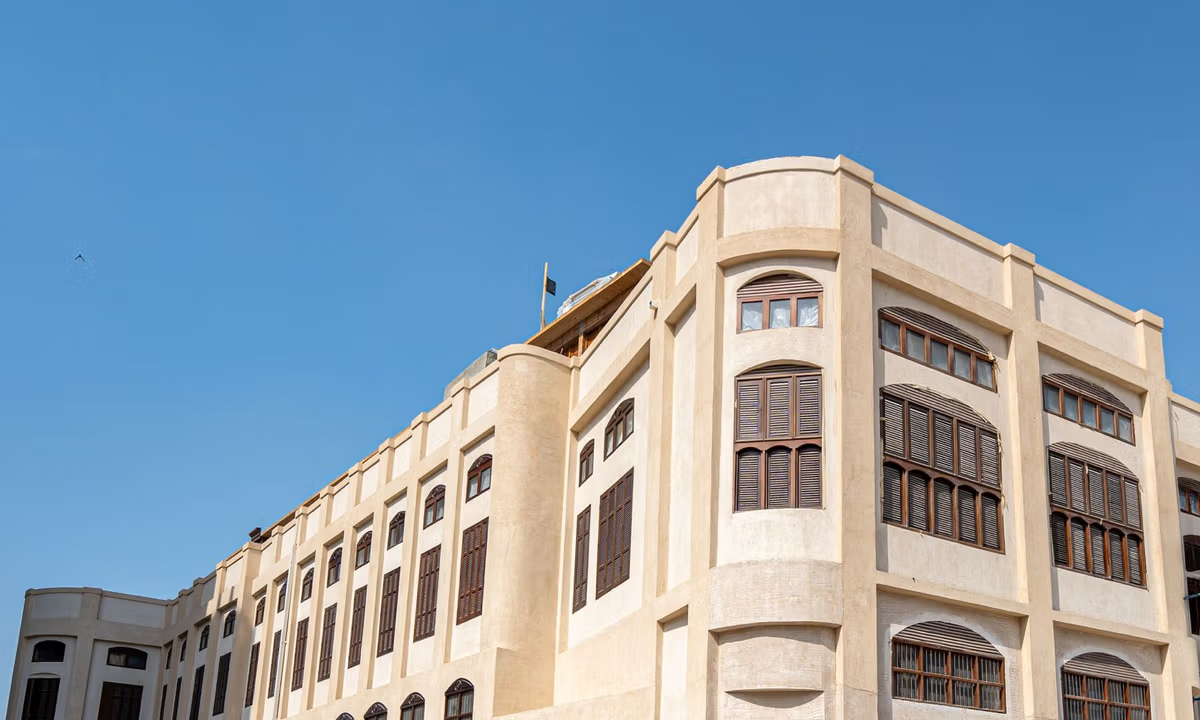
“We’re very much in the background, but we’re in the background with quite a specific purpose,” says Darren Barker of Barker Langham, a leading consultancy in Saudi Arabia, which has worked on projects including the Islamic Arts Biennale, the revitalisation of the historic town of Jeddah, and the development of AlUla in the northwest of the country. “And quite often we’re in the background and we’re shaping the vision for entire new nationally significant projects.”
These firms have provided a large part of the strategy for the ministry of culture’s museums sector, creating a vast and ambitious plan for dozens of new museums over the next ten years—among them, the Red Sea Museum, which opened this month in Jeddah, and the Black Gold Museum, which is soon to open in Riyadh.
Outside consultants and agencies also implement the projects. Curators for major projects and events are typically employed by an agency or a contracting firm; another agency will look after shipping and logistics; another delivers installation; another manages VIP relations; and another looks after press and communications.
“There’s nothing wrong with consultants per se,” says one consultant who has worked in both Saudi Arabia and the UAE, and who declined to be identified by name. “It makes sense for government entities to outsource some specialist knowledge. The problem is the over-reliance: when you have a skeleton staff who are essentially managing short-term consultants.”
Saudi Arabia is by no means alone in contracting consultants to fulfil government services—nor is it unique in facing criticism for it. In a recent report, the UK government called Deloitte’s test-and-trace Covid program a “failure”, and one for which the consultants charged the UK £1m a day. New publications by academics and journalists, such as The Big Con and When McKinsey Came to Town, sketch out the ramifications of the growing sector.
In Saudi Arabia, and in the wider Gulf, consultants are big business. According to a recent analysis by Source Global Research, the consulting market across the Gulf Cooperation Council countries is worth $8bn in 2025, with Saudi Arabia accounting for more than half of that figure. McKinsey and BCG are widely reported to have been the architects of Vision 2030 itself, and McKinsey was also behind the planning for US President Donald Trump’s 2025 visit, according to a government source.
In part this is due to the small number of Saudi, Emirati and Qatari nationals who had the executive training to deliver the enormous projects they have been tasked with. And Saudi Arabia wanted, government insiders say, to hire “the best”, which translated into McKinsey and other Big Four firms. But the revolving door of consultants means a lack of accountability, and their discretion can mask conflicts of interest. This came to a head last February when the Public Investment Fund (PIF), Saudi’s sovereign wealth fund, banned PricewaterhouseCoopers (PWC) for a year due to an ethics dispute.
In addition to these general concerns, artists and cultural professionals see an incompatibility between consultancies and their specific field. “When you treat art and culture as an industrial sector for economic growth, they inevitably get evaluated through industry metrics,” says Sabih Ahmed, a curator and writer who is the co-artistic director of the next Diriyah Contemporary Art Biennale. “It reduces art to parameters that are based on quantitative analysis; ROI’s [returns on investment], scalability, impact studies. Those rarely comply with artistic processes. It’s like building a culture for sport by building stadiums and merchandise strategies, rather than investing in training spaces, playgrounds and parks.”
Ahmed examined the influence of consultants in the book Mass Traffic (2023), written with Dubai/Berlin-based artist Lantian Xie, who also serves on the curatorial team for the Diriyah Biennial. The book outlines the emergence of a “consultancy aesthetic”, as a language of smooth renderings that they argue is shaping a new cultural paradigm.
One reason for this uniformity is the practice of benchmarking, or looking towards what has been done in other contexts and using these as models to follow. One example is the walkable districts that are being built to elevate the quality of living in Saudi’s car-dominated cities. According to a person involved in the project, McKinsey consulted on JAX, the vast cultural district outside Riyadh that hosts artists’ studios, galleries and the Diriyah Biennial Foundation spaces. Other consultancies worked on masterplans for AlUla’s Al Jadidah arts district and the pedestrianised area around Salwa Palace in Diriyah. While these have been successful in attracting visitors, they are also remarkably non-specific, with a mix of catering and retail options similar to what is found elsewhere in the Gulf.
The ancient region of AlUla is being developed into a tourist destination by the kingdom of Saudi Arabia © Richard Hargas
“External expertise can be very valuable,” says the artist Ahmed Mater, “but cultural identity grows best when it is shaped closely by those who live its realities daily. The most exciting art scenes emerge when local voices and global experience meet in balance.”
Mater’s criticism is notable because of his stature; he came to prominence as part of the arts organisation Edge of Arabia in the 2000s and was a senior figure in the Jeddah art scene of the 2010s. In 2017, when Crown Prince Mohammed bin Salman launched the Misk Art Foundation, he tapped Mater to lead it. More than other artists or cultural figures at the time, Mater was aware of what was going on within the government.
In an interview in Jeddah back in 2018, he told this journalist that the coverage of Saudi’s art scene was missing the real story: the disproportionate presence of consultants. In recent years, Mater has further explored the global implications of consultancies in an evolving research project called KPI.art. It considers, he says, how corporate concepts such as optimisation, measurement, and invisible infrastructures shape and control contemporary life, translating culture into value.
“When I was at Misk, I was always asked about my KPIs,” Mater says. KPIs are consultant-speak for “key performance indicators”, meaning goals or targets. “But as an artist, I know the best part of culture isn’t quantifiable.”
Another widespread complaint is that consultants actually work against capacity-building, or the idea of training a new generation of a workforce. Instead, government entities cycle through firms, who start anew on each subsequent project.
“There is no institutional memory,” says one curator who has worked on a Saudi government project. “The consultants are all incredibly competent people, and they can do the job incredibly well. But when the event is over, they leave, and the knowledge for the next time needs to be created from scratch.”
Barker at Barker Langham emphasises, however, that many of their projects are long-term, and that they have repeat clients. His firm worked for 18 years on the Qasr Al Hosn project, a heritage and cultural site in the centre of Abu Dhabi, and for ten years on the National Museum of Qatar. (They are currently at work on large-scale projects in Saudi Arabia but are not at liberty to disclose specifics.) They see their role as partners rather than consultants and draw a distinction between corporate consultancies and the smaller firms—such as theirs, or Consulum, Brunswick Arts, and Flint—that have grown into the niche of Gulf cultural consultants.
“We are really vested in to everything that we do,” says Lesley Gray, the head curator for Barker Langham. “Someone who’s more corporate could potentially parachute in for a project and do their bit and leave, but we stick around. We want to see the success of all of these things that we’re doing together.”
At this point in the evolution of the Saudi art scene, consultants have become part of the multi-ethnic picture, playing a role of strategy and delivery that is needed for any country with ambitious designs. For the Islamic Arts Biennale, Barker Langham’s team supported the named curators by researching the artefacts that were to be shown, selecting works, sourcing them, negotiating partnerships and loans, commissioning and editing the catalogue, and writing the labels and wall text. The scope of work was tantamount to being an integral part of the project; or, viewed the other way, it is an enormous amount of responsibility to delegate away from the biennial foundation.
And however outstanding the results of these partnerships might be—the Islamic Arts Biennial was both a critical and popular success—critics of consultants focus on structural concerns that emerge when cultural and government policy is so heavily outsourced.
“This is not just about the Gulf, it’s global,” Ahmed says. “It is reminiscent of the East India Company, when mercantile interests came perilously close to steering governance. We are witnessing the world over a large-scale outsourcing of institutional capacities in favour of private, commercial expertise that has little or no skin in the game.”
