






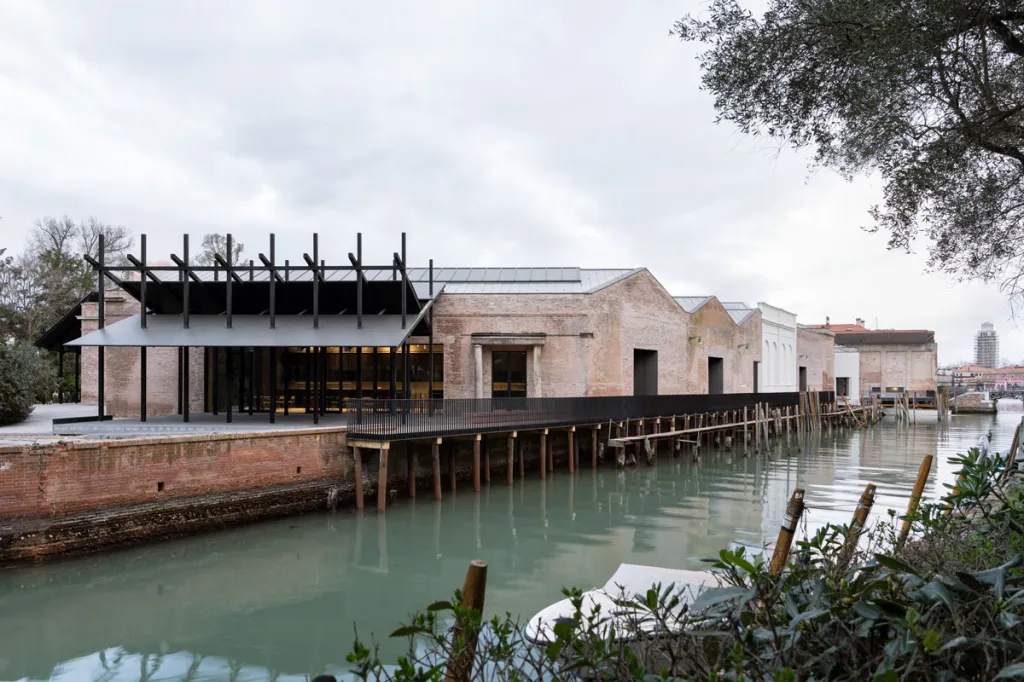
The Central Pavilion of the Venice Biennale, located within the Giardini della Biennale, has undergone a complete renovation ahead of the opening of the show’s 2026 edition in May.
The total budget for the renovation was €31 million ($36 million); public funding was supplied by the the Italian Ministry of Culture’s National Plan for Complementary Investments of the National Recovery and Resilience Plan (PNRR). The project is also part of the Culture Ministry’s “Great Cultural Heritage Attractors” program, which includes the enhancement of 22 sites around Venice that are connected to the Biennale.
Construction for the renovation, which has introduced a stark contrast between white walls and black ceilings and passageways, began in December 2024 and was completed in 16 months “within tight deadlines and in compliance with the milestones established by the National Complementary Plan to the PNRR,” according to a release.
The renovation was overseen by architect Arianna Laurenzi with engineer Cristiano Frizzele, both of whom work for the Venice Biennale. The Biennale also tapped several other firms to consult on the renovation, including Massimiliano and Maurizio Milan of BuroMilan, who served as the lead firm and focused on structural design, safety coordination, sustainability, and general contract administration. Independent architect Fabio Fumagalli and Labics’s Maria Claudia Clemente and Francesco Isidori worked on the architectural design and art direction, while Stefano Olivari did the landscape design.
The Central Pavilion was built between 1894 and 1895, ahead of the opening of the first edition in 1895. Over the ensuing decades, it has been undergone a number of architectural interventions and renovations, including a modification of the façade by Guido Cirilli in 1914. From 1932 to 1999, the Central Pavilion was the site of the Italian Pavilion, until the introduction of the International Exhibition with Harald Szeemann as its first curator. It was known as the Palazzo Pro Arte until its name change to the Central Pavilion between 2009 and 2011.
“The intervention goes beyond the logic of preservation-restoration to aim at a critical reinvention of the Pavilion,” a release explains about the latest renovation of the Central Pavilion. “Relying on a stratigraphic approach to the building’s history, the project enhanced the serial and essential nature of the architecture, preserving the memory of the different phases of construction but stripping it of all accretions and incongruous elements.”
The “Sala grande,” or Main Hall, of the Central Pavilion, Giardini della Biennale, Venice.
Photo Marco Cappelletti, Marco Cappelletti Studio/Courtesy La Biennale di Venezia
A major feature of the renovation is the streamlining of the interior, as the technical systems of the building are now all hidden behind walls or ceilings, “freeing the spaces of any obstructions,” per a release. New skylights have been added to give the different exhibition spaces uniform natural lighting, as well as the introduction of motorized shades, which can create a complete blackout in certain spaces. “The space remains bare, essential, flexible and efficient, where architectural quality prevails and sustainability is integrated into every element,” the release states.
Additionally, the renovation has seen the addition of two outdoor structures called altane that are attached to the pavilion’s café and multipurpose space and which are meant to “connect the Pavilion to the landscape of the Giardini, without competing with the existing masonry mass,” according to a release.
This year’s main exhibition at the Venice Biennale is curated by the late Koyo Kouoh, who died weeks before the title of her Biennale, “In Minor Keys,” was revealed last May. The Biennale is now being realized by a set of advisers and will feature 111 artists. Installation for Kouoh’s exhibition will now begin in the Central Pavilion ahead of the May opening.
In a text about the theme, Kouoh wrote, “The minor keys refuse orchestral bombast and goose-step military marches and come alive in the quiet tones, the lower frequencies, the hums, the consolations of poetry, all portals of improvisation to the elsewhere and the otherwise. The minor keys ask for listening that calls on the emotions and sustains them in return.”


