








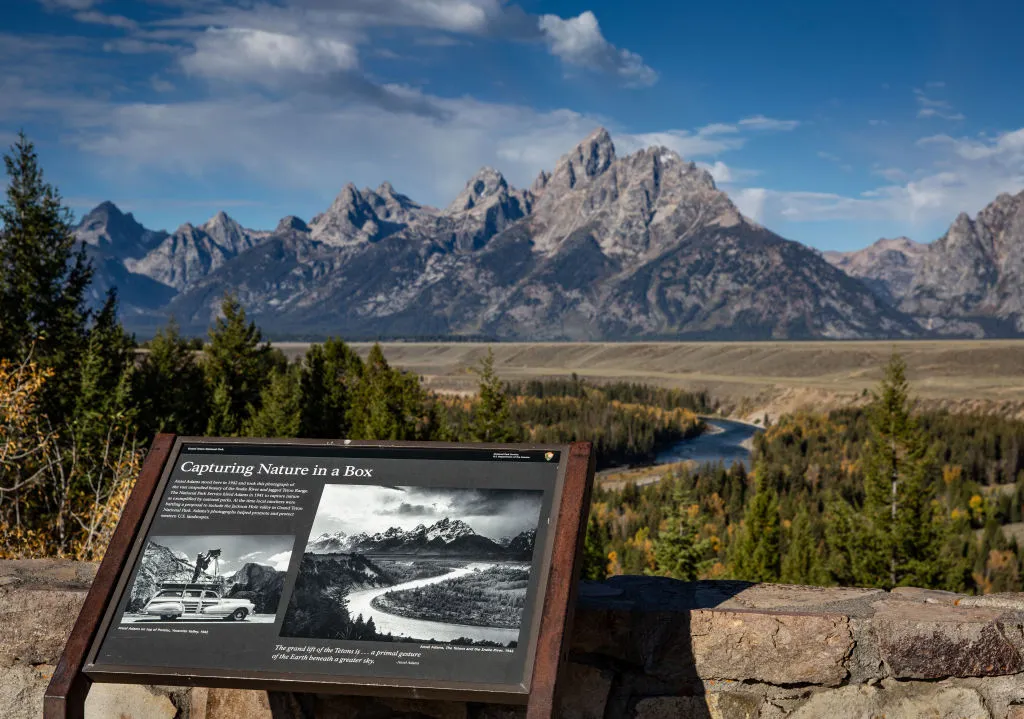
Six national nonprofit organizations devoted to the national parks, history, and science have sued the Trump administration over its censoring of signage it disapproves of in national parks across the U.S.
The plaintiffs in the sixty-page suit, filed Tuesday in U.S. District Court of Masachusetts, include the National Parks Conservation Association; the American Association for State and Local History; the Association of National Park Rangers; the Coalition to Protect America’s National Parks; the Society for Experiential Graphic Design; and the Union of Concerned Scientists. The suit names as defendants the U.S. Department of the Interior, Interior Secretary Doug Burgum, and Jessica Bowron, the comptroller of the National Park Service.
The suit accuses the Trump administration of “a sustained campaign to erase history and undermine science,” so that the parks no longer do what is required by the law that established them, including “reflect different cultural backgrounds, ages, education, gender, abilities, ethnicity, and needs” and “reflect current scientific and academic research, content, methods, and audience analysis.”
Among the instances the suit names: the National Park Service, on orders of the Secretary of the Interior, removed an exhibit in Philadelphia’s Independence National Historical Park that discusses the legacy of people enslaved by George Washington, the first U.S. president; removed information about climate change from a display at Fort Sumter, in South Carolina’s Charleston Harbor, which the suit describes as “one of the country’s most environmentally endangered parks”; and erased historical and scientific information at “countlesss” national parks throughout the country.
Trump’s March 2025 executive order 14253, “Restoring Truth and Sanity to American History,” dictated the removal of “monuments, memorials, statues, markers or similar properties” that, in the suit’s words, “do not adopt the administration’s preferred perspective.” Trump’s executive order claims that “over the past decade, Americans have witnessed a concerted and widespread effort to rewrite our Nation’s history, replacing objective facts with a distorted narrative driven by ideology rather than truth,” lambasting a “revisionist movement” and promising to “remind Americans of our extraordinary heritage, consistent progress toward becoming a more perfect Union, and unmatched record of advancing liberty, prosperity, and human flourishing.”
The Secretary’s order required that QR codes be included in park signage that, in part, invited visitors to report “any signs or other information that are negative about either past or living Americans.” This effort backfired, says the suit, pointing out that public comments “overwhelmingly denounced efforts to wash away discussion of history and science.” A National Public Radio review of dozens of comments found that none indicated needed changes. The Sierra Club similarly found that public comments “overwhelmingly reject the Trump administration’s attempt to sanitize history on public lands.”
All the same, the Parks Service has found that starting in summer 2025 and as of this month, hundreds of interpretive signs and other materials were identified for removal or actually removed. Among the early removals was one at New York’s Jamaica Bay Wildlife Refuge that mentioned aspects of history “we hope never to repeat—like slavery, massacres of Indians, or holding Japanese Americans in wartime camps.” Displays concerning the contributions of historically marginalized people, outlining atrocities against certain communities, and explaining scientific developments have been scrapped. Text explaining climate change has been stripped from Glacier National Park in Montana. Displays about harms to the land in Grand Canyon National Park by early settlers, cattle ranchers, and tourists were removed. An image of a visitor holding a Pride flag was stripped from Sunset Crater Volcano National Monument in Arizona.
Some of the removals have earned headlines all on their own, including that of the photo The Scourged Back (1863), showing Peter Gordon, who was enslaved in Louisiana, with scars covering his back. Numerous other references to slavery and slave uprisings were flagged, as was a sign at Manassas National Battlefield in Virginia that criticized the Confederate “Lost Cause” ideology. Because it mentions “equity,” staffers flagged the permanent exhibit about the titular landmark civil rights decision at Brown v. Board of Education National Historical Park in Kansas.
At Great Smoky Mountains National Park, into the bin went a display explaining how fossil fuels cause air pollution. At Everglades National Park, one offending sign described the impact of industrialization on the wetland ecosystem.
These removals, the suit argues, “ignore Congress’s mandate for how the parks must be managed; erase the history of countless people and communities from public spaces; limit the availability of scientific information relevant to ensuring the long-term preservation of the parks themselves; and impair the mission of the National Park Service to preserve the parks ‘for the enjoyment, education, and inspiration of this and future generations.’”
The National Parks Service calls the parks “America’s largest classroom,” and has acknowledged the need to share “an accurate and comprehensive history,” says the suit, including “the good, the bad, the ugly, and everything in between.” The Park Service’s policies require that the parks demonstrate the principles of science and challenge visitors, adjust to “an increasingly multiracial, multiethnic, and multicultural society,” and educate visitors about climate change.
At the same time that the administration has demanded removal of disparaging information on historical figures, the suit points out, the administration has also felt free to disparage people in national park sites, noting that the Trump has appended signage to a White House display that identifies Joe Biden as “the worst President in American History.”
The Park Service employs about 13,000 permanent workers and thousands more temporary and seasonal employees working at 433 park sites and helping to manage more than 150 related areas. The parks see some 332 million visitors a year.
The plaintiffs ask the court to vacate an order by the Secretary of the Interior that demands compliance with Trump’s executive order; require the Interior Department to stop its removal of historical and scientific information; and restore what has been removed. It argues that the administration’s acts undermine the nonprofits’ missions, deprive their members of free expression, degrade experiences of the national parks, and heap unnecessary work on their staff.


