








South Africa’s pavilion will remain empty at the 2026 Venice Biennale, the country’s culture ministry announced on Friday. This will be South Africa’s first absence at the exhibition since 2011. The news comes after a legal and political dispute over the ministry’s cancellation of their planned presentation of artist Gabrielle Goliath’s Elegy (2019-ongoing) last month. The 61st Venice Biennale will take place from May 9th through November 22nd.
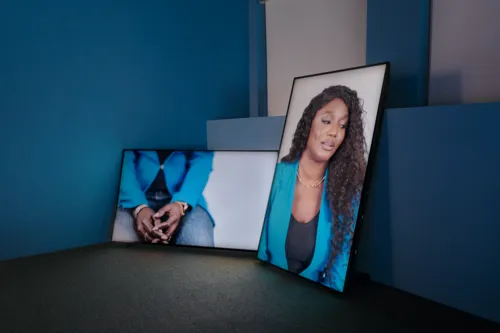
Goliath, a South African multimedia artist, had been unanimously selected by an independent committee to represent her country at the Biennale alongside curator Ingrid Masondo. She had intended to stage an updated iteration of her decade-long Elegy project, a performance and video series that honors women, gay, and trans people who have been victims of violent killings. The new iteration at Venice was to include a tribute to Hiba Abu Nada, a Palestinian poet killed in an Israeli airstrike, as well as the tens of thousands of women and children who have died in Gaza since October 2023.
On December 22nd of last year, South Africa’s culture minister Gayton McKenzie wrote a letter to Art Periodic, the nonprofit responsible for organizing the pavilion, requesting a change in direction. He threatened to withdraw funding for the project, which according to Artnet, he described as “highly divisive in nature and relates to an ongoing international conflict that is widely polarizing.” When Goliath refused to alter the work, McKenzie sent another letter on January 2nd informing Art Periodic he had canceled the pavilion, and terminated their contract with the ministry.
In response, the selection committee issued a statement calling the move by McKenzie “censorship,” while Goliath and Masondo called his actions “an abuse of power.” In a release of his own, McKenzie asserted he had the right to refuse the committee’s recommendation.
On January 22nd, the artist filed an urgent lawsuit alleging that McKenzie’s intervention was unconstitutional, and asked the court to overturn the minister’s decision. On February 19th, one day after the Biennale’s deadline to submit final plans, her lawsuit was dismissed by the country’s high court without an official reason stated. In response, Goliath told The Art Newspaper that “we will be appealing the court’s decision. This is crucial, not just for our chances of presenting Elegy as the 2026 South African pavilion exhibition, but on account of the dangerous precedent we believe this ruling sets for the broader arts community in South Africa.”
While Goliath and Masondo were launching their appeal, it was reported that the culture ministry attempted to find a replacement to send to Venice. On Friday, a spokeswoman for the ministry confirmed with the New York Times that “there will not be a South African-government-backed exhibition” at the Biennale this year.
In January, the artist’s studio said that she would finish this latest version of Elegy, and had planned to film the tribute with 16 female opera singers. Last week, she told The Art Newspaper that she would consider showing Elegy in a different space at the Biennale, saying “what Elegy demands are conditions of care; it is not contingent on any particular platform. I have presented it in galleries, museums, churches, halls—in South Africa and across the world. If Ingrid and I can convene a space in Venice to grieve, refuse and imagine the world differently, we will do so.”


