







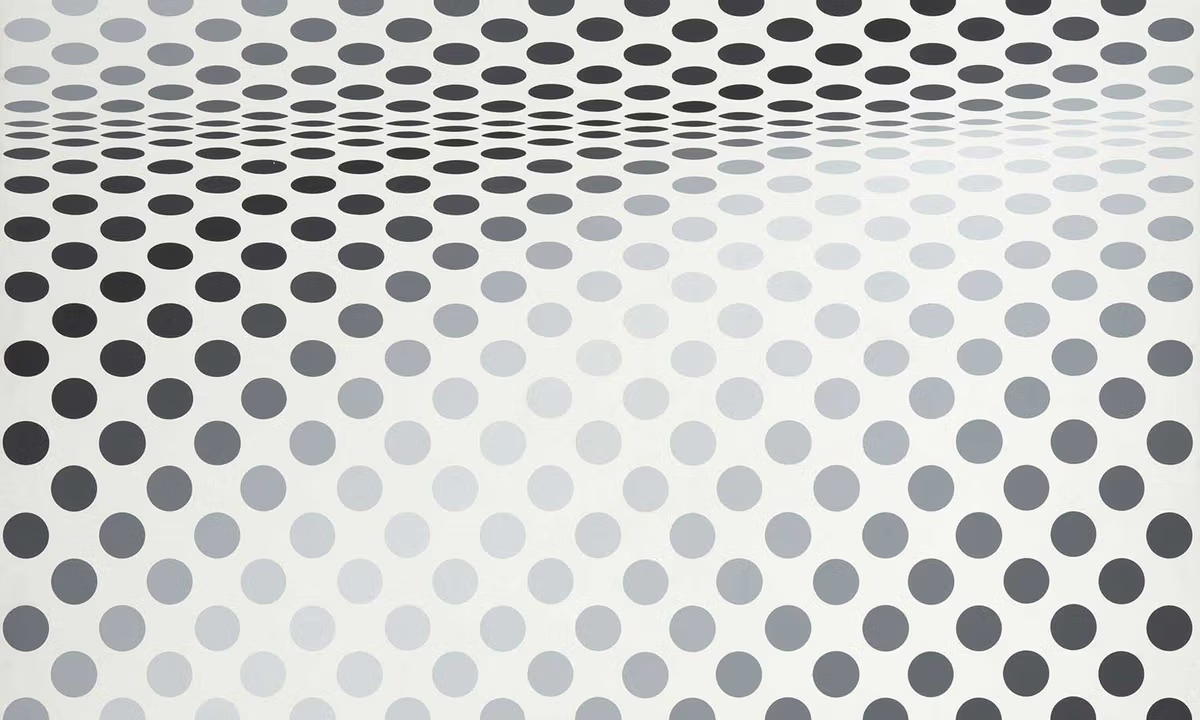
A landmark of Op art, Bridget Riley’s 1964 painting Hesitate has been cleaned for the first time. A conservation team at London’s Tate Britain used a pioneering treatment developed as part of Greenart, a three-year international research programme focused on finding safe, green cleaning solutions for cultural heritage.
Like Fall (1963), another Riley painting which Tate cleaned last year as part of the same project, Hesitate—a canvas of grey spots on a white background that gives the illusion of a wave rippling across it—had been flagged for conservation work for some time. Until now, cleaning was limited to dust removal because of concerns about the impact of traditional “swab rolling” (where a surface is cleaned using a solvent such as purified water, applied via a cotton swab), on the black-and-white house paints favoured by Riley during the early to mid-1960s, when she made some of her most distinctive and best-loved works.
The cleaning was carried out using hydrogels developed by Greenart’s project co-ordinator, the Centre for Colloid and Surface Science, a Florence-based research consortium with whom Tate had previously collaborated on a similar project called Nanorestart.
For Tate, Greenart offered a unique opportunity to research the mid-20th century polyvinyl acetate house paints used by Riley and others including Sidney Nolan, Kenneth Noland and Nelson Kenny. “We’ve spent a lot of time on acrylics and modern oil paints, but not so much on polyvinyl acetate. It’s quite heavily represented in our painting and sculpture collection”, says Tate’s principal conservation scientist, Bronwyn Ormsby.
Highly sensitive surfaces
Unglazed, unframed and unvarnished, Riley’s matt house paints are especially vulnerable to soiling, which causes yellowing and greying, but the surfaces are highly sensitive to pressure. Swab rolling would risk burnishing the surface, leaving a matt paint surface with a gloss. But doing nothing was also not a safe alternative, since over time the dirt is “imbibed”, making removal increasingly difficult. Limiting display time is similarly impractical for such popular paintings.
Hydrogels, which Ormsby says resemble “uncooked squid without the smell”, eliminate the need for mechanical action, holding a liquid agent in a semi-solid structure. “They’re laid down, they’re slightly patted to remove air bubbles, very lightly, and left for a period of time that we’ve determined is optimal. And then they’re removed gently. So there’s none of that hand pressure”, Ormsby says.
Hydrogels emerged as a revelatory new material in the Nanorestart programme, which ran from 2015 to 2018. Tate’s Whaam! (1963), by Roy Lichtenstein, was cleaned for the first time using Peggy 6 (polyvinyl alcohol-based polymeric hydrogel). “Through that project, we’ve developed a methodology about how to test these gels, how to ensure that they’re safe to apply to works of art,” Ormsby says.
Funded through Horizon Europe, the European Union’s funding framework for research and innovation, Greenart was part of a larger project aimed at dramatically improving the green credentials of the conservation industry. Tate’s place, which included the allocation of two conservators, was funded by UK Research and Innovation.
Peggy 6 set a high benchmark for Tate’s rigorous testing phase, the results of which determined whether and exactly how Fall, and separately Hesitate, would be cleaned. To be considered for use on the paintings, the product had to evenly remove the soil layer, without disturbing pencil lines or any other artist’s marks, or causing unwanted changes to the painting surface.
“We found a gel that worked better than the Peggy 6, which was amazing”, says the lead painting conservator Annette King, who worked with Katey Twitchett-Young on testing and fine-tuning the application method before taking the successful Greenart PVA-SU2 product to Riley’s paintings.
Microscopic analysis
Their preparatory work involved accurate mock-ups of both paintings, created using information from chemical and microscopic analysis of the paint layers, archived documents and interviews. Riley herself visited in 2024 to speak to the team, and an advisory committee was set up to bring in outside expertise, including Philip Young of the Bridget Riley Foundation, and Julia Nagle, a private conservator currently assigned to the exhibition Bridget Riley: Learning to See at Turner Contemporary (until 4 May). The mock-ups were light-aged and artificially soiled to match the originals.
Hydrogels were laid across the work before being removed gently
© Tate
Though Peggy 6 is biodegradable, the Greenart gels are cleaner still. “Polyvinyl alcohol is the main polymer, but they are—the word that the manufacturers use is ‘decorated’—with these fairly short-chain diacids, which come from plant sources. I think what they’re doing is gradually replacing the more synthetic polymer aspect,” Ormsby says.
The gels can be reused several times, as part of the manufacturer’s close attention to life-cycle analysis, which looks at products from the sourcing of ingredients all the way through to production, to use and then to disposal.
The sustainability of the products is tested separately, as part of a diverse and collaborative model that not only encourages institutions like Tate to work alongside partners including the Los Angeles County Museum of Art and the Peggy Guggenheim Collection, but aims to share technologies across industries. The Japanese cosmetic company Shiseido joined Greenart in 2024, a collaboration that seems likely to offer exactly the sort of reassurance of gentle cleaning that custodians of cultural heritage expect.
It is not yet clear when Hesitate will go back on display at Tate Britain. Fall is on display until 7 June.