







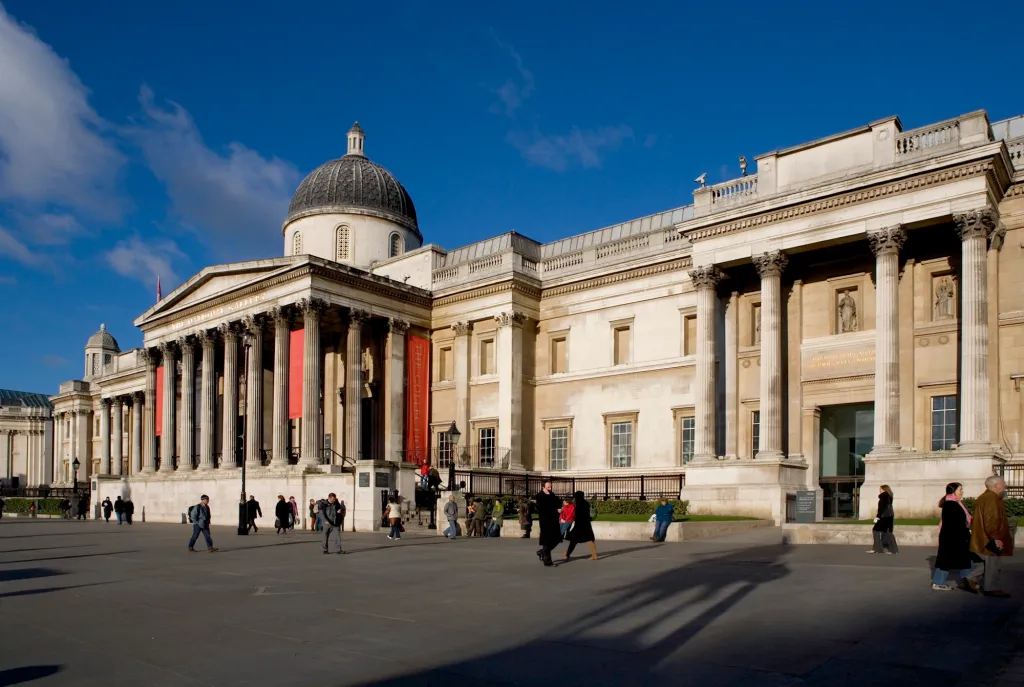
The National Gallery in London will institute cuts to staff and programming in the face of a deficit that would, in the absence of “decisive remedial action,” grow by 2027 to £8.2 million ($11.2 million), says the institution in an emailed statement.
The museum says that “in the present global landscape and with the cost-of-living crisis, like many other institutions, we face increasing competition for people’s time and share of wallet.”
“We have been working hard for a long time trying to mitigate the financial pressures we are facing in our day-to-day, business as usual,” says the statement from a spokersperson. “However, due to many widely reported circumstances which are beyond our control, such as rises in operational costs and commercial pressures, we have now reached a point where we must make difficult and painful decisions.”
The museum has instituted a “voluntary exit scheme” for all staff as well as ceasing “several of [its] activities,” whose costs can no longer be justified. It did not identify which activities. If the voluntary departures do not have a sufficient savings, layoffs are possible, according to a report in the Art Newspaper, which notes that the museum currently faces a deficit of about £2 million ($2.7 million).
The news comes just two months after the museum announced a $1 billion fundraising campaign for its new “Project Domani,” to collect art of the 20th and 21st centuries and build a new wing to house those acquisitions. At that time, about half the goal had been reached. Those funds are restricted to the purpose for which they were raised, notes the museum in its statement.
Last May, the museum celebrated its 200th anniversary by opening a revamped Sainsbury Wing after a three-year, $113 million project. In 2024-2025, the gallery had welcomed some 3.2 million visitors, placing it among the world’s most-visited museums. It also mounted a yearlong, £95 million ($129.4 million) festival, NG200, funds for which were also restricted to that program.
“We know this is hard, but we all must understand that things have changed in the world, and we must respond to them,” says the museum’s statement. “We need to make tough decisions now to futureproof the Gallery for the years ahead.”


