




While the marquee November auctions generated a robust—and somewhat surprising—$2.2 billion total, most market watchers agreed that the real test would be Miami. The week kicked off with NADA and Untitled Art once again opening a day before Art Basel Miami Beach, both explicitly courting the mid-level and emerging tiers of the market. They offered a more accessible entry point and genuine space for discovery—as well as the clearest place to assess the market’s true health.
The openings for both fairs were packed. The atmosphere was vibrant and sales were steady—never reaching the feverish sold-out-by-noon peaks of earlier eras, but reassuring enough to suggest that this end of the market may finally be recovering, albeit at a different pace and volume than in the boom years.
“It isn’t the same frenzy as a few years ago, but it is much stronger than earlier this year,” art advisor Adam Green told ARTnews, noting that the energy at Tuesday’s openings further fueled a sense of confidence that has been building since strong performances at Frieze London and Art Basel Paris in October.
“The market confidence is there from what I could see. Many of the things we inquired about today were sold,” advisor Maria Brito told ARTnews, adding that her clients were actively buying during the previews. Several collectors interviewed echoed that sentiment, pointing to the high energy at both satellite fairs. Several galleries, meanwhile, said they had works sold or on hold early in the day. The optimism was measured, but there was real action.
The audience so far, however, appeared mostly American and local, with noticeably fewer Europeans and almost no Asian buyers. At the same time, Miami’s transformation into a second-home hub for U.S. and Latin American collectors has meant that Miami Art Week increasingly feels like a seasonal migration of a new collecting community—rather than a one-off pilgrimage—one that could more sustainably support its ever-expanding ecosystem.
This year, however, the gravitational center leaned more towards the beach, with Untitled Art offering a more international pull and broader conceptual range. Several galleries that traditionally anchored NADA shifted to the tent, as ARTnews reported in August. The fair’s 157 exhibitors represent a slight decline from 2024’s 171, but it retains a strong international focus, with galleries from more than 70 cities. Untitled is also sporting a redesigned layout that draws clearer attention to its themed sectors, as its new executive director, Clara Andrade, continues to reimagine the fair as both a platform for galleries and a wider ecosystem.
Among those who switched from NADA, Hair+Nails (Minneapolis/New York) sold out its solo presentation of Emma Baetrez ($5,000–$9,000), while Tribeca’s Swivel Gallery paired Edgar Orlaineta’s playful compositions with Ioanna Liminiou, whose hazy, synthetic works—priced $2,000 to $18,000—nearly sold out between those in the booth and the gallery’s inventory. (The gallery opens her first U.S. solo show in December.) Miro Presents (London), Rhodes (London), Vigo (London), Spencer Brownstone (New York), SGR Galería (Bogotá), and Stems (Brussels) similarly reported early sellouts, as did Brooklyn gallery Carvalho’s all-women group presentation featuring Élise Peroi, Yulia Iosilzon, Rachel Mica Weiss, and Rosalind Tallmadge. All works at Carvalho were priced under $30,000.
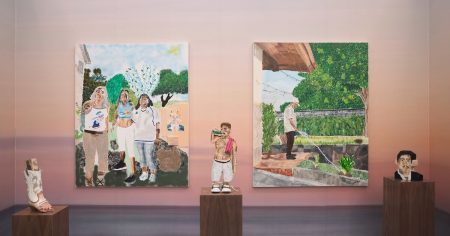
An installation view of Rajiv Menon’s booth at Untitled Art fair in Miami Beach.
Silvia Ros
Mid-tier and higher-priced activity held, too: Chicago dealer Kavi Gupta placed a Glenn Ligon work priced between $250,000–$300,000. Carl Freedman Gallery (Margate, U.K.) reported selling Lola Stong-Brett’s At Night I Sit and Beg For You for $46,000 and Billy Childish’s man in buckskins for $47,500. Rajiv Menon Contemporary’s presentation, “The Missing Figure,” reflecting on absence and erasure across South Asian histories, sold five of six works (priced $6,000–$10,000) within hours.
Right at the entrance, JO-HS (Mexico City/New York) captured attention with Celeste’s monumental, pink field installation in the Special Projects section titled Cosmos (2025). The work references Mexico’s pink Cosmos flower, which blooms each rainy season, and migrates naturally with water flows. The gallery also debuted a series by Rodrigo Echeverría, who reconfigures symbols from pre-Hispanic, Catholic, and more ancient traditions into fractured existential narratives. Three large canvases and eight smaller wood-panel works were on offer; the smaller pieces, $3,000 each, all sold out by Tuesday evening.
New York’s Latitude gallery drew strong early traffic at the tent’s beachside edge, selling four to five works by Iris Yehong Mao and Liane Chu for $3,000–$8,000 in the fair’s early hours. “We are reinstalling nearly half the booth around noon to show more available works,” founder Shihui Zhu said Tuesday morning.
Mexico City’s Adhesivo Contemporary told ARTnews it placed Jun Martínez’s $8,000 oil abstraction with a U.S. institution, while more than ten works by Camila Buxeda—small works selling for $2,000 each to large formats—sold briskly to local and international collectors.
Digital-native practices also made inroads. LatchKey Gallery presented Jessica Lichtenstein’s richly layered digital forest cosmology works—created without generative AI—with $35,000 prints gaining interest ahead of her show at New York’s Museum of Arts and Design next May. Heft Gallery bridged digital fragmentation and classical materiality through Auriea Harvey’s bronze and marble sculptures blending ancient mythologies with contemporary forms. (Heft is also showing in Art Basel’s inaugural Zero10 digital section.)
While Untitled Art provided the more international, concept-forward energy, NADA remains where many U.S. and Latin American galleries build and solidify their markets—particularly in the $5,000–$20,000 range. Charles Moffett had one of the strongest openings with Kenny Rivero, selling ten new works ($12,000–$25,000) ahead of his first solo exhibition in three years, opening next week. “We’ve introduced new collectors to his practice, and sales have been strong,” Moffett said.
Tara Downs sold out Yirui Fang’s U.S. debut ($6,000–$16,000) ahead of a January solo show that is nearly sold out. Mrs. placed four works by Lily Ramírez ($10,000), two by Elizabeth Atterbury ($4,500 each), and two by Sachiko Akiyama ($12,000 each). Harkawik (New York/Los Angeles) placed roughly $35,000 worth of works, including three Jackson Markovics pieces. Paris’s Bremond Capela sold a Madeline Peckenpaugh painting to the Femmes Artistes du Musée de Mougins in France, as well as multiple works by Alexis Soul-Gray and Valdrin Thaqi. Toronto’s Patel Brown sold two works by Alexa Kumiko Hatanaka—whose work was a hit at the Armory Show—and one by Sergio Suarez within the first half hour. Montreal’s Pangee nearly sold out its presentation of Claire Milbrath’s fragmentary landscapes ($5,000–$20,000).
Sargent’s Daughters offered one of the fair’s most curated booths, mixing the playful aesthetics of Wendy Red Star, Scott Csoke, and Debbie Lawson against Colefax and Fowler wallpaper. “Our departure from a traditional booth has been a hit,” owner Allegra LaViola told ARTnews, noting multiple sales to private and public collections.
Another standout was ProxyCo’s solo presentation for Lucía Vidales, whose symbolically charged paintings evoke an intuitive space between figuration and abstraction. Inspired by a dialogue with Mexican social realist David Alfaro Siqueiros, her eight-panel mural explored collapse and spiritual transformation—reflecting today’s ambient existential instability. Smaller works priced $8,000–$12,000 sold quickly, while the $60,000 mural—previously shown at the Kemper Museum of Contemporary Art and Ballroom Marfa—is still awaiting institutional commitment.
NADA also continues to surface strong discoveries, including the psychologically charged canvases of Kazakh artist Waldemar Zimbelmann at Amsterdam’s Althuis Hofland (all under $20,000). In the Projects section, Houston’s Laura the Gallery reported early placements, particularly Ernesto Solano’s bronzes and Gutai artist Keiko Moriuchi’s gold cosmology paintings, which have drawn interest from a local museum.
Overall, across both fairs, sales were steady—even without the once-upon-a-time clamor of rapid sellouts—and confidence seemed to be returning to the younger end of the market without tipping into frenzy or speculation. A broader range of narratives and techniques engaged fragmentation, mediatization, and alienation—defining conditions of this moment—while materiality, tactility, and ancestral mythologies resurfaced as grounding forces in a reality continually slipping between the real and the virtual, the ancient and the futuristic.
After a harsh season that tested the emerging and middle tier, both first day sales at Untitled and NADA suggested that the emerging and mid-market, while not roaring, is breathing again—and gaining curatorial and cultural depth in the process.