
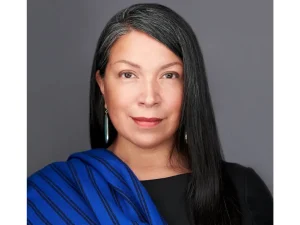






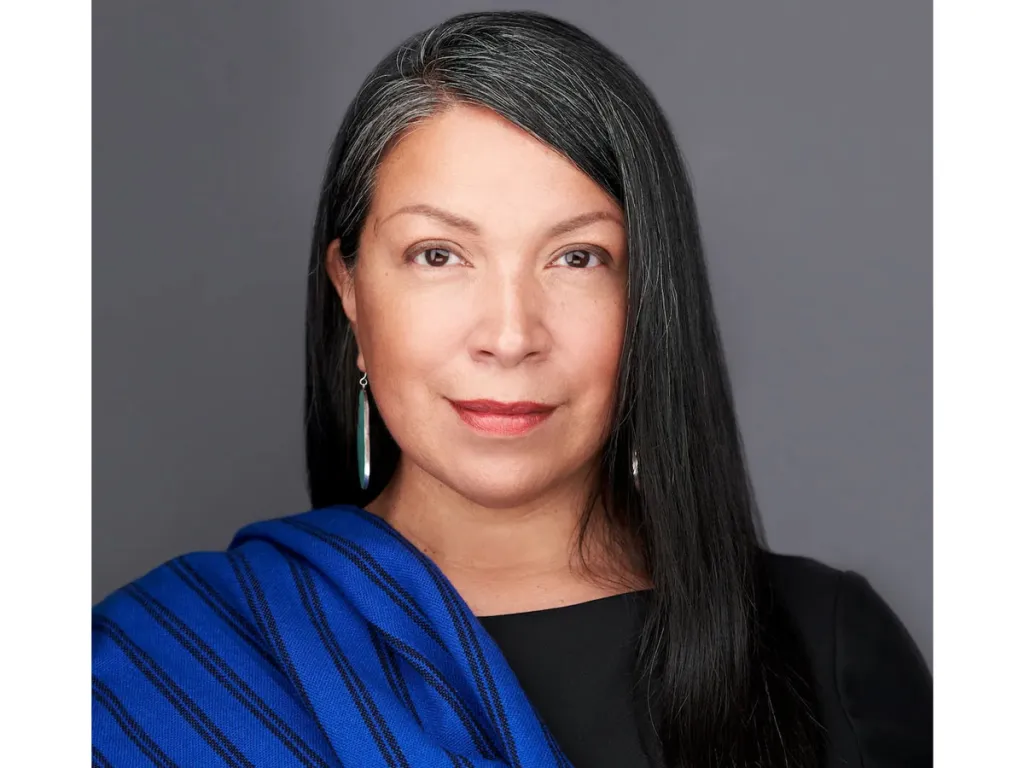
Patricia Marroquin Norby, the first curator of Native American art ever hired by the Metropolitan Museum of Art, quietly left her post in December 2025. Earlier this month, the Metropolitan Museum of Art in New York posted a job listing for a curator of Native American art to replace Norby, who had been the museum’s associate curator of Native American art since 2020.
Norby had been hired to great fanfare, as both the first person to hold the role at the Met and the first Native American to be hired as a curator by the institution. Her appointment was seen as both a watershed and as a response to criticism from various Native American tribes, who pointed to the museum’s poor documentation for many of the thousands of Native artworks and cultural objects it owns, some of which are on display in the recently opened Rockefeller Wing.
Norby’s departure was much quieter. She left the Met in December; Norby and a Met spokesperson both cited health reasons as the cause of her departure.
Since Norby was hired in 2020, her claims of Native heritage have been contested, including by the tribes she was affiliated with. Over the years, she has claimed ancestry to the Nde, Apache, and Eastern Apache peoples, who live in the Southwestern US and Northern Mexico, and the Purépecha, who live in Michoacán, Mexico. During her five-year tenure at the Met, she claimed only Purépecha as her Indigenous heritage.
Organizations, groups, and individuals that investigate false claims of Indigenous heritage in the US and Canada have made their work increasingly public over the past decade. A report published by the Tribal Alliance Against Frauds (TAAF) in 2024 said that Norby has “zero American Indian ancestry.” TAAF, responding to whistleblower reports, led an independent genealogical investigation that produced hundreds of documents tracing Norby’s family lineage, comprising US Indian census rolls and Mexican Indigenous identity requirements. For the Purépecha, community kinship is the main requirement, while the Mexican government stipulates linguistic fluency in order to claim such an identity.
Days after the Met job was posted, Norby published an op-ed in the Minnesota Star Tribune defending her identity as a private matter, setting her argument framed against the backdrop of the ongoing ICE raids nationwide and the University of Minnesota’s “Holding Our Ground: Voices and Strategies Against Self Indigenization” symposium. “Identities are personal,” she wrote. “If questioned, it is an issue to be resolved privately with their family and with the community that claims them or with whom they identify.”
Norby’s framing filters Indigenous identity through the lens of self-identification, but the majority of Indigenous tribes in both the US and Mexico prioritize community kinship, or an active relationship with the tribe one claims. “Tribal belonging exists through collectivity, not individuality,” Joseph Pierce (Cherokee Nation Citizen), an associate professor and the founding director of the Native American and Indigenous Studies Initiative at Stony Brook University, told ARTnews.
While the Met’s Native American art curator can legally be held by a non-Native person, Norby’s appointment made it seem as though it would be implicitly reserved for a Native curator. Norby’s departure raises a broader question, given the publicity surrounding her joining the museum used her identity as partial evidence of her qualifications for the job: What was the Met’s process for validating Norby’s ties to Native communities?
The answer remains opaque. The Met did not respond to multiple ARTnews queries as to whether a formal process existed to vet Norby’s claims of Indigeneity or if one has been established since. In a statement, the Met simply said, “As with all curatorial roles, candidates are evaluated through a rigorous search process that considers scholarly expertise, professional experience, and the ability to work collaboratively and respectfully with communities whose cultural heritage is represented in the Museum’s collections.” Citing federal and state law, a Met spokesperson pointed to the job listing’s equal opportunity statement, which reads in part that candidates are hired without regard to “race, color, … [or] ancestry.”
The Met’s statement continued, “The Metropolitan Museum of Art is committed to the thoughtful stewardship and presentation of Native American art, while working collaboratively and respectfully with Tribal Nations and Indigenous communities. Through ongoing consultation with culturally affiliated communities, Tribal leaders, artists, scholars, and cultural practitioners, the Museum seeks to ensure that the care, research, and interpretation of Native American works in its collection reflect their cultural significance and living traditions.”
View of the esxhibition “Mary Sully: Native Modern,” 2024 at the Metropolitan Museum of Art, New York.
Photo Paul Lachauer. © The Metropolitan Museum of Art.
In its statement, the Met also highlighted some of Norby’s contributions during her tenure, which included focusing research and compliance as well as building community collaboration for Native American Graves Protection and Repatriation (NAGPRA) and cowriting the Native American Arts Initiative (NAAI), “a strategic plan and guide for centralizing the proper care, presentation, and acquisition of Native American art, the first resource of its kind at The Met.” She also organized exhibitions on George Morrison and Mary Sully, as well as a group exhibition, titled “Water Memories,” featuring 40 works from historical, modern, and contemporary Indigenous artists in the Met’s collection.
In a statement relayed by the Met, Norby did not address the controversy related to her claims of Indigenous identity or her recently published op-ed, attributing her departure solely to her health. “In early 2025, I was diagnosed with two chronic illnesses that require full-time management,” she said. “My years at The Met were some of the most rewarding and challenging of my career. I am deeply proud of what we accomplished regarding exhibitions, NAGPRA protocols, and working collaboratively with Native American Nations and Indigenous communities.”
Pierce sees the stakes of a hiring like Norby’s and the hype around it as more than just an institutional concern. “If you say you’re Native American to a Native American artist, and they tell you something about their art, they’re telling you something with an understanding that you share an experience,” he said. “But you haven’t actually established trust with that person. You’ve actually established deceit.”
The gray area Norby appears to exploit lies between the Mexican and US Indigenous groups she claims. “Indigenous” is a global concept; “Native American” is not. In the US, Native identity is tied to political belonging—membership in sovereign Tribal nations—not a broad racial category. By contrast, Indigenous identity in Mexico operates differently within its national context, which has prized the concept of mestizaje, or the mixing of Indigenous with Spanish and African heritage, above all else since the Mexican Revolution. Indigenous communities in Mexico, however, continue to be marginalized to this day.
These distinctions matter legally, politically, and socially, Pierce said, noting that Norby’s shifting identities ultimately betrays a disconnection from living Native communities. He characterized ambiguity around one’s Indigenous identity as “a red flag… a kind of vagueness about the political affiliation.”
Norby’s op-ed prompted a response from writer Jacqueline Keeler (Diné/Dakota), who invoked the term “pretendian”—a portmanteau of “pretend” and “Indian”—used for non-Natives claiming Native heritage for personal or professional gain. “[Norby] argues that because ICE is violent, we should not question whether a former curator at the Met is who she claims to be,” Keeler wrote. “This is a classic ‘settler move to innocence.’ It implies that looking into the background of a well-paid academic is somehow the same as the violence at the border.”
False claims of identity are not limited to the art world, as several high-profile ones have rocked academia. The University of California system launched a “fact-finding mission” on the topic last year after several of its campuses have seen “pretendian” allegations surface, including at UC Berkeley and UCLA.
But opportunities for curatorial positions held by Indigenous people are even more limited than in academia. Beside the Met role, only a handful of Native curators hold curatorial roles at prominent institutions, including Dakota Hoska (Oglála Lakȟóta) inaugural curator of Native American art at the National Gallery of Art in Washington, D.C.; Kathleen Ash-Milby (Diné), senior curator of Native American art at the Portland Art Museum; Jordan Poorman Cocker (Kiowa/Tonga), curator of Indigenous art at Crystal Bridges in Bentonville, Arkansas; and Jami Powell (Osage), associate director for curatorial affairs and curator of Indigenous art at the Hood Museum at Dartmouth College.
Jeremy Dennis (Shinnecock), a visual artist and curator, sees this as a “complex dilemma” for mainstream museums: “do you ask for a tribal ID every time you work with a Native American artist or curator, or do you simply rely on reputation—a question that becomes even trickier when a candidate is a descendant.”
Pierce put it more succinctly, “If someone is claiming [Indigenous identity] as part of their credentials, the Indigenous people and the public have a right to understand what that means.”


