


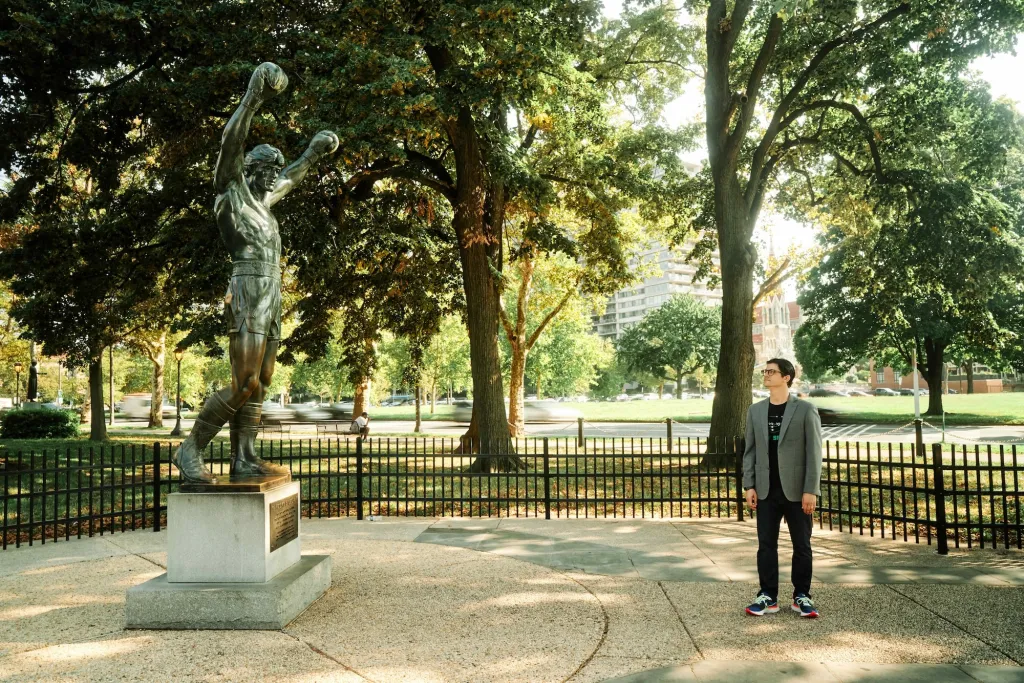
The Philadelphia Art Museum is organizing a 2026 exhibition centered on a famous artwork that is closely associated with it but is actually not part of its collection: the statue to Rocky Balboa, the fictional boxer created by Sylvester Stallone, that stands at the top of the imposing stone steps (now often called the Rocky Steps) leading to the institution.
“Rising Up: Rocky and the Making of Monuments” will open in April.
The show is curated by a man who lives and breathes public monuments and the questions they raise: Paul Farber, the co-founder of Monument Lab, a nonprofit Philadelphia public art organization. Founded in 2012 by Farber and Canadian artist Ken Lum, a professor at the University of Pennsylvania, Monument Lab is “dedicated to advancing justice by reminaging monuments as places for belonging, learning, and healing.”
“My life’s work is about monuments,” Farber told ARTnews in a phone conversation. “The statue in my own city I kind of took for granted, but I started to pay attention to the line. No matter what time of day or time of year there’s a queue. I started to research it five years ago and found as many people visit the Rocky statue as visit the Statue of Liberty—more than visit the Liberty Bell here in Philly.” Some four million people yearly make the trek to visit the statue, twice as many as visit the Liberty Bell. (The museum surely hopes to draw in some of those people to bolster the 800,000 who visit the institution annually. It could use some good publicity, embroiled as it is in a nasty legal battle with its ousted ex-director.)
Notably, Philadelphia’s show coincides with “MONUMENTS,” a Los Angeles exhibition, at the Brick and the Museum of Contemporary Art, that studies Confederate memorials and juxtaposes them with works by contemporary artists, some existing, some commissioned; the curators there commissioned a piece from Monument Lab.
The Philadelphia exhibition will include over 150 works by more than 50 artists as well as artifacts spanning over 2,000 years, investigating the role of monuments over time in the realms of fine art, sports, and popular culture. Farber has been deep in research on the subject for five years, and working for two years on the show, which is just the latest product of his Rocky obsession; he also hosted the excellent podcast “The Statue” from NPR and Philadelphia public radio station WHYY.
Curator Paul Farber outside the Philadelphia Art Museum.
Gene Smirnov
The show is timed to the fiftieth anniversary of the release of the blockbuster film, which won Academy Awards for best picture and for best director for John G. Avildsen. It was written by and stars Stallone as the title character, a down-and-out boxer and debt collector for a Mafia loan shark, who gets an unlikely shot at the world heavyweight championship held by boxer Apollo Creed, played by Carl Weathers. Notably, Rocky loses to Creed by a split decision, but wins a kind of victory by going it all fifteen rounds against the champ. The highest grossing film of 1976, it spawned eight sequels as well as the spin-off Creed series.
Stallone is also, incidentally, an artist and a noted art collector whose holdings include works by George Condo, Damien Hirst, Rashid Johnson, Bridget Riley, Sterling Ruby, and Andy Warhol, who painted the actor’s portrait while he was filming Rocky III.

Artist/maker unknown, Neck Amphora (510-490 BCE).
Penn Museum Photo Studio
The Philadelphia exhibition will feature stars like Keith Haring, Rashid Johnson, Delilah Montoya, Tavares Strachan, Hank Willis Thomas, Kara Walker, Andy Warhol, and Carrie Mae Weems, along with makers from Mural Arts Philadelphia’s Restorative Justice Program. An accompanying catalogue will include essays by artist Alex Da Corte, who lives in Philadelphia; former Philadelphia Eagle and Super Bowl champion Malcolm Jenkins; and Carrie Rickey, who was film critic at the Philadelphia Inquirer for twenty-five years.
Another key work is devoted to a fighter: the classic Hellenistic Seated Boxer, represented in the show by a plaster cast. Also considered will be Jack Johnson, who became the first Black world heavyweight boxing champ at the height of the Jim Crow era, and is represented in a sculpture by Augusta Savage. The show also looks at Philadelphia’s boxing gyms and closes with a gallery devoted to contemporary art.
A. Paul Schomberg in his studio.
Schomberg Studios.
Placing the Rocky statue in the context of works by such renowned figures raises the question: Is it a great work of art, or even an artwork at all? Stallone commissioned it from Colorado-based A. Thomas Schomberg, whose works, many devoted to sporting subjects, reside in both museums and other kinds of institutional collections, including the National Art Museum of Sport in Indianapolis, the Philadelphia Art Museum, and the Butler Institute of American Art in Youngstown, Ohio as well as the U.S. Olympic Training Center in Colorado, Yankee Stadium in New York, and the National Museum of the Marine Corps in Quantico, Virginia.
“One of the deep parts of this history is the debate: Is the Rocky statue a piece of art or a film prop?” says Farber. “I spent a lot of time with the artist, whose work is renowned, but is plagued by that question, and it haunted me. I spent time in his studio and looked at his process and understood the other work he made. The statue was made as part of the filming of Rocky III. They could have asked for a styrofoam prop. But he worked with an artist who works in bronze.”
Glenn Ligon, Skin Tight (Ice Cube’s Eyes) (1995).
Carlos Avendaño
If some art critics might look askance at the sculpture, it has certainly achieved a status most visual artists could only dream of for their work.
“It’s a cultural meeting ground,” said Farber. “I started to look at what Rocky represented but also what stories are off the pedestal—who gets represented, and whose stories get obscured. Something is happening there that’s remarkable. It’s a site of global pilgrimage for people finding a way through pain and difficulty. He’s the patron saint of the underdog. But it bears mentioning that the most mythical Philadelphian is a white boxer who never lived, while there are many Black Philadelphia boxers who were and are major members of their community.
“The steps are the ultimate people’s pedestal,” he said. “It’s Philly’s Mount Everest.”
Alex Webb, Philadelphia, Rock Ministries Boxing Club (2016).
©Alex Webb / Magnum Photos
Like the Los Angeles show, the Philadelphia exhibition comes against the backdrop of the great moment of iconoclasm and toppling of Confederate monuments that came as a result of the Black Lives Matter movement. It’s not America’s first such moment, points out Farber, recalling that statues of England’s King George II were melted down to create bullets used in the Revolutionary War.
“Right outside a world-class museum that has been incredibly important to me my whole life is the most dynamic cultural space I can think of,” said Farber. “Go any day and you see art and life on full display. In the show, we were responding to the legacy of uprisings for social justice and vigils and labor strikes that take place there. I grew up as a Philly sports fan and that’s where we went to celebrate.
“While there are other statues nearby, the ultimate part is the rising up, as a metaphor for fighting through life’s struggles,” he said, referring to the steps, which Rocky famously climbs as part of his morning run, a climb that pilgrims routinely reenact. “This is a living art history and public history curriculum. I go to that space to understand our complex relationship with monuments, the mythologies we get attached to and the way we create meaning. We make monuments and monuments make us.”
