





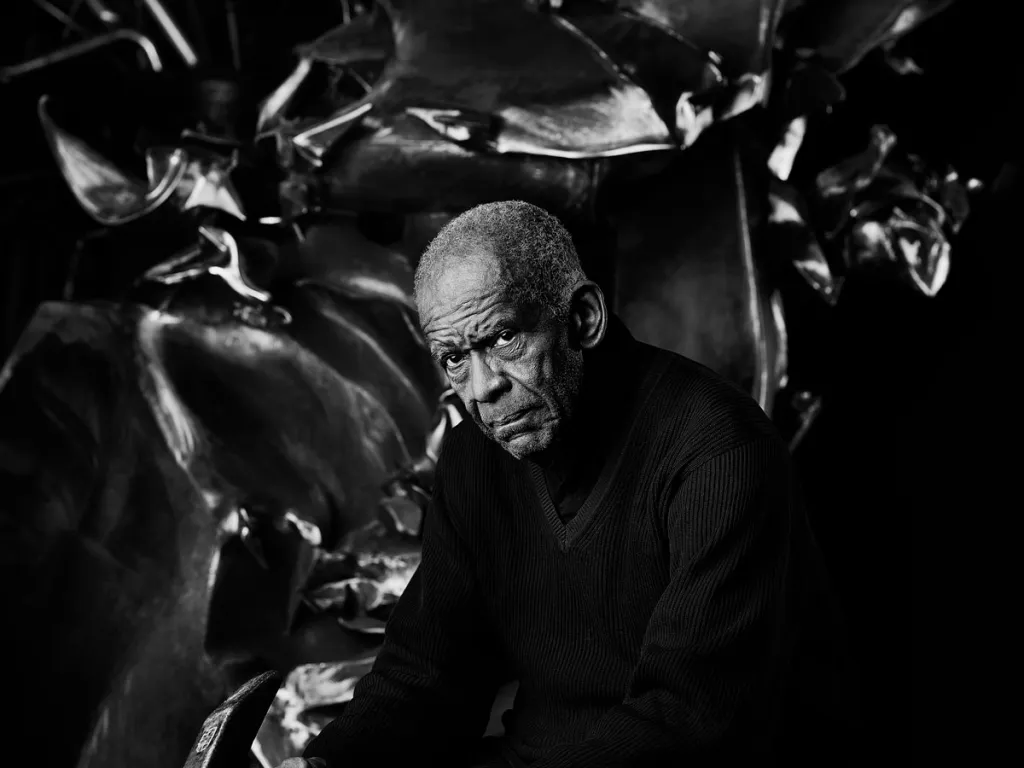
“The material basis of my sculpture is metallic opportunities. Bringing pressure to the right points, I draw the aesthetic out of the industrial process,” Richard Hunt, one of the most prolific public sculptors in the United States, wrote in a notebook decades ago.
This idea of pressure was central to Hunt’s theory about sculpture. Now that will be on full display in the late artist’s first institutional survey since his death at 88 in 2023, “Richard Hunt: Pressure,” at the Institute of Contemporary Art Miami. Across a seven-decade career, Hunt completed more than 160 public sculpture commissions in 24 states and Washington, D.C., and mounted over 170 solo exhibitions; his art is now represented in more than 125 museums around the globe.
The ICA Miami exhibition, which opens Tuesday and runs through March, features 28 sculptures made between 1955 to 2010, marking one of the largest gatherings of his work ever. Its presentation during Miami Art Week “gives an opportunity for Hunt to be at the center of the art world in a way that he hasn’t been before,” Jon Ott, the executive director of the Richard Hunt Legacy Foundation told ARTnews, noting that he hopes the exhibition will give Hunt and his work “a very well deserved and important introduction or reintroduction of his body of work to people from around the world.”
The “Pressure” in the exhibition’s title is double edged, according to cocurator Gean Moreno. On one side, Moreno sees that pressure as literal when looking at work of the 1960s in which the actual pressure applied to create the works feels palpable. And on the other side there is the pressure, by societal forces, that Hunt likely felt to make work responding to the day’s concerns while still be an especially rigorous formalist in creating an innovative sculptural language.
Richard Hunt, Linear Peregrination, 1962.
Photo On White Wall/©2025 The Richard Hunt Estate, ARS, NY and DACS, London
Hunt grew up on the South Side of Chicago, just a few blocks away from Emmett Till, the 14-year-old boy who was brutally beaten and killed by white men in Mississippi in 1955. Mamie Till, the boy’s mother, held an open casket public funeral, so that people could see the brutality inflicted on her son. Images of Emmett’s mutilated boy were widely circulated at the time, and his lynching was one of the many flash points for the Civil Rights Movement.
Hunt, who was nearly 20 at the time, attended the funeral, and it affected him deeply, shifting his focus to a more abstract, surrealist-inflected mode as a way of processing this trauma. In 1956, he created Hero’s Head a sculpture of a head welded with scars dedicated to Emmett Till.
As he began pursuing his art, his activism developed alongside it. He integrated a Woolworth’s lunch counter in 1960 in San Antonio, Texas. And Till’s lynching stayed with Hunt for the rest of his life. A short time before his death, he completed the model for a monument commemorating the young Emmett, which will be installed at Till’s childhood home in Chicago in the near future.


Richard Hunt, Hero’s Head, 1956.
Photo On White Wall/©2025 The Richard Hunt Estate, ARS, NY and DACS, London
“His commitment to shaping memorial and commemoration across the American landscape is an important aspect of his legacy,” said Melanee Harvey, an art historian at Howard University who often uses Hunt’s three sculptures installed on the campus as a starting point for her introductory art appreciation and African American art courses.
But Hunt’s take on social issues weren’t literal, and he eschewed figuration, which at the time was not always embraced as helping to propel the Civil Rights Movement forward. “He comes of age in a moment where modern sculpture in America is in its full stride and he works in that vein. But he has other concerns, particularly social issues, concerns that he can’t just leave behind,” Moreno said. “So he has to create these really interesting sculptural strategies to be able to produce this kind of work that formally is at the forefront of sculpture, but also somehow manages to still convey the social pressures that he thinks are important to deal with.”
Hunt was intentional about this approach, telling the Washington Post in 1972, “I got interested in being an artist in 1955 when black people felt they had to be white in order to succeed and the movement that has affected the development of people’s concern about being black wasn’t evident. But there was certainly in terms of my development growing up in a black community in Chicago, a kind of black pride.” The Post titled that article “Richard Hunt: A Black Artist Who Doesn’t Do Black Art.”

Richard Hunt seated with his early works at his studio, 1963.
©2025 The Richard Hunt Trust / ARS, NY
Born in 1935, Hunt spent his life in Chicago, and a visit to the Art Institute of Chicago’s 1953 “Sculpture of the Twentieth Century” exhibition, featuring works by Picasso and Giacometti, inspired him to pursue a career in sculpture. He studied at the School of Art Institute in Chicago (SAIC), receiving a bachelor’s degree in arts education in 1957. That year, the Museum of Modern Art in New York acquired his 30-inch-tall sculpture Arachne (1956).
But, Hunt never learned to weld metal at SAIC. “He represents this incredibly unique intersection of having a self-taught technique but being very educated in the Beaux Arts [style]. He really carried forward the torch of metal artist,” said Ott, who is also Hunt’s official biographer.
Hunt first began working public sculpture in 1969, when Walter Netsch commissioned him to make a work for a hospital he was designing just outside Chicago. The resulting Cor-Ten steel sculpture, Play, shows two glob-like shapes, one towering over the other, and it was inspired by demonstrators who were attacked by police dogs in Birmingham, Alabama, during the Civil Rights Movement. Hunt originally titled the work The Chase, as he saw it as being about pursuit, but Netsch asked for another title since it was for a mental health facility.
Cor-Ten steel would be one of Hunt’s preferred materials early on; at the time, it was one of the more durable metals, ideal for large-scale, outdoor work. That public art could have an “abstract basis and form,” as it did with his Play sculpture, “paved the way for Hunt to think about how art can be transformative in an abstract way, which was groundbreaking at the time,” Ott said.

Richard Hunt, From the Ground Up, 1989.
Photo Nathan Keay /©2025 The Richard Hunt Estate, Artists Rights Society (ARS), New York
But more so than any artist Constantin Brâncuși, known for his abstract modernist sculptures, would have the biggest influence on Hunt’s art. In 1957, Hunt traveled to Paris, not long after Brâncuși had passed away. There, he was able to visit the late sculptor’s studio—maintained just as it was the day he died. (Brâncuși bequeathed his studio to the French State upon his death; it was installed in exact replica across from Centre Pompidou in 1977 but is now closed as part of the museum’s ongoing renovations.)
How Brâncuși lived with his art-making became a model for Hunt, who would eventually purchase a decommissioned electrical plant to serve as his studio. Like Brâncuși, he lived in his studio, sleeping in a custom-built loft. “It was like he was never outside of the space and the materials and thinking of sculpture,” Moreno explained.
Hunt’s profile continued to rise and in 1971, he had his biggest breakthrough in the form of a mid-career retrospective at MoMA, the first for an African American sculptor and, at the time, a rarity for a Chicago-based artist. For the next several decades, Hunt would be especially prolific in creating public art, with commissions, including I Have Been to the Mountain at Dr. Martin Luther King, Jr. Reflection Park in Memphis, Swing Low at the National Museum of African American History and Culture in Washington D.C., and Book Bird at the soon-to-open Obama Presidential Center in Chicago.
Richard Hunt, Low Flight, 1998.
Photo On White Wall/©2025 The Richard Hunt Estate, ARS, NY and DACS, London
Though his sculptures were abstract in form and perhaps hard to grasp at first glance, Hunt saw the viewer’s experience with his sculptures, according to Ott, who added, “He reveled in the various layers of interpretation and invited everyone in to see his work as part of a conversation.”
Hunt created a visual language of his own, one that synthesized European modernism, African American history, and American abstraction. His sculptures have a spiritual sense to them, though they are often about secular topics. In abstracting his forms, his work has a universality and specificity to it at the same time, in which societal perceptions of the limits of one’s race are not only defied but surpassed.
“Sometimes it is not about making art,” Hunt once said. “Sometimes it is about making statements about culture and history or history and culture with and through art.”