






Can an art museum tell a non-linear version of art history and still be legible to its visitors? That’s the question guiding the David Geffen Galleries, the new building for the Los Angeles County Museum of Art that opens to members on April 19 and to the public on May 4.
Typically, museums narrate millennia of artistic expression as a series of progressive movements limited to the US and Europe, with everything else pushed to the margins. LACMA has historically been one of those museums, with one of the buildings it tore down to make way for the Geffen Galleries being devoted primarily to art of the Americas.
Now, with other institutions embracing a more global art history that emphasizes plurality, here comes the new LACMA, where artworks made across multiple centuries press up against each other, as do pieces made within in the same decade but in drastically different geographical contexts. It’s a triumph.
The plan to rethink LACMA’s entire campus has been in the works for 25 years, starting with its western half, where Renzo Piano designed two buildings—they opened more than 15 years ago, adding about 100,000 square feet of gallery space. LACMA’s current director and CEO, Michael Govan, arrived in 2006, and took over this massive, in-progress project. By 2009, the museum had pivoted to working with Swiss architect Peter Zumthor to propose a new building for its east campus.
The journey to get to this opening—with a final price tag of $724 million, some $125 million of which came from LA County—hasn’t been without controversy. Almost as soon as they were revealed, local critics skewered Zumthor’s designs. More vitriol followed changes to the design made to account for an environmental report, resulting in a 10 percent reduction in exhibition space, or about 10,000 square feet less than what it had before. Despite all this pushback, Govan never seemed to falter in his dedication to the vision he had for the Geffen Galleries, promising a museum unlike any other in the world. Suffice it to say that Govan has been vindicated.
This one-level museum eschews traditional museological hierarchies. European paintings are not given priority, Greco-Roman sculptures are not awarded long marble hallways, and art of the Americas, Africa, and Oceania is not tucked away in dusty corners. Instead, art from LACMA’s 15 curatorial departments can go anywhere in the building—no department has an earmarked space, and some departments, like the one for costumes and textiles, even have more on view than ever before. Certain displays are the product of multiple departments working together.
A presentation titled “Earth and Water,” features vessels from ancient Greece; the Acoma Pueblo; Colima, Mexico (200 BCE–400 CE); 1960s California, among other geographies.
Photo Maximilíano Durón/ARTnews
It helps that LACMA has minimal constraints on its permanent collection by way of donor bequests or long-term loans, giving LACMA the freedom to be more playful with its collection. In our conversations, Govan variously described the Geffen Galleries as a “laboratory” and a “platform for experimentation.” The curators will swap things in and out as they get used to the eccentricities of the new building. This means the galleries will change frequently, as has become increasingly common at museums the world over, and it means that the permanent collection often feels impermanent.
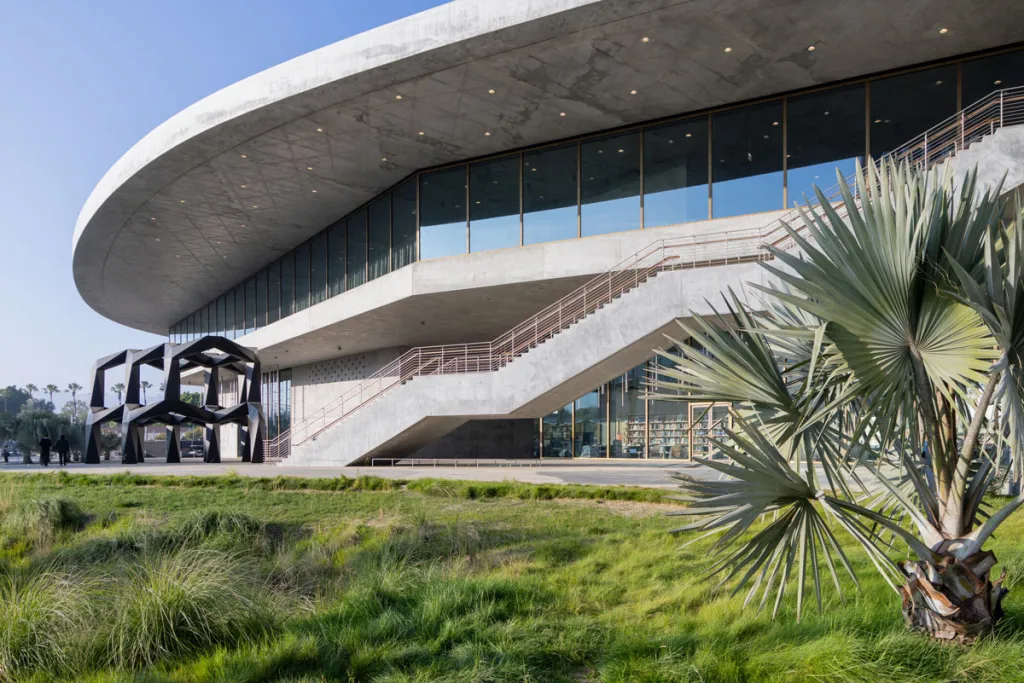
Zumthor’s Geffen Galleries, on the other hand, don’t feel like they’re going anywhere. That might be partially thanks to the seismic engineering by Skidmore, Owings & Merrill, which allows the building to sway five feet in any direction without comprising its structural integrity. But it also might be due to the choice of material: his structure is made of imposing concrete, with its layout is set and impossible to alter. No false walls will go up in this building, though the museum’s 26 interior galleries all have unique layouts and dimensions that make them adaptable to what LACMA already owns. Some galleries have had pigment—blue, red, black—mixed into the concrete, softening the material’s sterility. The building’s wrap-around windows connect you to the outside world, offering vistas of sun-drenched Los Angeles.


Works from LACMA’s Carter Collection of Dutch paintings hang on a blue-pigmented concrete wall in the Geffen Galleries.
Photo Maximilíano Durón
Walking through the building, one of the first things you notice is that the plinths, vitrines, and tables holding the art are made of wood and steel. These displays are meant to introduce some additional warmth to the overall building, adding a fascinating tension. The structure feels as though it were built by a blobitecture-loving parent, then inherited by a child obsessed with the clean lines of mid-century design. (The enclosed plinths are also highly technical: sandwiched between their two wood bases are miniature climate control systems that account for the fact that wood outgases.)
The building’s grounds are also majestic. Along with additional green space that is still being planted, LACMA has also put more art on view outdoors. The museum’s Rodins now line a grassy area between one of two handsome exterior staircases and a green fence along Wilshire. Around the corner is Alexander Calder’s 1964 fountain Three Quintains (Hello Girls), which has been lovingly restored and gleams in the early morning light. Across the street is Jeff Koons’s Spilt-Rocker (2025), which is lined entirely with plants native to California, ensuring that the work will be in bloom year-round. These sculptures are sure to become just as iconic as Chris Burden’s Urban Light (2008) and Michael Heizer’s Levitated Mass (1969/2012), both steps away.

Alexander Calder’s 1964 fountain Three Quintains (Hello Girls) is newly restored and installed just below the David Geffen Galleries.
Photo: Fredrik Nielsen Studio; Art: ©Calder Foundation, New York, and Artists Rights Society (ARS), New York/Los Angeles County Museum of Art
When I first saw Zumthor’s final rendering for this building, with its wrap-around windows and set number of galleries, I was skeptical about how the museum would display its collection—especially its paintings, since there seemed to be too few walls to do so. That was a misconception on my part: LACMA’s holdings lean heavily toward sculptures in marble, stone, and ceramics, and they benefit from Zumthor’s building, which is designed to prioritize floor space over wall space. All the natural light that pours in through the windows has also been taken into account: sheer, stainless-steel curtains by Reiko Sudo modulate the illumination, bringing it to museum standards.
The only thing Zumthor didn’t seem to account for was the acoustics, as the concrete does little to dampen the sound bleed from video art on view and the din of people talking. When filled with people, the Geffen Galleries are quite noisy. That’s not to say a museum should be as silent as a library, but it’s not so pleasant an art-going experience when you can hear someone gossiping from two galleries away.
During the planning stages, Zumthor’s design was controversial because his proposal involved having his building jut across Wilshire Boulevard, one of LA’s main thoroughfares. Some went as far as to compare the building’s designs to those of an airport hangar. But in its finished form, its curve is elegant. Yes, it does recall one of LA’s thousands of freeway overpasses—but I say that in the most loving way possible: they are essential parts of the city’s visual culture. Adding another freeway overpass to a part of the city that has never had one: how much more LA can you get?

Works by Rodin in the Cantor Sculpture Garden, with the portion of the Geffen Galleries that crosses Wilshire in the background.
Photo Iwan Baan
LACMA’s curators take on the inescapability of LA’s chosen of mode of transportation with a gallery entitled “Car Culture,” the centerpiece of which is a 1963 Studebaker Avanti, acquired in 2014 and restored in 2022. During one of my conversations with Govan on Wednesday, he noted that LACMA’s collections included everyday items, like cups and silver spoons, but no cars or surfboards. The museum has now fixed that, and it’s putting objects like that Studebaker and Duke Kahanamoku’s ca. 1917 surfboard front and center.
This gallery smartly pairs that Studebaker with Carlos Almaraz’s Crash in Phthalo Green (1984), a fiery scene of cars plummeting off a green freeway; Judy Chicago’s abstract Pasadena Lifesavers Yellow #4 (1970), drawing on her training in auto-body school; and several of Ed Ruscha’s “Parking Lots” photographs, about the empty lots needed to support all these automobiles.

Installation view of the “Car Culture” presentation, showing, clockwise from foreground, the 1963 Studebaker Avanti, Carlos Almaraz’s Crash in Phthalo Green (1984), and Ed Ruscha’s “Parking Lot” photographs.
Photo Maximilíano Durón/ARTnews
“Car Culture” is just one of the 78 initial thematic sections that LACMA’s curators have put on view in the Geffen Galleries. Instead of opting for some overall arching theme—say, “The World Is Hard to See,” à la the Whitney Museum’s “America Is Hard to See” for its 2015 reopening—the hang draws its inspiration from four bodies of water: the Pacific Ocean, the Indian Ocean, the Mediterranean Sea, and the Atlantic Ocean. The thinking, according to a brief text on the map of the museum’s floorplan, is to consider “art and history as a dynamic, oceanic flow” in which works “accrue meaning through exchange, transit, time, and translation.”
The approach is both ambitious and apt. Walking through the Geffen Galleries, with its 110,000 square feet of exhibition space, it’s easy to get lost because the presentations feel so fluid. At one point, you might wash ashore in a room bringing together centuries of Polynesian art. Then, a few feet in another direction, you might end up in a section looking at the art of Mesoamerica. Guido Reni’s Baroque painting Bacchus and Ariadne (ca. 1619–20) is separated from a 15th-century Turkish calligraphic mosaic by only a narrow passageway. The goal is to get visitors to wander. That verb also happens to be the name of the guidebook LACMA has just published to help orient visitors.
A 15th-century Turkish calligraphic mosaic (left) is separated from Guido Reni’s Bacchus and Ariadne (ca. 1619–20, right) by only a narrow passageway.
This is a sharp contrast to the four buildings LACMA tore down, including its original Ahmanson Building, from 1968, and the Art of the Americas Building, opened in 1986. As a native Angeleno, I was always loathed visiting these poorly lit, claustrophobically hung galleries. Now, you can really see all that LACMA has in its holdings. Boy, is it a beaut.
The complete lack of descriptive wall labels for individual objects, still a matter of debate among the curators, according to Govan, privileges looking. And I hope that LACMA leaves out the extended wall labels for objects—it’ll ruin the elegant hang that is currently on view, and the majority of that information can be accessed via the Bloomberg Connects app. I’m typically against this kind of thing, but this iteration reminds you that a museum should be about experiencing art first and researching it second, with all that looking acting as the spark that ultimately leads to further inquiry.
One presentation that is sure to spark further study is a gallery entitled “Transatlantic Exchange and Its Legacies,” which looks at the transatlantic slave trade and the goods and people that moved through it. One corner juxtaposes Winslow Homer’s The Cotton Pickers (1876), showing two recently emancipated Black women in a cotton field; a ca. 1840 “Lady of the Lake” Quilt, which shows how the cotton picked in the South was transported to a textile factory in Vermont; and Betye Saar’s powerful I’ll Bend But I Will Not Break (1998), featuring a vintage ironing board emblazoned with the 18th-century print showing captured Africans tightly packed in slave ships, along with a freshly ironed white sheet embroidered with “KKK” hanging behind it. The connections between these three works, and the rest on view in the room, are somewhat obvious, though the old LACMA would never have made them.
From left, the “Lady of the Lake” Quilt (ca. 1840) and Betye Saar’s powerful I’ll Bend But I Will Not Break (1998), installation view, at David Geffen Galleries, LACMA.
Photo Maximilíano Durón/ARTnews
Elsewhere in the museum are displays like “The Iberian World: From Spain to Spanish America,” which explores how European artistic traditions were imported to Spain’s New World colonies via two depictions of the martyring of saints Dutch artist Frans Franken II’s ca. 1620 painting of Saint Andrew and then a similar looking one of Saint Catherine of Alexandria, made two decades later in Mexico by Baltasar de Echave Ibía. Nearby, in multiple thematic displays, you see how these European techniques were remixed with Indigenous traditions to create new syncretic art forms like a Pax sculpture by a Nahua artist (ca. 1575) or Manuel de Arellano and Antonio de Arellano’s iconic 1691 Virgin of Guadalupe painting, which combines the Virgin Mary with the Aztec mother goddess Tonantzin.
There are modern and contemporary artworks interspersed throughout the hang, they don’t overwhelm it. Still, there are stellar examples on hand: a 2026 Sphinx sculpture by Lauren Halsey; rafa esparza’s …we are the mountain (2019); a Do Ho Suh commission, Jagyong Hall, Gyeongbok Palace, that is spliced by a concrete wall; Henri Matisse’s 1953 mosaic La Gerbe, commissioned for the Holmby Hills home of Sidney F. Brody and his wife Frances Lasker Brody in the 1950s; and LACMA’s newest, most prized possession, Francis Bacon’s Three Studies of Lucian Freud (1969), bequeathed to the museum by Elaine Wynn, the museum’s late former board co-chair, whose $50 million donation launched the capital campaign for the Geffen Galleries.
rafa esparza, …we are the mountain, 2019, installation view, David Geffen Galleries, LACMA.
Photo Maximilíano Durón/ARTnews
Seeing everything on view here feels just barely accomplishable within the span of half a day. The Geffen Galleries currently have 1,700 objects on view, with around 800–900 more expected to be added over the summer. (Compare that to the 2,400 or so objects that the Museum of Modern had on view during its 2019 reopening.) I’m looking forward to coming back for those newly introduced works—a sign that the Geffen Galleries are successful—and to seeing what other future hangs might entail. If this is what the future of museological display is, count me in.


