







The US art market showed signs of life in 2025. Auction sales rose 23 percent from the previous year to about $3.17 billion, according to a new report from Bank of America and the analytics firm ArtTactic. But the rebound did not come from a surge in demand. Instead, it was driven largely by major estate consignments, renewed interest in well-known historical artists, and an auction system increasingly supported by financial guarantees.
Yes, the market appears to be stabilizing, but in a very different form than the speculative boom that defined the early years of this decade.
As a whole, the report suggests the art market is entering a more cautious phase. The surge of speculation that pushed prices for younger artists to precipitous levels earlier in the decade has started to fall flat. More than ever, auction houses are relying on financial guarantees to secure major consignments. And collectors are increasingly spread across the country rather than concentrated in traditional hubs like New York. For dealers, collectors, and artists trying to understand where the market stands now, these shifts may matter more than the headline sales figures that people obsess over.
Collectors Shift from Wet Paint to Established Names
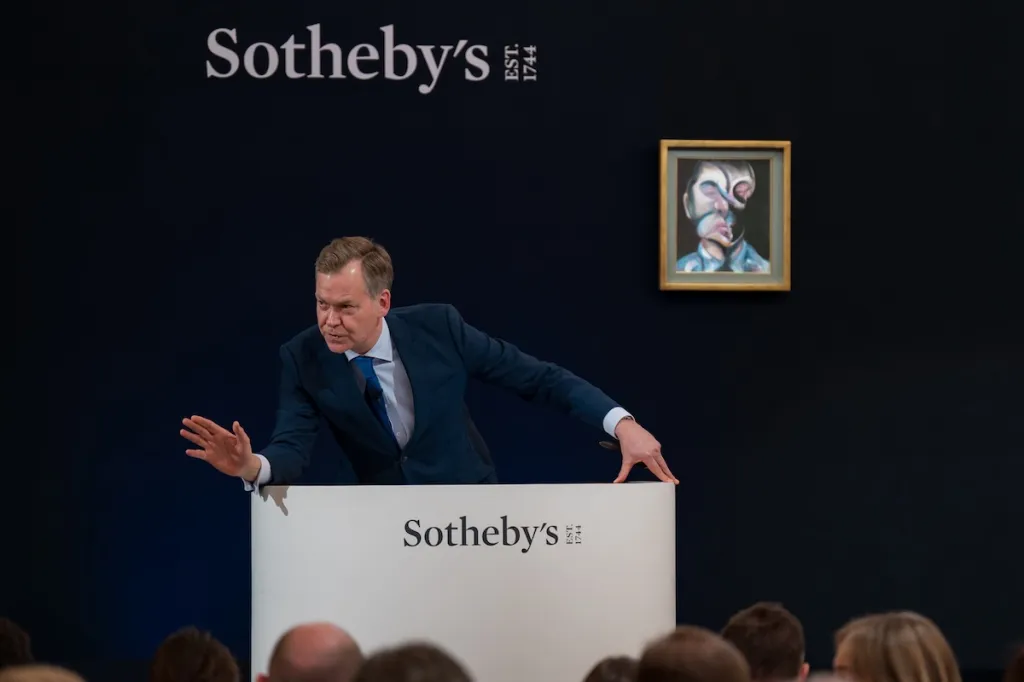
Auctioneer Oliver Barker just before he strikes his gavel to sell Gustav Klimt’s portrait of Elisabeth Lederer.
Julian Cassady Photography/Courtesy Sotheby's
During the pandemic-era art boom, flipping newly purchased works at auction, sometimes within a year or two, became common. That style of business is now proving far riskier.
According to the report, artworks resold within five years of purchase produced negative returns on average in 2025, losing about 5.7 percent annually. Works held longer than a decade, by contrast, continued to generate positive gains.
The shift has reshaped what collectors are buying. Historical categories such as Impressionist and Modern art saw strong growth last year, while the market for younger contemporary artists contracted sharply. Sales in the “young contemporary” segment fell roughly 40 percent last year. The message from collectors appears straightforward: after several years of speculation, it’s time to return to established artists and longer holding periods.
Another striking change is the growing role of financial guarantees in the auction system. For years the auction cycle has been beholden to the guarantees—agreements that ensure sellers receive a minimum price even if bidding falls short—that auction houses offer their clients. But today, the report says, nearly 80 percent of the value of New York evening sales in 2025 was backed by guarantees, the highest percentage since 2015. Even more notable is who is providing them. About 97 percent of guaranteed lots were backed by third-party investors rather than the auction houses themselves.
The arrangement helps auction houses secure major consignments while limiting their financial risk. But it also means outside collectors and financial partners are increasingly underwriting the market’s biggest sales, taking the surprise out of the market’s biggest public indicator.
The rebound in auction totals was also shaped by a surge of major single-owner collections. These dedicated sales, often built around estates assembled over decades, have become an increasingly important source of supply. Such collections tend to include museum-quality works that rarely appear on the market, which of course can spark intense competition among bidders.
Changing Demographics and Geography


Atmosphere at Frieze LA at the Santa Monica Airport on February 29, 2024 in Los Angeles, California.
River Callaway for ARTnews
Demographics are the root here.: Many of the most significant private collections in the United States were assembled by baby boomers during the late 20th century. As those collections are divided among heirs, donated to museums, or sold, auction houses could see a steady flow of high-value estates entering the market.
The report also suggests that the geography of collecting in the United States is shifting. Buyers in the western United States—including California, Washington, and Arizona—accounted for the largest share of art purchases in 2025, representing 35 percent of the total. Meanwhile, the Northeast has steadily lost market share over the past decade. In 2015, collectors in that region accounted for more than half of purchases above $1 million. By 2025, their share had fallen to roughly one-third.
Rising wealth in states such as Florida and Texas, along with a growing art ecosystem in cities like Los Angeles and Miami, has helped redistribute buying power across the country.
The report also challenges the longstanding claim that art functions as a strong financial investment. In 2025, works resold at auction generated average annual returns of about 4.4 percent, down from 5.3 percent the year prior. By comparison, the S&P 500 rose roughly 16 percent over the same period. Those figures, of course, do not account for the costs associated with owning art, including storage, insurance, and auction commissions, which can further reduce profits.
The data suggests that while art can produce significant gains over long periods, it may be far less reliable as a short-term investment than many market participants often claim.


