





The most sure-fire way to fund a creative career is family money. So says Mason Currey in his new book Making Art and Making a Living: Adventures in Funding a Creative Life—and only a whiny nepo baby could possibly disagree.
And yet, the history of art is no mere “history of rich kids.” Only egomaniacs get into art expecting sure-fire success. But more than that, I find it is often the people who most need the world to be different than it is who wind up the most creative, who need to shape what they have into something else. Stories of trials and triumphs punctuate Currey’s book, which is no how-to. Instead, it’s a trove of idiosyncratic, colorful stories—those titular adventures—that exemplify the many resourceful and creative ways artists have made it work.
Even in the first section on the fortunate, paths to family money are not always straightforward but rely on twists of fate. Arthur Schopenhauer, for example, would have been resigned to a life as a clerk in the family business, per his father’s orders, had said father not committed sudden suicide and left him an inheritance. As a woman and divorcée, Louise Nevelson hardly had access to an inheritance, but her brother proved generous and she made every cent count. When he helped her buy a 4-story brownstone, she filled almost every inch with sculpture, living exclusively off sardines and toast and rotating, for years, between her two gray sweatsuits. She was saving every cent, every square foot, and every ounce of energy for her art.
None of these stories are exactly replicable, hardly moldable into pat, prescriptive advice. Still, some patterns do emerge. Currey’s book is structured according to the tendencies he found, with a focus on stories that span the Renaissance to today.
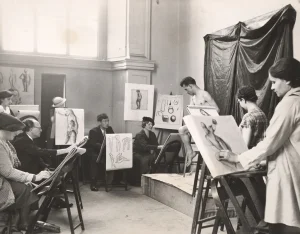
The second section is “Jobs.” There are artists with odd jobs, like Grace Hartigan, who worked as a nude model at the Art Students League, absorbing the instructor’s advice to students and getting a free art education in the process. Despite this and countless other gigs, she lived without heat in her New York apartment, as did Jackson Pollock and Lee Krasner and so many others, scrounging and scraping by. Philip Glass worked as a plumber and a taxi driver. Agnes Martin worked dozens of jobs: waitress, dishwasher, janitor, cashier, tennis coach, rabbit breeder, and so on. And Kathy Acker had a sex work stint, performing a simulated-sex Santa routine with her then-boyfriend in Times Square. “A straight job would lobotomize me,” Acker explained.
There are also moonlighting artists with double lives—who maintain full-on careers that have nothing to do with their art, in an effort conserve their creative energy for themselves and to free their art from commercial pressure. Kafka worked in the family asbestos mine, and William Carlos Williams was a doctor, delivering over 300 babies and even serving as Robert Smithson’s pediatrician.
But of course there are also artists with jobs that make use of their creative skills. Currey’s two examples take place at prestigious institutions: the Museum of Modern Art and Harvard University. At MoMA, Frank O’Hara wrote poems while manning the ticket desk after seeing a Matisse show and deciding he’d like to come back for free. His friends would visit and chat and pass the time until, eventually, he worked his way up to curator. Edward Steichen, Sol LeWitt, and Luis Buñel worked there too, and artist Howardena Pindell became the museum’s first Black woman curator while Jeff Koons was working the desk downstairs. Koons was a natural salesman, capable of charming crowds into MoMA memberships.
The book’s section on teaching is surprisingly short for the outsized role it has played in supporting artists, but maybe those stories were simply less interesting: Kurt Vonnegut, after all, said it was “spiritually pooping to care desperately about student work that probably isn’t worth caring about.”
Currey’s vivid writing turns mundanities into a page-turner. But his stories are also all pulled from secondary sources—like biographies and published journals—so don’t expect any new big discoveries. Whipping out the most fun facts at dinner parties, I’ve learned to be prepared that my companions may well reply: “I know.”
After family money and jobs comes a section on patrons—the book’s most troubling passage, both for the way artists are made to dance for the rich and for Currey’s glaring omissions. We learn that the US poet laureate’s annual stipend of $35,000 has not been adjusted for inflation since 1986, and that Joseph Haydn’s time as the court composer for a Hungarian prince paid him in “more floggings than food.” Only when the prince died could Haydn even play for other people.
James McNeill Whistler’s Peacock Room.
Photo Neil Greentree/Smithsonian/Wikimedia
Not one to play court jester, James McNeill Whistler—the subject of a retrospective at Tate Britain this summer—liked to turn the tables. Currey describes him as “demonstrating immense natural charisma and an equally immense antiauthoritarian streak”—a recipe for success? When commissioned to decorate a room in a London townhouse, Whistler went rogue, adorning the walls in leather and gold leaf. Then, despite his patron’s displeasure, he asked for a raise, hoping to be paid in guineas rather than pounds. The former—which equals one pound plus one shilling—typically went to professionals; pounds were for tradesmen. After his request was denied, Whistler made an addendum to the room, painting a peacock hoarding silver coins at its feet—an unflattering portrait of the patron himself emblazoned right there on his own walls. It was a real class act.
These are entertaining stories, but they are hardly the most important: not a single Medici or museum commission is mentioned in this “Patron” section. The quirky eccentricity can be charming and fun, but on occasion, elisions disturb. The second “Patron” chapter is titled “Government Checks,” and it contains only one example: the New Deal–era Works Progress Administration, which staved off unemployment by commissioning posters and murals from artists deemed “workers with a brush.” This choice paints the picture that government funding is a rare occurrence, a pipe dream—but this is flatly false. So many other nations, from Germany to Qatar to Canada, fund art past and present much more generously than the United States—never mind that the New Deal itself had several other programs for commissioning art, and that the New Deal was hardly our only attempt. Instead of looking anywhere else—to China or Scandinavia or the Soviet Union—the checks chapter stays put in New York and pivots, improbably, to Peggy Guggenheim. She’s a worthy patron, to be sure, but she is no elected official. Doubly odd, she is the book’s sole art collector besides Theo Van Gogh.
The writer confesses that “the pressure I felt to create a container for all these stories, and make some kind of sense of them, truly overwhelmed me.” But he did, eventually, create containers; he just failed to fill some of them.


Harlem Community Arts Center in 1938
Photo David Robbins/Works Progress Administration, Federal Art Project
For instance, the third “Patrons” chapter, “True Fans,” advocates crowd funding, even arguing that “some of the most successful instances of patronage in art and literary history have come not from powerful rulers, wealthy industrialists, enterprising heiresses, government programs, or internet strangers, but from other artists who have recognized a need and stepped into meet it.” Intriguing. But the eclectic examples brought in hardly support this claim. We get an early subscription model; Substack; the cadre of literary greats (Hemingway, Eliot, Yeats) who supported Ezra Pound, unbothered by his pro-fascist, antisemitic views; and Augusta Savage, who received crucial encouragement in the form of a state fair prize before establishing and directing the Harlem Community Art Center.
That Center, in turn, launched the careers of Romare Bearden and many others. But it was also a New Deal project, not exactly artists pooling resources. I guess, then, it’s welcome news that Currey’s narrative is a misleading one, for if the most successful models in history were really Substack and some boys club, we’d be even more doomed than we already are.
The final section has the most enticing theme—“Schemes.” In it, we see artists getting creative not only on the canvas or the page, but in the ways they run their lives. Chantal Akerman made Jeanne Dielman, 23 Quai du Commerce, 1080 Bruxelles—which topped Sight and Sound’s 2022 poll of the greatest films ever made—as a 24-year-old high school dropout. How? She got a job at a porn theater and pocketed $4,000, making the books look clean by ripping tickets in half and sharing them among customers, distributing one for the price of two and keeping half. It helped—30 times as much—that she also got a $120,000 grant from the Belgian government.

Sgt. Romare Bearden in February 1944.
Jean-Luc Godard, Akerman’s biggest inspiration, funded his early films through theft, too. Though born to a wealthy family, he was cut off when he got rejected from film school but clung steadfastly to cinema anyway, opting to teach himself by watching four movies a day. His parents had planned to support his education, but not like this. So he stole rare editions of Paul Valéry books from his grandfather, the executor of the poet’s estate, and is even believed to have stolen and sold his grandpa’s Renoir.
John Cage, a more benevolent schemer, got his big break by winning money on an Italian game show, where he answered questions about mushrooms, one of his great passions, and, at the age of 46, w five million lire—almost $90,000 in today’s money. It was “the first consequential amount of money I’ve earned,” he explained. Another “scheme,” according to Currey, is just Romare Bearden on the GI bill. But even plenty of anti-welfare fiscal conservatives would agree the GI Bill was hardly scheming. Reading Making Art and Making a Living, you’d totally miss that the world of contemporary art is full of, if not epitomized by, blue-chip schemers, those taped-banana vendors and crypto-crazed con men skilled at convincing the ultra-rich to pay big sums for… what, exactly? The elusiveness is the appeal.
Then there are the artists who are simply bad with money, focusing all their energy intensely and with tunnel vision on their craft. Artists like Martin Kippenberger and Bernadette Mayer flatly refused to waste their energy on dismal accounting, with Kippenberger spending (and drinking) recklessly and Mayer never even opening a bank account: she kept her money instead in a book of Shakespeare’s sonnets. She once wrote, “i write unbalanced poetry, i cannot balance my checkbooks, nor do i have one.”
This is no book expressing class rage, and though I’m all for letting stories speak for themselves, the greater narrative they cumulatively tell leaves something to be desired. Painting such a scant picture of government funding makes it seem unimaginable, but it isn’t; and some of the omissions and labels do no justice to the revolutionary resourcefulness that the best artists embody. Think of Nan Goldin, who said that, for her community, survival was an art, and her pictures prove it—grit and glamor, poverty and principle coalescing into snapshots. Goldin and plenty of others remake the economics of daily life, and this is part and parcel with their artwork rather than simple failure or bad management. They didn’t just struggle to find a place in an unjust economy; they refused to.
Currey withholds judgement, to be sure, it’s just that his schemers are drunks, thieves, and GI-Bill welfare queens. What about Pippa Garner, who, trained in industrial design, spent her life staving off drudgery by playing inventor, imagining fantastical interventions that capitalism could never reduce to mere commodities? She performed as a capitalist—titling her last solo show “Sell Yourself”—but lived a life of poverty, a gig worker supplemented by a government check for her exposure to Agent Orange. What about Beverly Buchanan, who bartered with artworks for ordinary services like doctors’ visits and plumbing?
There’s one more unspoken but persistent theme: artists who think they are on a linear path toward ascendency only to face a midcareer crisis, abetted by economic turmoil or simply changing tastes. The poet John Berryman scored a prestigious job at Harvard only for the spring of 1943 to roll around and send his students, almost all men, off to war, cancelling his class. In desperation, he took out a classified ad in the New York Times offering to do anything: “would like to continue living and writing if possible.”
“Maybe I was naïve,” wrote Bernadette Mayer, “to think if you’re pretty famous and you’ve been influential in the literary scene and in the art world for over five decades, and you’re living, you’d be set.” But it is probably John O’Hara who said it best, speaking for most of us when he began a letter to a New Yorker editor with a simple request: “I want more money I want more money I want more money I want more money I want more money I want more money I want more money I want more money I want more money I want more money.”


