


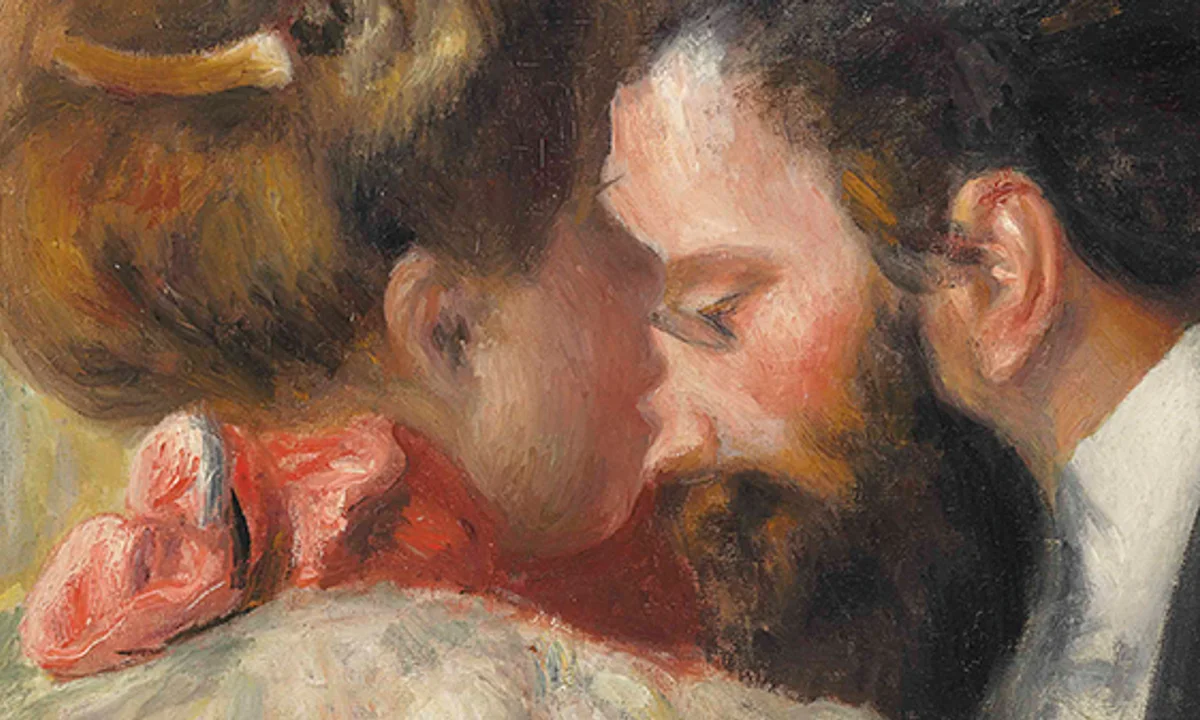
The British art historian John Golding regarded Pierre-Auguste Renoir (1841-1919) as having a restless mind. The French artist was also someone who knew how to hustle. In his History of Impressionism, John Rewald relays how, as a 20-year-old enrolled in the Swiss painter Charles Gleyre’s studio, the budding artist was so hard up, he would pick up the tubes of paint other students discarded, to squeeze out every last drop of paint.
Hardship and experimentation are hardly the first things that come to mind when some people talk of Renoir, however. His detractors, those who itch for a bit more spice, or edge, to their art, have variously deplored his “saccharine scribbles”, his paying “no heed to line and composition”, his “pretty little paintings”. But that, the forthcoming Renoir double bill at the Musée d’Orsay in Paris seeks to demonstrate, is largely because most people have stopped actually looking at his work.
Renoir and Love: A Joyful Modernity (1865-85) opens on 17 March alongside Renoir Drawings, which travels from the Morgan Library and Museum in New York. “The last big exhibition of his paintings at Orsay dates back to 1985,” says the curator Paul Perrin, “which a few people might remember, but not that many.”
Impressionist founder
Where the 2009 show Renoir in the 20th Century at the Grand Palais covered the artist’s latter years, the focus here is on the first 20 years of his work during which he is a founding member of Impressionism then bit by bit detaches himself from it, through a continued focus on scenes of modern life. “All these works where Renoir depicts contemporary life—entertainment, leisure pursuits, boating, dancing, eating, the streets of Paris, the theatre—all this truly modern inspiration means that Renoir, during these years, can be considered one of the great painters of modernity,” Perrin says.
Along with masterpieces that have not graced Paris in decades, such as Luncheon of the Boating Party (1880-81), visitors will get to see pieces from private collections, like Confidence (1897) which was once owned by Greta Garbo, that are hardly ever shown in public. After Paris, the show will travel to the National Gallery in London and the Museum of Fine Arts in Boston. For the three museums, Perrin says, it is an invaluable opportunity to contextualise the popular Renoir paintings that they each hold: Dance at Le Moulin de la Galette (1876) in Paris, The Umbrellas (around 1881-86) in London and Dance at Bougival (1883) in Boston.
Renoir’s Le Déjeuner des Canotiers (1880-81) will be in the show, which will travel to London and Boston after Paris
Photo courtesy of the Phillips Collection, Washington, DC
Love, it transpires, is the golden thread linking them all. Renoir saw the world through the lens of human relations, not just those of seduction between men and women, but conversation, discussion, friendship, camaraderie—and, more broadly, family, conviviality, fraternity. “It’s what sets him apart from Manet, Degas and the others,” Perrin says. “His modernity is that of human connection.”
Look closely and you see Renoir seeing people not through bourgeois sentimentality but with eyes wide open because these are his people. When Degas or Manet depict prostitutes or café workers, Perrin says, they do so with the remove of a middle-class observer. Not Renoir, whom Christopher Riopelle, a curator at the National Gallery, describes as “a working-class lad”. Riopelle adds: “He came from very simple stock in Limoges. He suddenly found himself in the middle of Paris, basically in a slum, and he had to work his way up. And so I think, as for many of us, friendship took on an extreme importance for him—male friendship, female friendship, whatever—as a way to situate himself in the world.”
• Renoir and Love: A Joyful Modernity (1865-85), Musée d’Orsay, Paris, 17 March-19 July; National Gallery, London, 3 October-31 January 2027; Museum of Fine Arts, Boston, 20 February-13 June 2027
• Renoir Drawings, Musée d’Orsay, Paris, 17 March-5 July
