







The UK’s Kent County Council is selling off a chunk of its art collection on Tuesday (10 March), including a cache of prints by Tony Ray-Jones, a key figure in postwar British photography.
The auction features 168 lots originating from the Kent Visual Arts Loan Scheme (KVALS), and includes an early work by the British artist Andy Goldsworthy, a lithograph by Australian artist Sidney Nolan, and a significant archive of 33 photographs by Ray-Jones, many depicting public festivities and local traditions across the county.
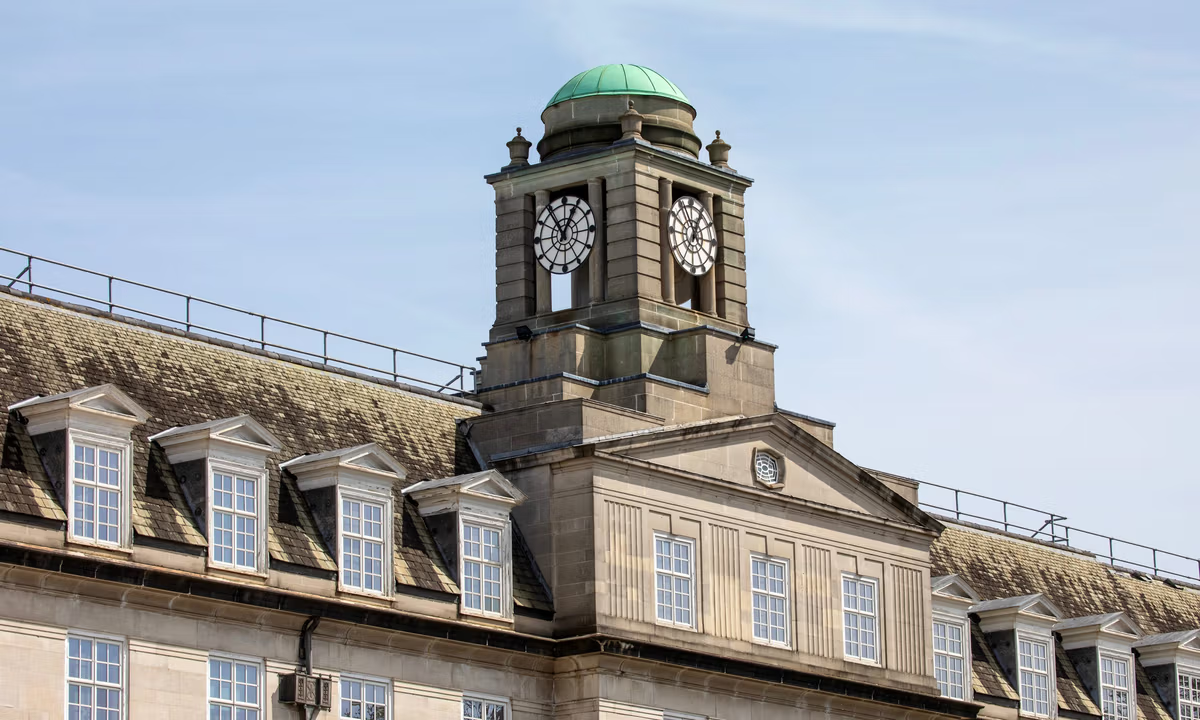
The Reform-led council says the collection has been stored in the basement of County Hall in Maidstone and now needs to move. “Due to the lack of viable alternative storage options and in light of the significant financial pressures facing the county council, no suitable alternatives were identified,” a spokesperson tells The Art Newspaper. However, the council admits that the works have not been offered to any of the county’s museums or galleries. The authority also faces a severe budget deficit, and Reform has yet to deliver tax cuts promised ahead of winning control of Kent in last spring’s local elections.
The council had not responded to a request for comment on the reasons for selling the work, and whether it or a previous administration initiated the sale, by the time of publication.
“The disposal of significant photography and other artwork [from public collections] is always a concern, especially when it includes rare work from figures such as Tony Ray-Jones—one of Britain’s great documentary photographers and an inspiration to luminaries such as the late Martin Parr,” the photography historian Michael Pritchard tells The Art Newspaper. “Kent’s short-term financial gain will be at the long-term cultural expense of Kent residents and visitors.”
Ahead of an earlier sale of works from the collection, held at Sworders Fine Art Auctioneers in July 2025, the council said that an unnamed art historian had advised that the items for sale “might not represent any official historic value but are nonetheless interesting”. That sale included works by established artists including Norman Ackroyd, Victor Passmore and Anthony Gross, many of which illustrated town and country scenes from around Kent. The net income was £29,060, the council spokesperson says, which they say was put towards a “Culture and Creative Economy Service revenue budget“. The Art Newspaper has requested more details of the budget.
John Brazier, who was the head of arts and museums at Kent Council from 1990 to 2005, takes a different view. He acquired the Tony Ray-Jones photographs that are in the sale, after an exhibition that toured the county in the late 1980s. They were bought to be part of the KVALS—set up for the lending of work to schools and workplaces—and were stored in proper archival facilities in a converted hangar at RAF West Malling, a former Royal Air Force station. The scheme, however, was mothballed at least a decade ago.
“They [the council] don’t know what they have,” says Brazier. “The value of having the work in Kent is a great deal more than the value of flogging them off.”
Ray-Jones, who was born in Wells, Somerset, had local connections, having spent early childhood in the Kent town of Tonbridge, and many of his photographs in the sale depict public gatherings from around the county, such as May Queen celebrations in Chatham, a Dickens festival in Broadstairs, and a beauty contest in Margate. All were taken during a two-year period in the late 1960s when the photographer embarked on a major project documenting the English at leisure. The series, A Day Off, was posthumously published by Thames & Hudson in 1974, two years after his death at the age of 31. Several pictures from A Day Off appear in the Sworders auction on 10 March, and a number are included in a current display at Tate Britain, Modern and Contemporary British Art, which runs until 17 May.
“His work helped elevate documentary photography into the realm of British art,” says Nicoletta Lambertucci, the curator of Modern and contemporary British art at Tate. “It continues to resonate as an invaluable cultural record of a society in transition, made all the more poignant by the tragically short span of his life and career.”


