







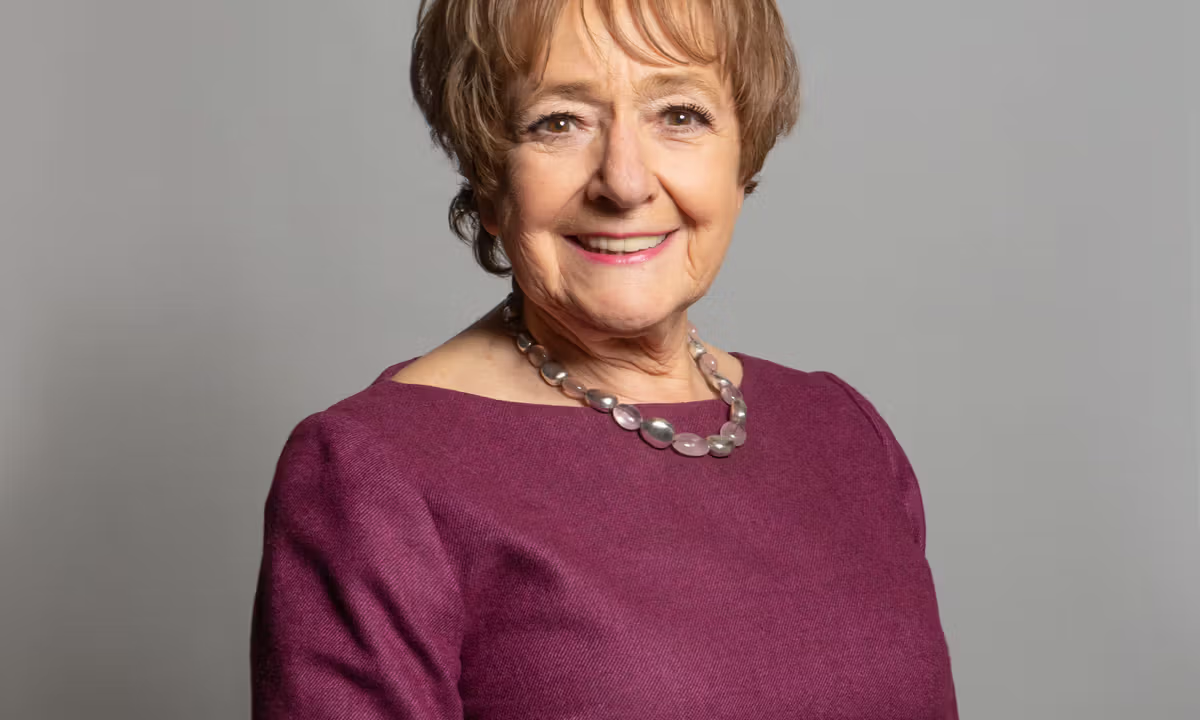
The UK government has responded to a far-reaching review of Arts Council England (ACE) by the Labour peer Margaret Hodge, saying that it welcomes her “wide-ranging vision of reform” for the arm’s length public funding body, including the idea of charging international visitors admission fees at UK national museums.
While some proposals have sparked concerns, the government has said it recognises that “implementation will require a phased and balanced approach, and some recommendations will require difficult choices about funding, timing and prioritisation”.
Hodge’s review, overseen by the UK Department for Culture, Media and Sport (DCMS), was published last December. “My report provides a clear path, with a range of new initiatives that cover everything from new funding models to fundamental systems reform, that will enable ACE to strengthen its key, positive role in sustaining a world-class creative sector for the future,” Hodge said.
In its long-awaited response, the government said it “strongly agrees” with Baroness Hodge that there must be a national Arts Council, and that the “arm’s length principle”—the principle that ensures Arts Council England’s individual funding decisions are taken outside of political interference from all levels of government—must be protected.
In order to fill funding gaps for the arts and culture sector, the government says it believes charging international visitors at national museums could “provide significant benefits” and will work with the museum sector to “explore options for charging international visitors”.
But the proposal angered some cultural commentators. Alison Cole, the director of the Cultural Policy Unit thinktank and the former editor of The Art Newspaper, told the Guardian that charging overseas visitors would be a “very bad idea”. This view is echoed by Maria Balshaw, the outgoing director of Tate, who said earlier this month: “What does it say to people from the rest of the world if we say, ‘We’ve got your stuff, but we’re going to charge you to come in’? I don’t like that idea.”
The Hodge review also recommended a levy on overnight stays, boosting plans for a so-called tourist tax supported by the Cultural Policy Unit. The government recently launched a consultation linked to a new discretionary power for Mayoral Strategic Authorities (areas run by mayors) to introduce a visitor levy on short-term, overnight accommodation, whose results will be published in due course, according to the government. Research from the charity Art Fund showed that 72% of the public supported a tourist levy subsidising free entry to national museums.
Hodge also recommended new “ways of responding urgently to the underfunding that has undermined the arts over the last decade”, giving new funding proposals based on philanthropic giving and tax incentives. DCMS says it will provide evidence to HM Treasury regarding new tax reliefs and will soon publish a roadmap to support the “growth of place-based philanthropy”.
The government also supports the recommendation that ACE should work with the museum sector to develop a strategy and long-term plan for the sector, “working closely with DCMS and voices across the sector including DCMS-sponsored museums and galleries”.
The government also backs Hodge’s ideas for overhauling the model for National Portfolio Organisations (NPO) that receive regular funding from ACE, which distributes more than £680m annually. It strongly agrees with Baroness Hodge that the application and monitoring processes must be less bureaucratic and onerous for organisations, earmarking up to £8m in new funding to enable ACE to invest in their systems. There should be longer funding rounds for the NPOs of up to five years, rather than the current three-year period, the government adds.
Hodge urged support for emerging and mid-career arts professionals. “ACE should introduce a new National Programme for individuals, using money from existing funding streams” and “providing individuals with funding of around £30,000 per year and mentoring support,” said her report. The government subsequently pledges to “understand routes” to support individual artists and to establish a fund for future artists and creatives.
The UK’s minister for creative industries, media and arts Ian Murray said in a statement: “We will stand alongside the Arts Council as they implement these reforms to revolutionise the way we fund the arts in this country and the way we work with creatives and the public to provide the access to culture that our country needs, wants and deserves.”
Arts Council England issued its own response, saying that over the next year, it will focus resources on five immediate priorities: a new strategic framework; a new National Portfolio process; a new service for individuals including artists; a new online platform, where people can apply for our funding and access its services; and a “renewed focus on growing investment for England’s cultural sector”.
ACE chief executive Darren Henley said in a statement: “We’re committing to removing old barriers and building new bridges to success. That means you’ll see an Arts Council that is simpler, more straightforward and more responsive. We all want more artwork and less paperwork.”


