








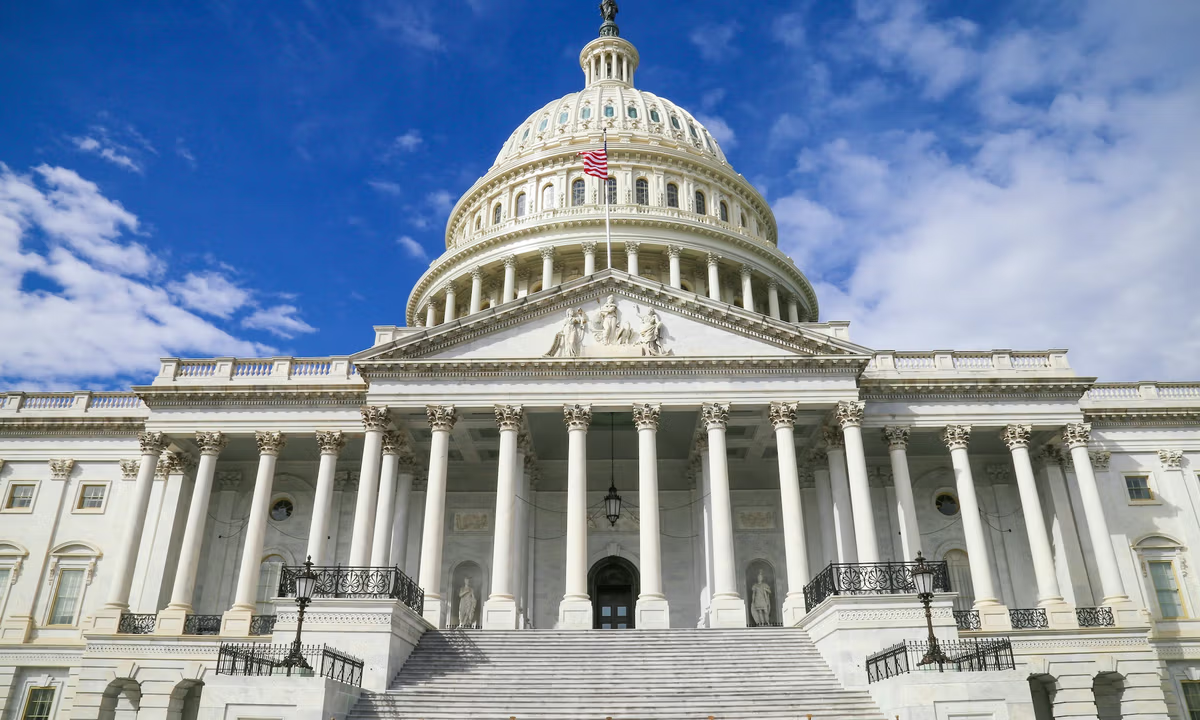
The US congress has approved legislation that will deny museums and other art owners many of the standard protections that are routinely available to defendants in lawsuits, if the claim is to recover Nazi-looted art. With the house of representatives’ approval on 16 March, the Holocaust Expropriated Art Recovery (Hear) Act of 2025 will now become law upon president Donald Trump’s signing, having been approved by the senate in December. The Hear Act of 2025 not only continues the 2016 Hear Act that would have expired at the end of 2026, but also prohibits numerous traditional defences such as “laches” and the usual deference by US courts to the domestic actions of foreign nations.
After Monday’s unanimous approval in the house, the bill’s bipartisan co-sponsors lauded the act’s elimination of procedural defences in Nazi-era art recovery claims. Representative Laurel Lee (Republican of Florida) said the new version of the law ensures that such claims “are evaluated on their merits—not dismissed because of technical legal barriers”. Representative Jerrold Nadler (Democrat of New York), who led efforts to pass the original Hear Act of 2016, said the house had affirmed that plaintiffs with credible claims deserve “to have their day in court, with their case heard on the merits alone. Justice must no longer be denied due to procedural technicalities”, legislative sunset provisions, or “a legal loophole”.
The new law continues the remedy provided in the Hear Act of 2016 to perhaps the most common obstacle in Nazi-era art restitution claims: state statutes of limitations that bar lawsuits after certain time periods. The extension continues the original law’s national, six-year time limit to sue, after the claimant actually discovers certain key aspects of the claim. Unlike the original law, it contains no “sunset” or expiration.
“Technical barriers to claims against American possessors can have the effect of codifying a crime, permanently shielding looters and denying families the last tangible links to the lives that were stolen from them,” Mark Weitzman, the chief operating officer of the World Jewish Restitution Organization (one of the organisations that supported the new legislation), said in a statement. “We now urge American museums to greatly expand provenance research of their collections in order to ensure transparency and so that family members can find artwork which was looted from their families.”
In a statement predating the bill’s passage, the Association of Art Museum Directors (AAMD), which established museum guidelines on resolving Holocaust-era art restitution claims in 1998, raised concerns about the new version of the Hear Act, writing that AAMD supported extending the law in its original form, without the expanded defences or perpetual duration. The removal of traditional defences “would set a dangerous precedent by overturning fundamental principles of our legal system”, threaten relations with foreign countries, undermine reasonable and good-faith defences that institutions might offer in the face of a claim, and could lead to more litigation. For example, the new version precludes “all non-merits discretionary bases for dismissal”, without defining those “bases”, Sascha Freudenheim, a spokesperson for AAMD, told The Art Newspaper.
In contrast, Nicholas O’Donnell, a lawyer in Boston who represented Alan Philipp in a claim against Germany to recover the medieval Welfenschatz, or Guelph Treasure, which the US supreme court denied in 2021, said the Hear Act’s extension “is important news” and a “repudiation” of the court’s decision against Philipp. That decision was based on the “domestic takings” rule, which the Hear Act of 2025 eliminates as a defence. In the Philipp case, the supreme court said the heirs of German Jewish art dealers who sold the Guelph collection to the Prussian Nazi government in 1935, allegedly under duress, could not sue Germany, because the Foreign Sovereign Immunities Act requires a claim that a foreign government took property in violation of international law. International law did not cover expropriations of property belonging to a country’s own nationals, the court said.
Foreign states “will now be subject to lawsuits and the jurisdiction of the US courts for Nazi-era art claims in the manner that congress always intended”, O’Donnell tells The Art Newspaper, calling the measure “a welcome corrective”.
Another defence eliminated by the Hear Act of 2025 is laches, which lets a defendant argue that the claimant waited too long to sue and thus unfairly prejudiced the defendant due to consequences such as loss of evidence. In 2019, the second circuit court of appeals said the Hear Act did not preclude the Metropolitan Museum of Art from raising a laches defence, which barred a claim to recover the painting The Actor by Pablo Picasso, which the plaintiff alleged her Jewish ancestors sold under duress in Nazi-era Italy. Mary-Christine Sungaila, a lawyer for the plaintiff in that case, applauded the congressional action.
“Had this been clarified years ago, my client Laurel Zuckerman—like many others—would have been allowed to proceed to litigate the merits of her claim,” Sungaila says. With the Hear Act of 2025, “congress allows those with long and still-pending claims to have the chance many never had: have the courts reach the merits of their family’s disputes over ownership of Nazi-looted art”.
The new law will preclude defendant claims of acquisitive prescription, which under certain foreign laws can establish ownership in a work if the holder possessed it for a certain period of years without actually knowing it was stolen. Also set aside are the act of state doctrine, under which US courts do not hear claims based on a foreign state’s actions inside its own territory, and deference to foreign nations under “international comity”, which lets courts choose to decline to hear cases involving a foreign nation’s legislative, executive or judicial acts, based on mutual respect.


