






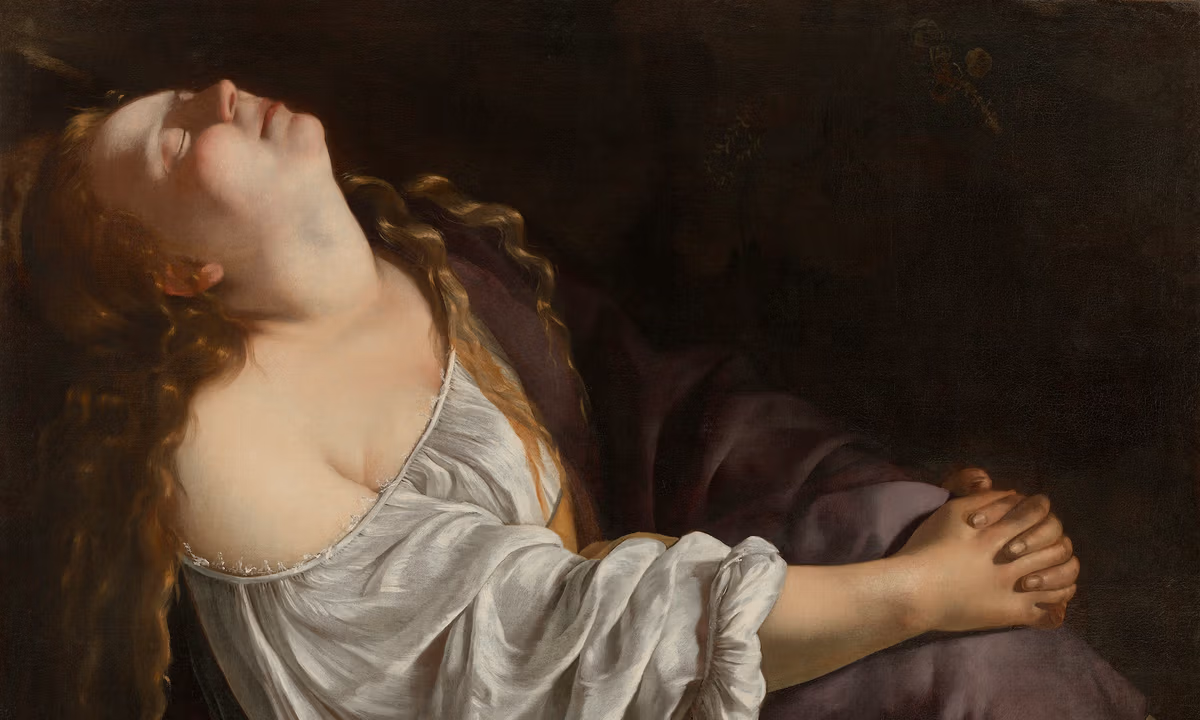
Some of the world’s leading art museums have been busy snapping up works by Artemisia Gentileschi, the Italian Baroque painter known for her varied and vivacious depictions of women. Now it is the turn of the National Gallery of Art (NGA) in Washington, DC, which is set to announce today that it has acquired Mary Magdalene in Ecstasy (around 1625).
The daughter of the Tuscan-born Caravaggesque painter Orazio Gentileschi, Artemisia (1593-around 1654) led a dramatic and itinerant life, which took her from Florence and Rome to Venice, Naples and the English court of Charles I. The new NGA painting belongs to her so-called “second” Roman period, which lasted from 1620 to 1626 or 1627. Eve Straussman-Pflanzer, the museum’s curator and head of Italian and Spanish paintings, says that these years, when the artist did without a workshop, produced “some of her strongest works”.
The painting depicts the titular saint, her face turned upward, “going through the throes of change from a secular life to one of devotion”, says the curator. Shown without her usual attributes of a skull or an ointment jar, or any other signs of penitence, Mary Magdalene is instead depicted in a state of near undress, a shoulder provocatively exposed.
Though produced around three decades before Gian Lorenzo Bernini’s 1652 sculptural altarpiece, The Ecstasy of St Teresa, which theatrically fuses sexual pleasure with religious transformation, Mary Magdalene in Ecstasy might also simultaneously suggest the erotic and the spiritual, says Straussman-Pflanzer. Even before Bernini’s revolutionary work, she says, the 17th-century Catholic imagination did not regard the two at cross purposes, as we might. “That binary that we now use between the spiritual and the erotic was actually then closer, and entwined in a way that is very hard for us to understand.”
Straussman-Pflanzer arrived at the NGA in 2020 from the Detroit Institute of Arts, which includes in its permanent collection another prominent work by Gentileschi from that same Roman period, Judith and Her Maidservant with the Head of Holofernes (around 1623-25).
Straussman-Pflanzer says she has long had her eye on Mary Magdalene in Ecstasy, which resurfaced in the south of France in 2011 after the Italian art historian and curator Gianni Papi used a black-and-white photograph in a Sienese library to help authenticate it.
The painting set an auction record for the artist in 2014, when Sotheby’s sold it in Paris for €865,500 ($1.2m, all prices include fees).Straussman-Pflanzer went on to include it in her show By Her Hand: Artemisia Gentileschi and Women Artists in Italy, 1500–1800 (2021-22), done in Detroit, in conjunction with the Wadsworth Atheneum museum in Connecticut. That show also included Artemisia’s Self-Portrait as Saint Catherine of Alexandria (around 1615-17), sold in a 2017 Paris auction for a hammer price of €1.85m ($2.1m), and then acquired by the UK’s National Gallery.
Mary Magdalene in Ecstasy was acquired by the NGA from a private collection for an undisclosed sum.
Artemisia Gentileschi, Lucretia, around 1627 J. Paul Getty Museum
The current record for the artist at auction dates to an Artcurial sale in Paris in 2019, which saw a premium price of €4.8 ($$5.3m) for Lucretia (around 1627), which was then acquired in 2021 by the J. Paul Getty Museum. And this week, her market is being tested again when Christie’s in New York auctions an early self-portrait with an estimate of $2.5m to $3.5m.The current auction record for a female Old Master came in a 2019 Sotheby’s sale in New York, when Élisabeth Louise Vigée Le Brun’s monumental 1788 portrait of Muhammad Dervish Khan, an Indian ambassador sent to France, sold for $7.2m.
Straussman-Pflanzer says the NGA’s new Artemisia Gentileschi does not need any conservation work but is set to undergo a new round of technical analysis, which, among other tasks, “will try to assess the pigments that she used”.Right now, the museum is waiting for a new 17th-century frame to arrive from a Swiss dealer. Then the plan is to exhibit the work in late February in the same area as a few paintings associated with her father, Orazio, including the The Lute Player (around 1612/1620), long in its collection.“But with a lot of space between it and the Artemisia,” she adds.


