





To receive Morning Links in your inbox every weekday, sign up for our Breakfast with ARTnews newsletter.
The Headlines
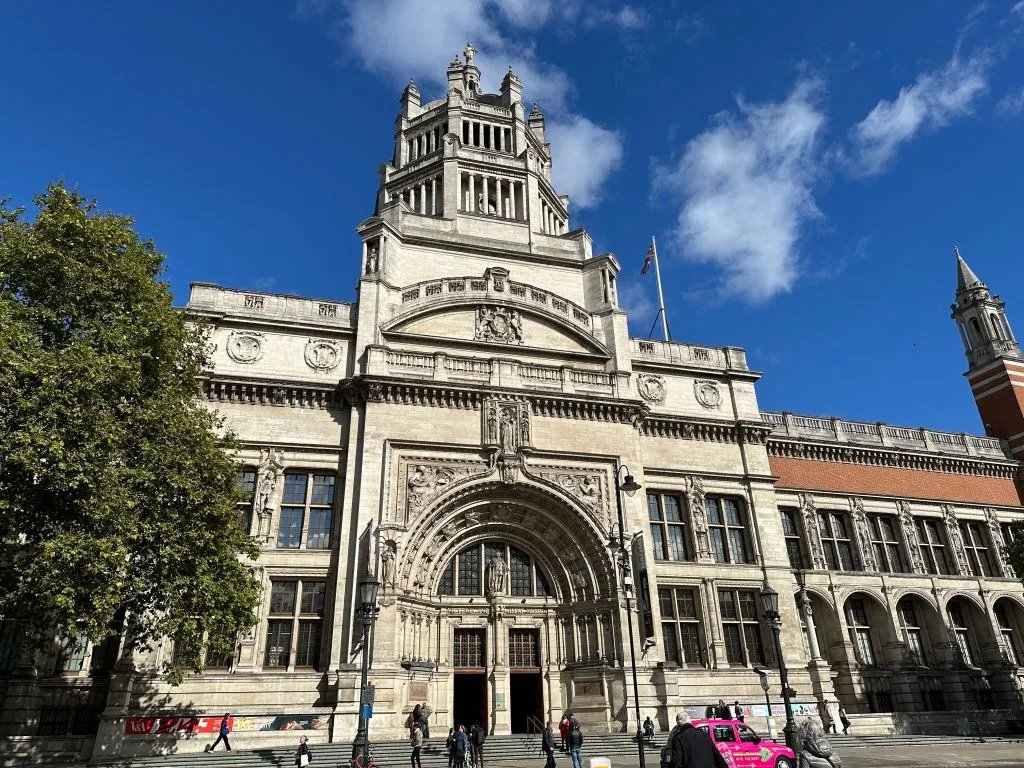
CHINA’S RED PEN. The Victoria and Albert Museum censored maps and images in its catalogues following objections from its Chinese printer and state authorities over content deemed sensitive to Beijing, the Guardian reports. The museum agreed to remove material from at least two recent exhibition publications, including an image of Vladimir Lenin and a 1930s illustration of British imperial trade routes featuring a map of China. In a statement, the institution said it was “comfortable making minor edits.” However, the Guardian’s investigation suggests there was internal unease over the unexpected demands. An email reviewed by the newspaper from Chinese printer C&C Offset Printing, which produced the catalogue, said the original map had been “rejected” by Beijing’s censorship body, the General Administration of Press and Publication. “Our suggestion is to delete this map or use another image,” the email continued. The museum complied, but staff were reportedly baffled. “It’s a historic map showing British colonial rule, so nothing to do with China, just shows China on the map and that seems to be enough to warrant rejection!” one internal exchange read. “So sorry, must have been very stressful,” wrote V&A East director Gus Casely-Hayford after learning it was too late to switch printers and that the intervention had delayed publication.
HIGH MUSEUM HITS LOW POINT. Former chief operating officer of Atlanta’s High Museum of Art, Brady Lum, pleaded not guilty on Tuesday to a federal theft charge, ARTnews reports. The US Attorney’s Office for the Northern District of Georgia alleges Lum manipulated financial records and approved fraudulent purchases to fund personal expenses, including musical instruments, private lessons, and workshop equipment. The charges stem from an internal investigation that found Lum misappropriated roughly $600,000 over several years while serving as COO from January 2019 until his resignation in December 2025. Lum “betrayed one of Atlanta’s civic crown jewels,” said US Attorney Theodore S. Hertzberg. “Our office will move with swift precision to prosecute individuals who abuse positions of power and trust to enrich themselves at the expense of nonprofit institutions.”
The Digest
German culture workers have signed a letter in protest of alleged “attempts by politicians to intimidate freedom of expression and artistic freedom,” via a new government policy of reviewing lists of jury members at art institutions, who are responsible for awarding funding and art prizes. [Der Spiegel]
A Financial Times story about Sotheby’s offering 7 percent interest to delay paying sellers their proceeds “relied on creative interpretation of data” and “a mishmash of unrelated financial figures,” to indicate weakness in the art market, argues market reporter Marion Maneker. [Puck, Wall Power]
The California Science Center in Los Angeles has finished building a new space center, three decades in the making, and will display the space shuttle Endeavor in a vertical, ready-to-launch position. [Los Angeles Times]
An activist with the group New Generation, wearing a face mask depicting German Economic Minister Katherina Reiche, glued herself to a coin display case in Berlin’s Bode Museum to protest the government’s economic policies. [dpa]
The Kicker
DOOR’S ALWAYS OPEN. The Financial Times stepped inside the home of Rirkrit Tiravanija on the outskirts of Chiang Mai, where lush greenery spills through expansive windows and creeps into the interior itself. Much like his practice—transforming museums into social spaces with makeshift kitchens and replicas of his own apartment—his geometric, airy concrete house on stilts is designed for gathering. “I think of this house as both a public and private space and, in a way, it’s always open,” he said. That ethos extends to his long-standing interest in architecture, now on view at Pirelli HangarBicocca. The exhibition, “The House That Jack Built,” curated by Vicente Todolí, centres on installations inspired by modular modernist buildings—“the mess that one finds hanging off a perfect Corbusier building,” as Tiravanija put it. The show also includes a replica of his Thai home. For Tiravanija, the communal table remains a guiding metaphor: “I’m happy to make the table, but I wouldn’t want to sit at the head of it—or even in the middle. I’d rather sit at the corner,” he said. “In that sense, I think of spaces, houses, rooms, architecture, as platforms for others to react to and collaborate in.”


