





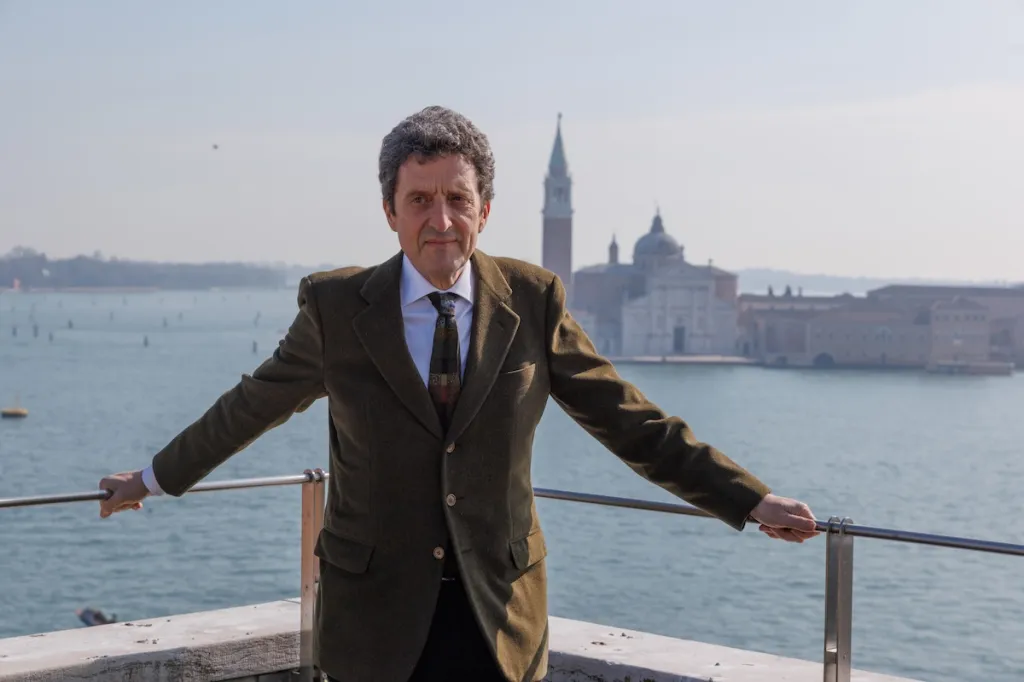
Venice Biennale president Pietrangelo Buttafuoco said this week that he had no qualms about hosting the Russian Pavilion for the first time since the onset of the country’s invasion of Ukraine.
“The Biennale is independent; I’d do it all over again for the Russian pavilion,” Buttafuoco told the Italian publication Corriere della Sera in a candid interview that touched on his politics and his views on how the Biennale should function with regard to geopolitics. “With us, art wins.”
The Biennale’s choice to let Russia mount its pavilion was a particularly controversial one. It cost the Biennale a 2 million euro grant from the European Commission, a cabinet of the European Union that claimed the pavilion ran in defiance of international law. It also resulted in protests from other nations participating in the Biennale, along with many artists in the main exhibition, who also denounced the pavilions for the United States and Israel.
Amid the protests, the Biennale claimed it could not keep any country that is recognized as such by Italy from staging a pavilion. In March, ahead of the opening of the 2026 edition, the Biennale said it “rejects any form of exclusion or censorship of culture and art.”
The Russian Pavilion ended up allowing visitors only during the preview days; it is now closed to the public.
Even within Italy, Russia’s pavilion proved polarizing. Alessandro Giuli, the Italian culture minister, said, “Putin won at the Biennale.”
The Corriere della Sera interview featured a new response from Buttafuoco to that remark: “Putin didn’t win, art did. The Biennale won not because of me, but because of the history of an institution that looks to the world and that, throughout its 131 years, even during many conflicts, has always welcomed everyone. It would have been impious to suspend an ancient precept of our civilization, that of the truce at the Olympics.”
He also addressed the European Commission’s pulled grant, saying, “In all the formal and official acts, there is not a single comma that violates laws and regulations.”
Since taking the helm at the Biennale three years ago, Buttafuoco’s politics have been the matter of some scrutiny. “I am not a fascist,” he once said. “I am something else.” What that “something else” might be has been confusing: He has spoken in support of Italian cultural identity, a core tenet of right-wing politics in the country, per the Guardian, which labeled him “an eccentric type of conservative.” Yet he has also critiqued conservatives on a host of issues, including the right to bear arms. Moreover, his conversion to Islam in 2015 alienated some right-wing politicians, including Giorgia Meloni, who is now the nation’s Prime Minister and whose administration has since gone on to praise Buttafuoco.
Asked if he felt “close to the right wing” today by Corriere della Sera, Buttafuoco said, “I have an identity, not a membership. Within the Biennale, I serve the institution, not my own personal beliefs.”
Buttafuoco’s interview came out during the start of the Venice Film Festival, and the occasion led the art Biennale to find a surprising supporter in Sergei Loznitsa, perhaps the most famous Ukrainian filmmaker working today.
Loznitsa, whose films have sharply critiqued Russia, said he would “never ever” visit the Russian Pavilion, according to the Guardian. But he also said the European Commission’s termination of its grant to the Biennale had a problematic logic behind it. “This is a much more serious issue than whether there is a Russian pavilion in Venice or not,” he said. “Cutting off funding to the Biennale is like a punishment in kindergarten.”


