






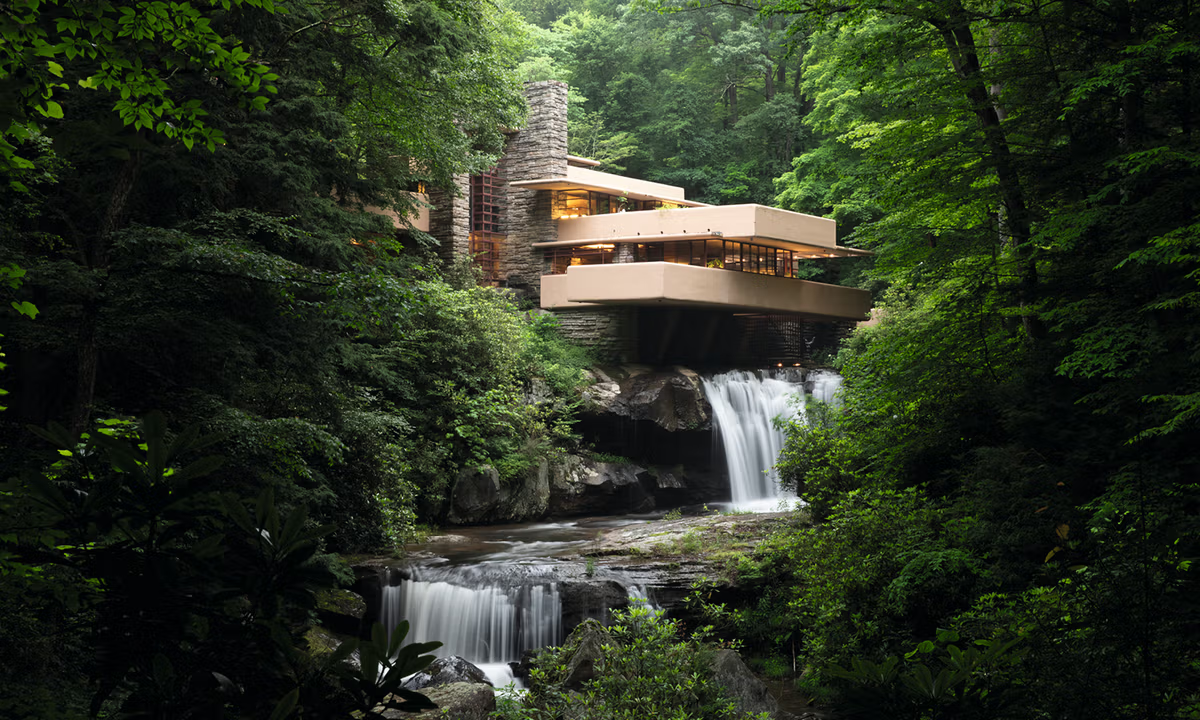
Most houses are meant to outlast the impermanence of nature. Not so with the architect Frank Lloyd Wright’s Fallingwater, a remarkable house in the Pennsylvania woods built over a 30ft waterfall.
A Unesco World Heritage Site since 2019, Fallingwater was completed in 1939 as a weekend retreat for the Pittsburgh department-store magnate Edgar J. Kaufmann and his family. Although Wright’s Modernist masterpiece inspires awe, it contains major engineering flaws. (The same is true of many of Wright’s buildings, including the Solomon R. Guggenheim Museum in New York.) Almost 90 years after the house’s completion, conservators are still working on stabilising Wright’s experimental design—including endemic leaking problems unrelated to the waterfall. The latest in these conservation efforts, a three-year, $7m project to repair and protect the house, is scheduled for completion in April.
“Wright created a sculptural masterpiece, but he was pushing the boundaries of residential construction,” Justin Gunther, the vice president of the Western Pennsylvania Conservancy (WPC) and director of Fallingwater, tells The Art Newspaper. “He didn’t put enough reinforcing steel in the cantilevers of the house over the waterfall, so as soon as they removed the formwork, the house started to sag. Wright was always assuring the Kaufmanns it was natural, but it was the house failing.” From the beginning, Fallingwater could have collapsed at any moment—thankfully, this has been mitigated by years of conservation efforts.
In this most recent project, Fallingwater’s conservators have been looking to both fix past mistakes and help protect the house from an uncertain future. One of the central tenets this time around is adapting the house to a changing climate. “We were seeing additional roof leaks and water infiltration issues occurring,” Gunther says. “We just decided that now was the time to replace all the waterproofing assemblies, get the building tightened up and ensure long-term preservation moving forward.”
Most visitors to Fallingwater are not looking at its stone masonry or the steel on the doorframes, but these are integral parts of the beauty of the house and were in danger of degradation. The preservation project will be invisible to the untrained eye, with no aesthetic changes to the structure’s exterior. Any use of modern building techniques remains under the surface, so that Fallingwater’s aesthetic remains consistent even with major restoration to its roofs, exterior walls, terraces, windows and doors. The preservation team had original paint to colour-match any repainting during the process and did its best to honour how the Kaufmanns lived in the house.
Of course, there is no way to ask the architect, who died in 1959, what he would have wanted. “It’s always dangerous to put your head in the artist’s mind and ask what Wright would do,” Gunther says. (Given Wright’s reputation as both intensely arrogant and highly unpredictable, this would have been an especially difficult task.)
Fallingwater’s conservators have been fixing past mistakes and future-proofing the house
Nature and impermanence
The most important legacy of Fallingwater is its ability to connect people to nature. Where residential houses typically work against nature, Fallingwater attempts to work with it. As such, Gunther and his team have run up against the larger questions of how the human relationship to nature is changing as environmental concerns become more dire.
“To think of Fallingwater in 50, 100 years… What will that dialogue between the architecture and nature be?” Gunther muses. “There may be a different forest in 100 years. Maybe there will be palm trees in Western Pennsylvania. Will climate change totally change our forest? Will that dialogue be completely different? What if the waterfall isn’t there anymore?”
Preserving Fallingwater means reckoning with these existential questions while simultaneously making microscopic decisions about technical details. In a way, this conversation mirrors the one about the environment at large. Climate change feels like an existential threat that eclipses the minutiae of, say, washing clothes using cold water to save energy. Likewise, testing novel techniques like liquid grout injection—12 tons of grout were squeezed into the cracks of Fallingwater’s walls to prevent leaks—might feel trivial compared to philosophising about whether the structure will survive future environmental catastrophe. But small acts done with intention help to abate existential threats.
“From a preservation standpoint, you always try to maintain the stasis in the building, and that’s the approach we take,” Gunther says. “Nature’s going to bring its patina to the architecture over time, but we always have taken the approach that it’s our responsibility to steward this architecture as best we can and use the best preservation approaches and standards to preserve it for as long as we can.”
Fallingwater’s Unesco designation has helped WPC, which owns and operates the site, to raise the needed funds to undertake such intensive conservation. With this latest project at its end, Gunther hopes that Fallingwater continues to play a role in discussions around Modern architecture and what it can do.
“With computer-aided design guiding architecture education, you can certainly tell what was designed by hand and what wasn’t—so much of it feels disposable, thrown up for the speculative benefit,” he says. “For the Modern movement in America and its impact around the world, Fallingwater is an important building to have a conversation about, even more so as we start thinking about sustainability issues.”
There is a Sisyphean element to trying to preserve something that has meditations on impermanence baked into its concept. After all, Fallingwater was meant to change with the environment around it. Wright may never have thought the house should exist 50 or 100 years into the future. In a 1935 letter to the Kaufmann family, the architect implored them to use their home as a means of relating to the natural world: “I want you to live with the waterfall, not just to look at it, but for it to become an integral part of your lives.”
Gunther hopes that Fallingwater continues to serve this philosophical purpose for its roughly 140,000 yearly visitors. “The thing I worry about the most for Fallingwater is its ongoing relevance,” Gunther says. “You can look at it in pictures, but until you actually see it you can’t understand its impact. Every sense is activated, you’re seeing something beautiful, smelling the forest—all of that amplifies and intensifies a connection to nature.”


