







We asked the beloved novelist, whose book Transcription is out in April, to single out one artwork that impacted him.
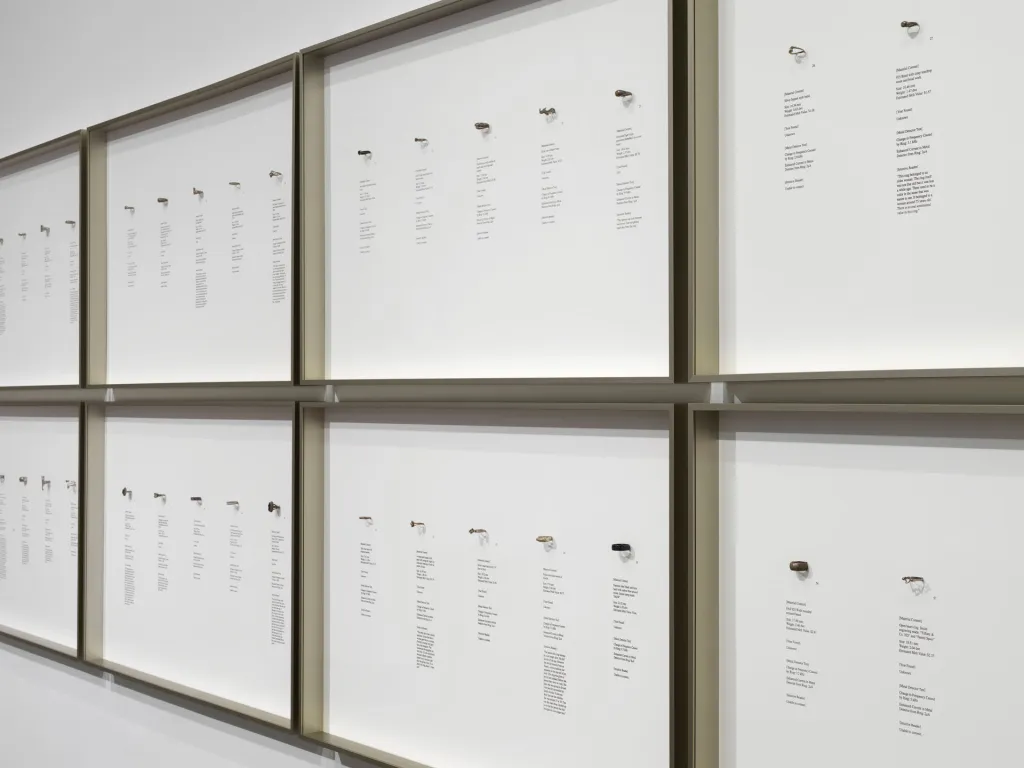
I thought of Rose Salane’s 60 Detected Rings (1991–2021) when asked to inaugurate a column called Revelations because the word is so close to “revaluations,” and what the art I love reveals to me is how our measures of value might be challenged and transformed. Salane bought the rings in 60 Detected Rings at an estate sale; they’d been collected by a woman named Jill Benedict, who, using a metal detector, had gleaned them from the beaches of Atlantic City over a period of 30 years. Salane had the rings evaluated by a lab that recorded the electromagnetic frequency of the metal (when detected) and the ring’s “melt value”; she also had psychics interpret—reveal—what they could about the rings’ previous owners. Salane then mounted the rings in cases and captioned them with these scientific and economic and psychometric classifications. I first saw the resulting artwork at the New Museum triennial in 2021, but I think of it often.
What value did these rings once hold for those who wore them? The pathos of the “melt value” is that the metals of these objects are decidedly not precious. The spiritualists’ speculations about the histories of the rings’ wearers are ways of imagining sentimental value in conflict with the meager price the materials would fetch. What value did the rings hold for Benedict? What did Salane pay for them? What did she pay to have the archive assayed by the lab, by the spiritual workers? And how much does it cost to collect 60 Detected Rings, what is the “value added” when these materials become Salane’s work of art?
Rose Salane: 60 Detected Rings (1991-2021) (Person 36-40), detail, 2021.
Courtesy Carlos/Ishikawa, London/©Rose Salane
A metal detector senses disturbances in the electromagnetic field caused by an object; as I looked at the rings I also detected small disturbances, fluctuations in value that seemed to make these rings vibrate with possibility. The newly auratic rings felt haunted—by those who wore them, by Benedict. Salane makes the rings—which might have been dismissed as litter—appear like small archaeological finds or religious relics. I think of Robert Smithson’s Monuments of the Passaic, his reading of industrial sites as “ruins in reverse” and “memory-traces of an abandoned set of futures”; Salane offers a more intimate version of this artistic anthropology. There is also a postapocalyptic feel here, as though Atlantic City had been washed away; “apocalypse” of course means “revelation.”
All these oscillations between new and old, trash and treasure generate a little wave of possibility. Salane achieves something I aspire to in writing: a reframing, a recontextualization, that reminds us that our world might be weighed differently. Great works of art melt value so that it can be reformed.


