
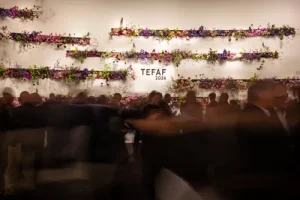





What does “Tefaf” stand for? The European Fine Art Fair? Or the European Fine Art Foundation? When I was editing Apollo we used to tie ourselves in knots parsing that second “F” even as our Tefaf Maastricht coverage went to press.
To crack the acronym I consult Johnny van Haeften, one of the group of dealers who founded Tefaf in 1988. ”Which came first, the chicken or the egg?” he says. In establishing the fair, a foundation (stichting in Dutch) seemed the most fitting legal entity for the purpose of creating an event “run by dealers, for dealers… so that nobody had an advantage over anybody else.”
That Tefaf operates as a not-for-profit differentiates it from other major art fair brands. There are no shareholders demanding a return, no owners to primp the thing for sale. Tefaf is governed by an executive committee and a board of trustees, which includes collectors and museum representatives as well as participating dealers. Among recent appointees is Eike Schmidt, the director of the Museo di Capodimonte in Naples.
“It is a completely different animal [from other fair organisations],” says Laura Kugel of Galerie Kugel, who has been a trustee of Tefaf since 2020. “The money it makes is reinvested to make it the best possible event for the community.” Tefaf sets out to work for its dealers, in other words—to facilitate “what they’re trying to achieve”, says Will Korner, Tefaf’s head of fairs, and to amplify “what they believe in”.
Of all fairs, though, to my mind Tefaf Maastricht can speak most authentically of a community that reaches beyond its exhibitors to encompass the curators, art historians and collectors who convene there every year. “It’s a bit like the Davos of the art world,” Kugel says. “It tries to create links that go beyond the relationship between a dealer and a collector.”
Perhaps its non-corporate structure has been a factor in enabling Tefaf to develop formal initiatives with museums too. Certainly, for a public institution to partner with a not-for-profit looks like a smoother road than navigating commercial potholes elsewhere. This year museum collaborations at Tefaf Maastricht include a Giacometti exhibition presented by Kunsthaus Zürich.
For all that its stichting status is essentially a legal designation, Tefaf has increasingly embraced the more charitable associations conveyed by the English word “foundation”. Since 2008 it has supported Cultural Emergency Response, an international NGO that protects threatened or damaged cultural heritage. In 2012 it launched its museum restoration fund, which makes two grants annually of €25,000 to restore works of art in museum collections.
Dealers sometimes grumble about art fair initiatives that seem to eclipse the immediate business of selling art. But when they are purposeful, the whole sector stands to gain. That Tefaf and the Netherlands Commission for Unesco are collaborating again on the Tefaf Summit (16 March) augurs wider dialogue where there might otherwise be dispute.
So what does that second “F” stand for? “It stands for fairs,” Korner says. “But it also stands for the foundation—and that’s something we really care about.”
• Thomas Marks is the co-founder of Marks|Calil, a strategic consultancy that works with museums and art businesses. From 2013 to 2021 he was the editor of Apollo magazine


