




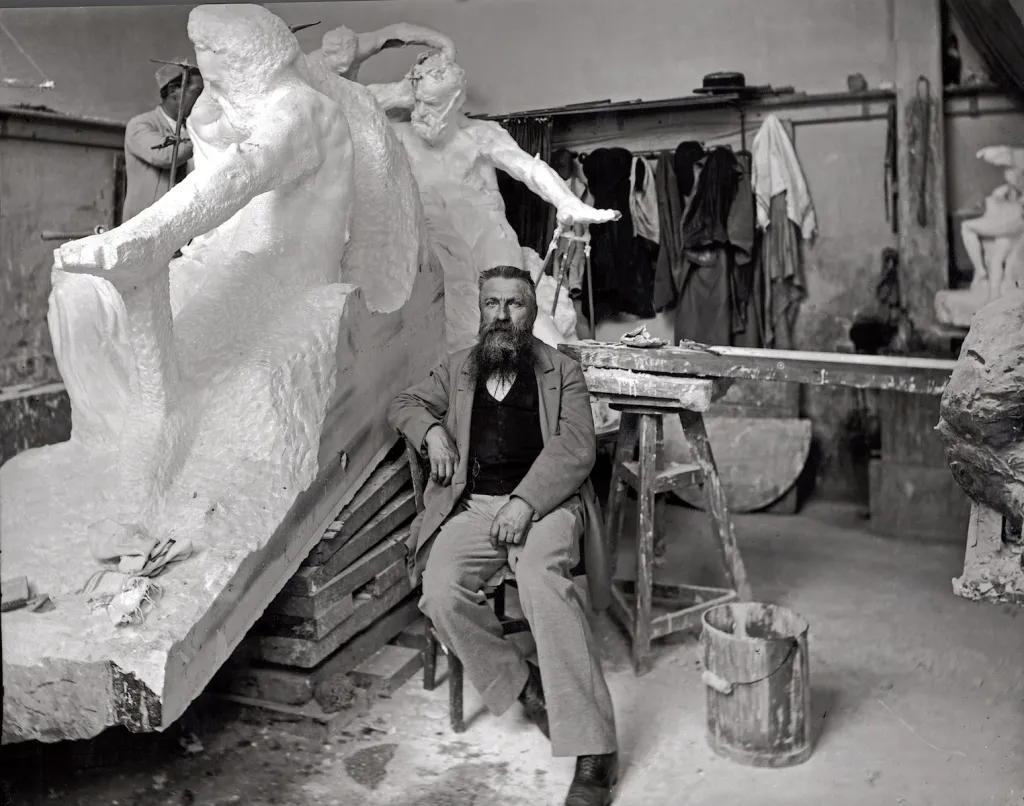
Aside from Michelangelo, there’s no artist as synonymous with sculpture as Auguste Rodin (1840–1917). He created an art-historical icon—The Thinker—that rivals Leonardo’s Mona Lisa for pop-cultural fame. But more than this, he set sculpture on its path toward modernism, breaking with the mythological themes and neoclassical refinement endorsed by the French Academy and revolutionizing the medium, imbuing it with raw emotional expression.
Rodin’s approach was a rebuke to the Renaissance tradition of idealizing the body as epitomized by Michelangelo’s David and other feats of flesh wrested from stone. Michelangelo famously spoke of that sculpture as being already alive within the quarried block, awaiting the artist to free it by “chisel[ing] away the superfluous material”—which, along with the chips and dust, meant erasing the artist’s hand by polishing marble to perfection.
For Rodin, visibly manipulating form became key to his most famous works. In pieces such as The Burghers of Calais (1884–95), he massaged the clay, leaving traces of his fingers as they ran along the surface or gouged into it. In essence, Rodin’s process (eventually leading to bronze editions) manifested feeling in both senses of the word.