





French painter Claire Tabouret’s earliest memory of experiencing art is seeing Monet’s “Water Lilies” (ca. 1897–1926) at the Museum de l’Orangerie in Paris. At only four years old, “I was completely amazed and struck by the paint,” she told Artsy. “I just wanted to be in it.” The founder of Impressionism’s seminal works—rooted in the natural world, painted in blurred hues, and verging on abstraction—may be a surprising source of inspiration for Tabouret, who is best known for figuration and portraiture. Yet for her, “the face is a bit like the surface of the water, something that’s evolving every day.”
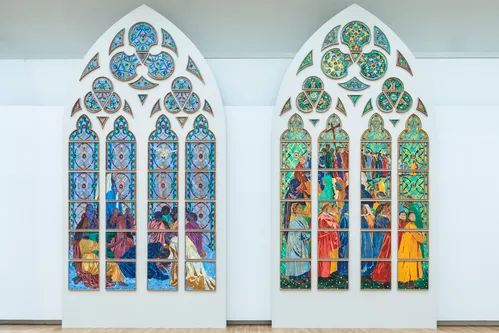
2026 is a pivotal year for Tabouret. Her first major museum-wide retrospective, “Weaving Waters, Weaving Gestures,” which surveys the past decade of her work, opened at Museum Voorlinden in Wassenaar, The Netherlands, in late January and runs through May 26th. Later this year, her contemporary stained-glass windows for the newly renovated Notre Dame Cathedral—a commission awarded by the French Ministry of Culture following a lengthy application process—will also be unveiled to the public. Designs and preparatory sketches for the windows are on view at Paris’s Grand Palais until March 15th.
Together, these projects demonstrate why Tabouret is regarded as one of the most compelling painters of her generation. She bridges the personal and the universal in dynamic compositions that embrace vibrant color palettes and expressive brushwork. Her unusual approach to layering color—neon pink undergirds a dark nighttime scene, for example—also imbues her work with surprising magnetism. “You can feel the warmth and light coming through,” Tabouret said.

Born in the south of France and raised in Montpellier, France, Tabouret studied at the École des Beaux-Arts in Paris, completing an exchange in New York before pursuing a professional artistic career. After quickly gaining recognition in France, she moved to Los Angeles in 2015, a decision she describes as “impulsive,” driven by a desire to “break up with a lot of things, like habits, paintings, people, boyfriends…”
There, Tabouret’s work entered the collections of numerous North American museums, including the Los Angeles County Museum of Art, the Montreal Museum of Fine Arts, and the Pérez Art Museum Miami. The artist also found a new sense of freedom. “No one knew me, and I could experiment even more,” Tabouret said. Her playful approach to medium and material has led her to collaborate with weavers and porcelain makers, venture into sculpture, and paint on faux fur. Working on that fluffy substrate, she said, is akin to dancing in deep snow. In other words, she said, “How can I keep my gesture, my brushstroke in this strange material?”
In 2025, Tabouret moved back to France, both to focus on the Notre Dame project and to immerse her young family in her native language and culture. Such domestic changes are a frequent source of inspiration for the artist. Motherhood-induced insomnia, for example, deepened her fascination with the subtle hues of nighttime and culminated in a 2025 series of deep blue nocturnes. In Self-portrait on the Couch at Night, she sprawls across a couch in baggy pajamas, illuminated by moonlight. Tabouret’s recurring thematization of pregnancy and motherhood is in part a way to reconcile the dual roles of creating art and life. “For so long, women have been the mother or the muse,” she said, “but you can be a painter, too.”
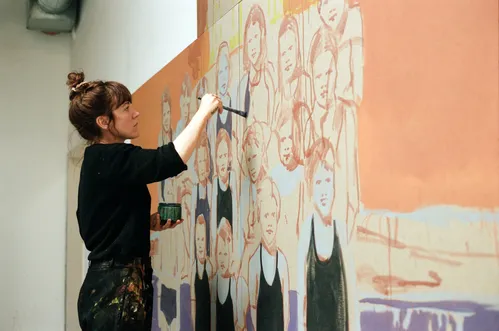

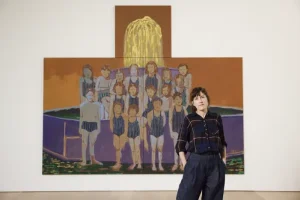
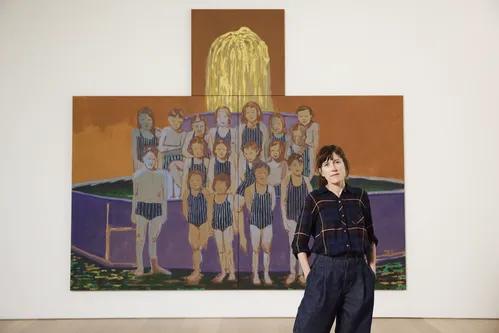
Tabouret’s paintings are deeply personal, even when the subject matter seems far afield of her own experience. In 2017, she produced a series of paintings of gold miners whose endless quest for fortune reflects her tireless drive to create. “A lot of people lost their minds during the Gold Rush,” she said, referring to the mid-19th-century mania that followed the discovery of gold in California (she too struck it big on the coast). “People lost track of time, cleanliness, sense…For an artist it’s the same.” Tabouret’s fascination with swimmers—an entire room at Voorlinden is dedicated to the motif—is also a reflection of her reality: She cannot swim. Never in water herself, she likes “to swim through the painting and imagine the feeling” of drying in the sun after exiting the sea.
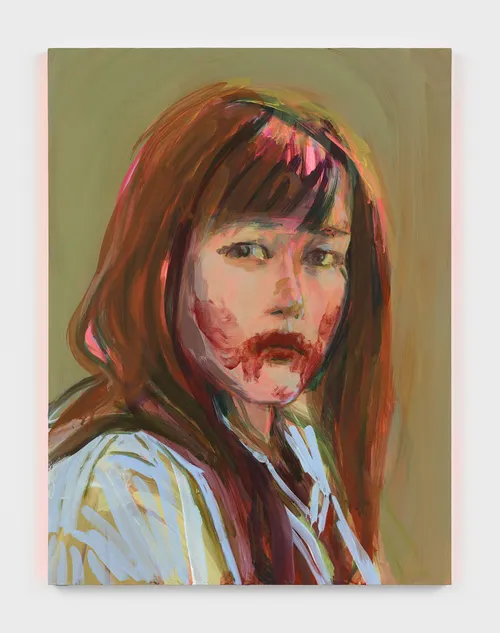
Tabouret’s work also grapples with the harsher side of her omnivorous creative approach, though she doesn’t espouse any particular moral standpoint. The Voorlinden exhibition opens with her 2019 work Self-portrait as a vampire, red blood smeared across her mouth like a toddler sticky with jam. “It’s this idea that the artist is always a bit of a vampire, or a sponge. Whatever is going on in the world around you will come out in the work,” she said. She referenced Agnes Martin’s famous line that “there are two endless directions, in and out.”

The outward direction has gained increasing importance for Tabouret in recent years: at the 2022 Venice Biennale, she participated in the Pavilion of the Holy See (Vatican City’s Pavilion), painting intimate portraits of female prisoners’ children and loved ones from photographs they sent her. “For the first time, I was painting something that was not coming from my own story,” she said, “and putting myself at the service of others.” She connects this experience with her current commission for the Notre Dame windows, where she is interpreting the story of the Pentecost—the day the Holy Spirit descended upon Jesus’s apostles and followers in Jerusalem, marking the birth of the Christian Church.
When Tabouret first heard about the Notre Dame project, she was surprised both by the cathedral’s interest in a figurative painter—rare in France, where public commissions tend to be abstract—and by its ambition to bring contemporary work into a historic monument. “We don’t change things very easily,” she said of her home country. She noted that the project has sparked considerable controversy, with opponents arguing that replacing the cathedral’s south-side windows, designed by 19th-century architect Eugène Viollet-le-Duc, violates the 1964 Venice Charter, which guides the protection of historic buildings. In contrast, Tabouret sees the commission as “a breath of fresh air, a window open for the future, [an answer to] how we can stay alive as a culture while living in harmony with history and the past. These buildings are made of layers and layers of history. The idea of freezing them in time makes no sense.”
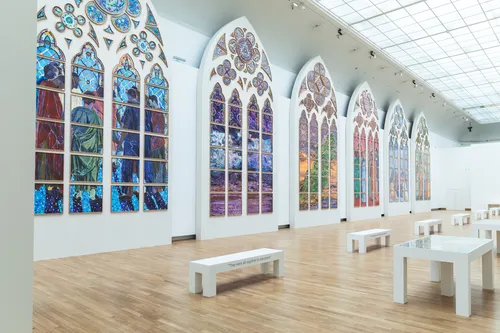
The stained glass medium offers Tabouret an exciting new challenge. She is collaborating with Reims, France–based Atelier Simon-Marq, a 400-year-old glassmaking studio that previously worked with the likes of Marc Chagall and Joan Miró. “There’s this very technical aspect to how the lead holds separate pieces of glass together, but it also affects the artistic interpretation,” Tabouret said. “[The lead] gives the image its rhythm and accents the composition, so it’s led to a lot of discussions.”
While Notre Dame is Tabouret’s second project linked to the Catholic Church, she herself is not religious. She experiences spirituality, instead, through her vocation. “Since childhood, painting has given meaning to everything I’ve been through. I always felt it was bigger than me and coming through me,” she said. “When I hear the [Archbishop of Paris] talk about their own belief, I feel that if you replace ‘Christ’ with ‘art,’ we’re basically saying the same thing. They believe in Jesus Christ, and I believe in art.”
This belief will surely carry her through this watershed year. “I’m sure during the unveiling there will be a lot of talking. Then [the windows] will live [their] own life, and I think I’ll have to go back to silence—back to painting and privacy.” As long as the faces around her remain in constant flux, like the impressionistic ponds that initially inspired her, she’ll have plenty to explore in this next phase of her career.


